The contemporary web ecosystem is developing at a rapid rate. Smart devices, cloud platforms, and Internet of Things (IoT) systems generate huge amounts of data on a second-by-second basis. Although it enhances efficiency and automation, it also exposes it to cyberattacks. Conventional models of cybersecurity, relying on centralized servers and resource-intensive monitoring tools, cannot keep up with the requirements of the decentralized environment.
Lightweight blockchain-based cybersecurity is considered a solution to these challenges as a future-ready tool, which is under investigation by researchers and security professionals. It also distributes verification over a network, instead of just one authority, and this renders the systems more robust to tampering and intrusion.
Understanding Blockchain in Cybersecurity
Blockchain is a distributed ledger technology in which the data is stored in blocks that are cryptographically connected to one another. It is so hard to alter data once it has been logged on without being spotted. This is a strong attribute of cybersecurity software like identity verification, secure logging, and access control.
Traditional blockchains such as Bitcoin and Ethereum have heavy consensus mechanisms that require high processing power and storage. Nevertheless, not all digital environments, in particular IoT and edge networks, are able to sustain such overhead. This is the reason why lightweight blockchain frameworks were created. These protocols minimize the computational complexity with cryptographic trust, and they are appropriate in embedded systems and mobile devices. This development has made lightweight blockchain-based cybersecurity an option to the establishment of conventional security infrastructure.
Why a Lightweight Approach Is Necessary
The vast majority of contemporary attacks are aimed at weak authentication, central databases, or under-protected terminals. Centralized security models have one point of failure whereby one successful attack can lead to failure of a whole system. Conversely, a decentralized design spreads the trust throughout a number of nodes, which mitigates the effects of a single system failure.
Lightweight blockchain systems rely on reduced consensus mechanisms and small data structures to ensure minimal latency and energy usage. This enables them to be used in real-time applications like smart grids, industrial automation, and connected cars. Under this architecture, blockchain-based cybersecurity is lightweight and does not overburden the system resources by continuously validating devices and transactions.
Core Components of Lightweight Blockchain-Based Cybersecurity
1. Decentralized Identity Verification
Every device or user on the network is provided with a cryptographic identity in the blockchain. The authentication is achieved through checking this identity with the distributed ledger as opposed to a central database. This model minimizes risks of impersonation, and it does not allow unauthorized access since all requests are validated cryptographically.
2. Cryptographic Data integrity
The hash functions and digital signatures are used to ensure data integrity. Any manipulation of information stored in the store alters the hash value, exposing tampering instantly. The mechanism prevents the silent manipulation of logs, access records, and configuration files in a cybersecurity setting to enhance forensic analysis and compliance work.
3. Distributed Trust and Consensus
Trust is distributed among participating nodes instead of being distributed among a single security authority. The rules of consensus determine the validity of transactions, which makes it difficult to inject malicious data in a network. This distributed trust architecture has a significant impact on limiting insider threats and end-to-end compromise.
Applications in Modern Digital Systems
1. IoT and Smart Devices
IoT devices usually have low memory and processing capacity and thus, are simple targets for the attackers. These devices can be authenticated in a secure way without centralized servers with the help of lightweight blockchain frameworks. This method helps to exclude rogue devices from the network and have a guaranteed exchange of trusted data.
2. Edge Computing Environments
Edge computing processes data closer to its source, reducing latency but increasing exposure to attacks. Blockchain-based protection allows edge nodes to verify transactions locally while maintaining a tamper-proof audit trail. This ensures secure coordination among nodes even in highly distributed environments.
3. Healthcare and Medical Data
Patient records require strict confidentiality and integrity. A blockchain-based model enables decentralized access control while maintaining immutable logs of every data interaction. This improves transparency, accountability, and trust between healthcare providers and patients.
Benefits of Lightweight Blockchain-Based Cybersecurity
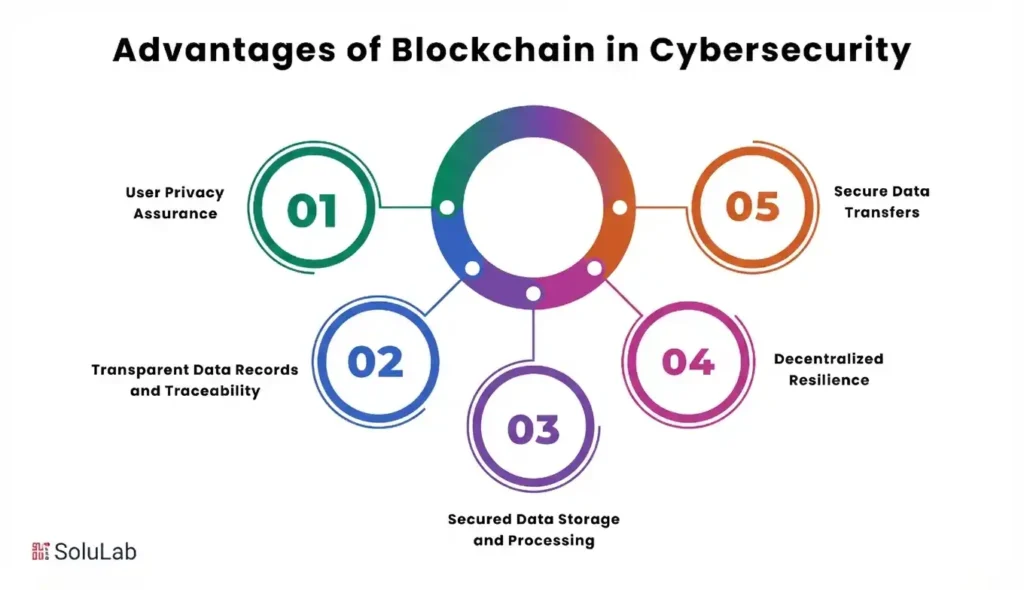
- A notable advantage of lightweight blockchain-based cybersecurity is that it is capable of providing robust cryptographic security to low-power devices without introducing performance bottlenecks, enabling IoT ecosystems and mobile platforms to continue to be secure even within the constrained capacity of a stringent set of hardware specifications.
- Transparency and traceability are other significant benefits, as all transactions or access requests are stored forever on a distributed registry, and thus security audits, compliance checking, and attack investigations have become greatly more effective and efficient.
Challenges and Limitations
In spite of these benefits, this technology is still subject to a number of practical challenges. Scalability is also a problem, particularly when thousands or millions of devices have to communicate at the same time. Although lightweight consensus mechanisms minimize overhead, overhead can still be incurred due to network congestion and synchronization latency as well as in large-scale deployments.
Another problem is interoperability. Blockchain structure varies across different standards; hence, it makes it hard to integrate it with current security infrastructure. Also, regulatory and legal frameworks continue to adjust to blockchain-based security models, which cause uncertainty in the most regulated industries, including finance and healthcare.
Integration with Zero-Trust Security Models
The zero-trust approach presupposes that all users and devices are not to be trusted per se, no matter where they are in the network. All requests should be checked to provide access. Lightweight blockchain-based cybersecurity would be perfectly aligned with this philosophy since it will impose cryptographic verification upon every transaction.
In a zero-trust environment, blockchain serves as a common level of trust in which authentication and authorization verdicts are stored in an immutable manner. This limits privilege escalation and cross-network movements in a hacked network. Decentralized validation with continuous monitoring can help organizations to create more adaptive and resilient defense systems.
Future Trends and Innovations
The combination of blockchain and AI and machine learning is the future of security. Anomaly detection based on AI can detect the patterns of suspicious behavior, and blockchain allows maintaining the security logs to be inaccessible. The combination of these technologies can give rise to self-guiding security systems that are able to respond to threats in real time.
Quantum-resistant cryptography is another new field. With the improvement of quantum computing, the existing encryption techniques might be compromised. Quantum-safe blockchain algorithm research is focused on securing distributed ledgers against future cryptographic attacks, which increases long-term security.
As the development of autonomous systems and smart infrastructure gains speed, decentralized protection models are going to become more significant. Lightweight blockchain-based cybersecurity will most likely be at the center of the digital interaction security in this dynamic environment.
Conclusion
With the increase in the complexity of digital ecosystems, cybersecurity will need to keep up with that change, but it will no longer be possible to use centralized and resource-intensive models. Conventional security solutions cannot easily secure highly distributed networks, including IoT networks, edge platforms, and cloud-integrated systems. Lightweight blockchain-based cybersecurity is an effective solution to this gap because it strikes a balance between security, efficiency, and scalability.
This solution provides a solid basis for the next-generation security systems by employing the concept of decentralized trust, cryptographic integrity, and efficient processing with the use of resources. It facilitates device authentication, which is secure, transparent audit trails, and constant verification without saturation of system resources.
Lightweight blockchain-based cybersecurity is not only a new innovation but also a strategic requirement of organizations wishing to be digitally resilient over the long term. With the ever-increasing technology, decentralized security models will be used to lay down and sustain trust within the digital world.
Leave a Reply