Author: anil

  • Cloud Migration Strategy: Building a Smarter Path to the Cloud

    Cloud Migration Strategy: Building a Smarter Path to the Cloud

    With the increase in digital transformation in industries, the traditional systems and legacy infrastructure are becoming harder to administer and combine with modern software environments. Compliance, security, or logistical barriers continue to inhibit the migration of many organizations to the cloud. Nevertheless, when it is done in the right way, cloud migration can transform the way your business operates, scales, and innovates.

    What is Cloud Migration?

    Cloud migration involves transferring digital assets, i.e., applications, databases, and services, from off-premises infrastructure to the cloud or across cloud platforms. This is aimed at improving the scalability, flexibility, and performance, as well as operational costs.

    A clear cloud migration strategy would see that this complicated process occurs in a smooth and secure fashion, and it is in line with your business goals. A data-first approach will enable you to preserve data integrity, optimize infrastructure, and implement the approach to match the unique requirements of your organization.

    It is appropriate to first have a review of the best practices to prepare a successful transition before discussing the most prominent cloud migration strategy.

    The 7 Best Practices of Cloud Migration

    Movement of workloads to cloud is not merely a technical undertaking it is a strategic project. By adhering to these cloud migration strategy best practices, one can prevent disruption and it will make the process smooth.

    1. Set Clear and Realistic Goals

    Determine the image of success before commencing migration. Your objectives are to improve the performance of your systems, increase their security, decrease costs, etc., and clearly set objectives help you to make the decisions. Be honest about deadlines – large migrations can be divided into small, manageable steps, and this can be more successful.

    2. Design Architecture Aligned with Business Objectives

    Design a cloud environment that will support both the present and the future objectives. The migration of clouds and integration with other solutions, such as data warehousing or analytics platforms, in most cases is more insightful in terms of performance and scalability. Engage a cloud architect to plot the appropriate architecture of your firm.

    3. Build a Cross-Functional Team

    Effective migrations demand cooperation. Add IT specialists, developers, data engineers, and major business stakeholders. The presence of the executive-level participation assists in making sure that the priorities of the whole organization can be matched and that the implementation processes can be unproblematic.

    4. Evaluate a Multicloud Approach

    A multicloud approach, or multiple cloud vendors, can be a good way to achieve flexibility, minimize vendor lock-in, and increase security.
    Consider multicloud if:

    • You do not want to completely rely on a single cloud provider.
    • You require specific equipment from various vendors.
    • You deal with controlled information that needs to be of a certain recalcitrance.

    5. Cleanse and Organize Data Before Migration

    Migration success is directly related to the data quality. Audit, clean, and organize all datasets- eliminate duplicates, correct the errors, and standardize formats. Organized and precise information reduces the problem of migration and provides the flawless work of your cloud environment at the very beginning of the process.

    6. Leverage Low-Code or No-Code Platforms

    In the migration process, it is not rare that temporary throwaway code is needed. With a low-code integration platform, such as iPaaS, it is possible to reduce manual code, speed up integration, and reduce post-migration technical debt. It simplifies the procedures and allows developers to work on strategic activities as opposed to momentary, one-time coding work.

    7. Optimize Data Management with iPaaS

    The Integration Platform as a Service (iPaaS) brings together data processes in the cloud system and on-premise. It is simple to do backup, sync, and monitor and ensures a steady flow of data, minimizes errors, enhances efficiency of operations, and provides ease of integration between applications within a cloud migration setup.
    cloud migration strategy

    Common Challenges of Cloud Migration

    Even with a strong cloud migration strategy, organizations may face several challenges.

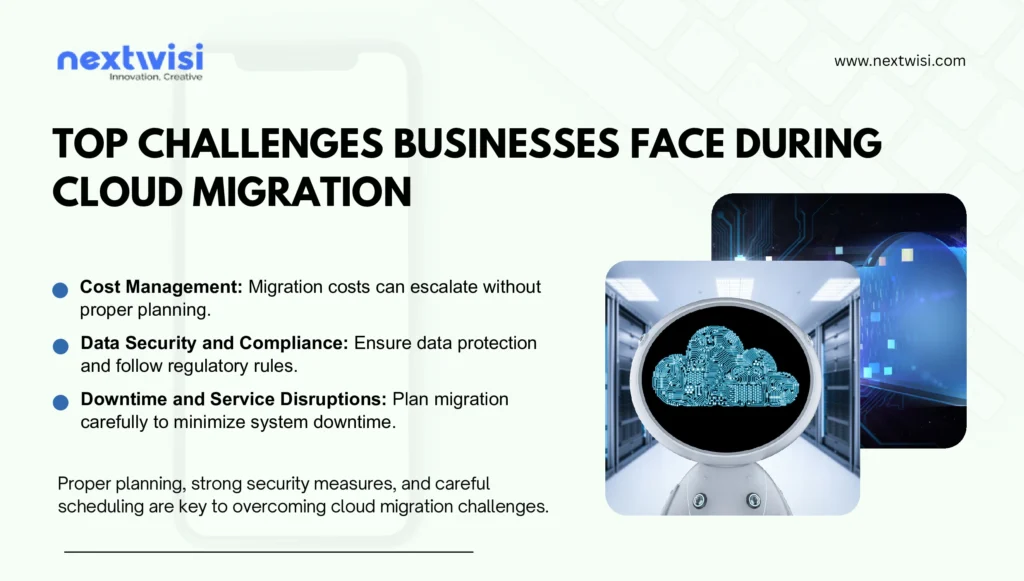
    1. Cost Management

    Migration costs may easily become out of control without proper planning. Pay-as-you-go systems can result in unforeseeable costs. To ensure that you are in control of your budget, it can be helpful to create a detailed cost model and keep track of how it is being used.

    2. Data Security and Compliance

    Security and privacy of data are the biggest concerns. It is important to be sure that you follow industry-related rules (GDPR or HIPAA) and use effective encryption, access controls, and threat detection tools in your cloud environment.

    3. Downtime and Service Disruptions

    Migration can have a temporary impact on the availability of the systems. Tests, automated migration tools, and scheduling of downtime when there is less traffic can be used to mitigate disruption and minimize chances of transfer failures.

    9 Cloud Migration Strategies

    Organizations take various strategies based on resources, maturity of clouds, and business requirements. The strategies presented below outline successful techniques of an effective cloud migration strategy.

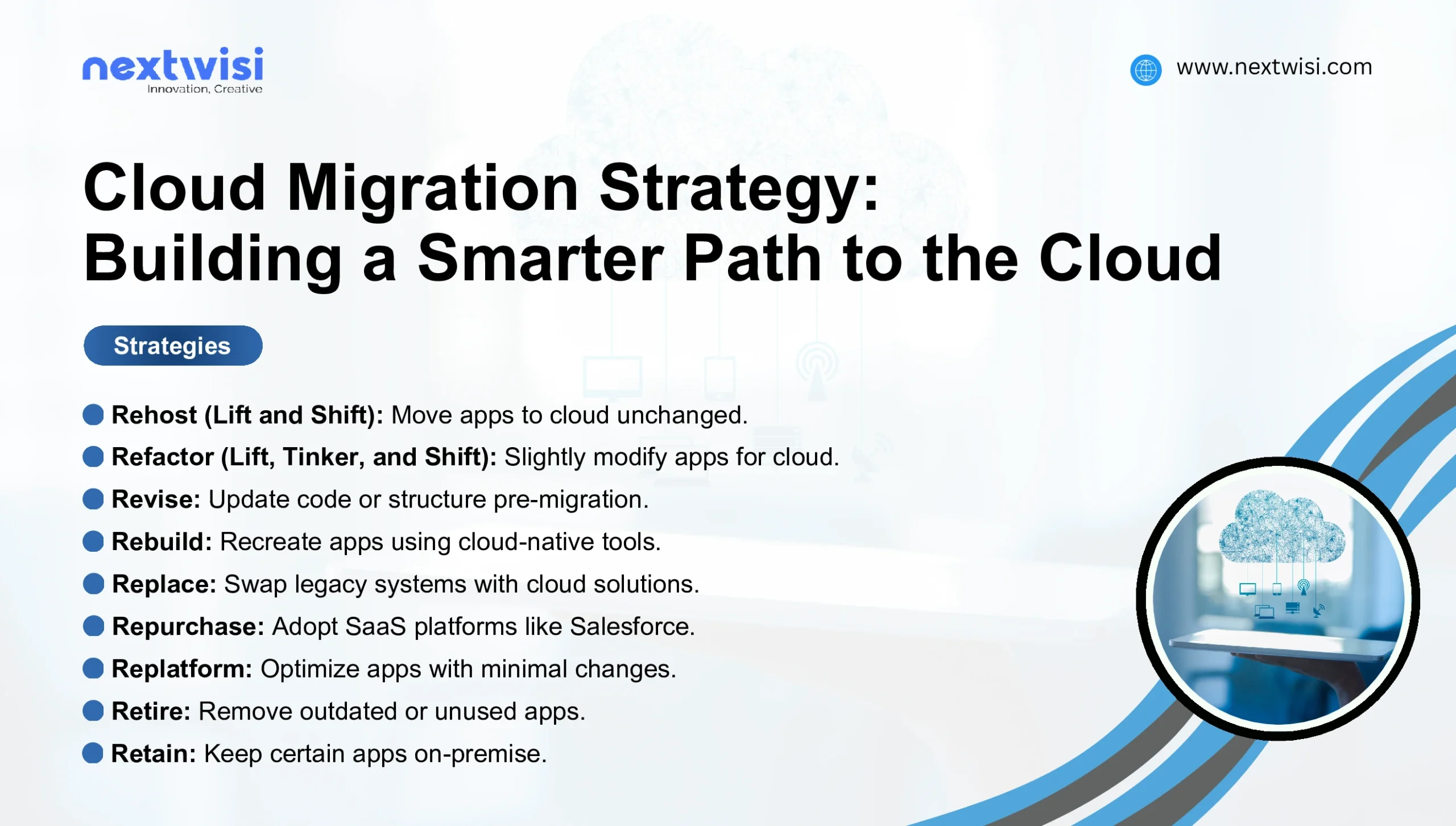
    1. Rehost (Lift and Shift)

    Rehosting relocates the current applications to the cloud with a few modifications. This low-cost, quick methodology is best suited to new cloud environment organizations and is a platform of many cloud migration strategy.

    2. Refactor (Lift, Tinker, and Shift)

    Refactoring gives minimal optimizations prior to migration to take advantage of cloud-native features. It improves performance and efficiency but does not entirely redesign applications, so it is an expedient and universally used measure in any large-scale cloud migration strategy.

    3. Revise

    The revise approach repurposes application code and architecture to make use of cloud-native services, including microservices, containers, and auto-scaling, to the fullest. It achieves maximum performance, scalability, and long-term advantages, which are ideal in support of highly developed cloud migration strategies.

    4. Rebuild

    Rebuilding is a re-creation of applications in the cloud. This method is time -consuming, however, it provides the best in the market of modern, scalable systems that can keep pace with your business growth and is a key component in a progressive cloud migration strategy.

    5. Replace

    Substituting old systems with ready-to-use cloud applications makes it easier to deploy and will cut back on the maintenance cost. Although customization is not allowed, the approach is effective in streamlining operations and can be incorporated into larger enterprise-wide plans of cloud migration strategies to realize efficiency in the long term.

    6. Repurchase

    SaaS adoption, or the repurchase strategy, involves dispensing old software and equipment with cloud-based systems. The use of an in-house tool as a substitute of Salesforce or HubSpot can fast-track implementation and reinforce any properly thought-out cloud migration strategy.

    7. Replatform

    Replatforming involves minor refinements like database or operating system upgrades to improve performance without changing the architecture. This is one of the strategies that are typically integrated with an enterprise-based, practical, and performance-oriented cloud migration strategy.

    8. Retire

    In the course of evaluation, obsolete or unnecessary systems may be phased out in order to cut down on the complexity and cost of operation. Unemployed components enhance efficiency and aid organizations in adopting a leaner and superior cloud migration strategy.

    9. Retain

    The applications are sometimes kept on-premises temporarily because of compliance, cost, or technical constraints. With a careful and measured approach to a wider cloud migration strategy, it is prudent to keep some systems to be implemented in phases to ease the transition to the cloud as the environment is conducive.

    Conclusion

    Migration to the cloud is not only a matter of data changing location, but it is a matter of reinventing business itself in the digital world. Defining clear objectives, adhering to best practices, and choosing the appropriate cloud migration strategy will help organizations to reduce risks, manage costs, and maximize performance in the cloud.

    Nextwisi Solutions is a company that offers end-to-end cloud migration services to enterprises to facilitate a smooth migration to the modern infrastructure. Our team develops and implements tailored cloud solutions to improve scalability, build security, and promote continuous innovation. We also make sure that your cloud transformation is both efficient and smooth, regardless of whether you are rehosting, refactoring, or rebuilding, and future-ready.

  • Why Slippage Control Matters for Decentralized Exchange Traders?

    Why Slippage Control Matters for Decentralized Exchange Traders?

    Get to know why slippage control is important to DEX traders and how it makes trades predictable, saves on money, and makes exchanges more profitable on decentralized exchanges.

    Introduction to Slippage Control in DEX Trading

    The results of the trade can be greatly influenced by small price changes in the rapidly developing environment of the Decentralized Exchange (DEX) trading. This variance, which is also referred to as slippage, occurs when the anticipated trade execution price is not the same as the actual one. Unmanaged slippage may add to the trade cost, lower profitability, and user confidence.

    Slippage Control and Slippage Protection are thus important elements of a stable decentralised trading platform. In the case of a professional DEX Development Company, such as Nextwisi Solutions, the incorporation of vigorous slippage management will entail fair, foreseeable, and efficient trades on a blockchain based exchange.

    What is Slippage Control and Why It Happens

    Slippage Control is where there is a fluctuation in market conditions between the moment a trade is placed and executed. In decentralized exchanges, it may occur as a result of market volatility, lack of market liquidity, or latency in trading by smart contract.

    Whereas market orders will be filled immediately at the most optimum price, they are prone to greater slippage. Limit order and slippage tolerance can be used to ensure that the execution of trades does not occur at unfavorable prices providing a trader with a greater level of control.

    Types of Slippage Control in Decentralized Exchanges

    1. Slippage Tolerance Settings

    This is one of the main aspects of DEX Slippage Control, which gives traders the opportunity to determine the percentage of price variation they would accept. In case market price exceeds the established limit, it is automatically canceled and the traders are not expected to lose money.

    2. Limit Orders & Advanced Order Types

    Limit orders, in contrast to market orders, guarantee that every trade is completed at a specified price or at a better price. Advanced order types of stop-limit and trailing orders are available on many exchanges to further decrease the risk of execution.

    3. Price Impact Calculators

    Such aids assist the traders in determining the way their trades are likely to shape the market prior to trading. Knowing the effect of size on a trade allows the user to modify their orders to improve the results and reduce price slippage.

    4. Dynamic Slippage Algorithms

    In the modern DEXs, dynamic slippage algorithms are used to analyze the market real-time conditions. This guarantees that trades are made as close to the desired price as possible which enhances the overall predicted trading experience.

    Why Slippage Control Matters for DEX Traders

    Traders can get more or less than they wanted without good slipperiness control, particularly on volatile markets or with low liquidity trading pairs.

    Slippage Protection guarantees traders with constant and fair trading experience and gives traders confidence in their trading and they are able to manage the cost of trading. Knowing the reasons why slippage control matters in the context of DEX traders is essential to everyone involved with decentralized finance.

    Key Factors Affecting Slippage Control

    1. Market Liquidity and Volatility: Slippage is significantly controlled by market liquidity and volatility. When liquidity is reduced or abrupt price fluctuation happens, the chance of slippage is high. The price deviations tend to increase when traders are operating in volatile conditions because of a lack of order matching.

    2. Trade Size: The magnitude of a trade will directly affect the degree of slippage. With the low-liquidity market, larger trades tend to shift the market price more significantly. To reduce this, merchants may subdivide large orders into smaller ones so that they may have an easier time executing them.

    3. Order Type: Slippage can also be affected by the kind of an order that is placed. Market orders are also carried out immediately at the best price which might not necessarily be the estimated price. Conversely, limit orders provide traders with control over the execution prices and this can reduce the risk of slippage.

    4. Time of Trade: Timing is significant to slip managing. Making trades in low-volume hours can result in slippery performance as fewer people are trading. During the busiest times, it is good to trade and have high liquidity and stability of prices.

    5. Liquidity Pool Stability: The liquidity pool stability is essential in the slippage control in the decentralized exchanges. Stable pools stabilize the prices and enable the trades to transpire effectively. Properly run pools reduce volatility hence giving the trader a more flowing and predictable trading experience.

    Slippage Control

    How to Reduce Slippage in DEX Trading

    1. Set Optimal Slippage Tolerance

    The first thing is to reduce slippage in DEX trading by establishing the appropriate tolerance. The traders are advised to select a level that can strike an equilibrium between trade execution and price accuracy. When it is too tough, the trades are lost, when very generous, the losses are more. This is in a bid to reach a compromise that will guarantee good and accurate trades.

    2. Trade During High Liquidity Periods

    During high-liquidity trading, the trading is done to reduce the slippage. When there are many buyers and sellers the orders are executed quicker and at constant prices. Trading volume decreases the price nodes and volatility and enhances the evaluation rates. A clever step towards a steady performance is tracking the high trading times.

    3. Use Smart Order Types

    Limit orders and other intelligent types of orders are used by traders to manipulate prices. Limit order ensures that you do not get executed at undesirable prices. This is suitable in unstable markets and minimizes undesirable slippage. It assists traders to hold on to their intended planned strategy with confidence.

    4. Analyze Price Impact Before Execution

    Calculate the effect on prices of any trade before making a trade. Price impact calculators, among others, determine the possible slippage before the order can be executed. This knowledge will enable you to set order size or timing to reduce risk. When you know the effect of the price, your capital is not affected by the sudden changes in the market.

    5. Optimize Liquidity Management

    In the DEX development, stable liquidity pools are vital in order to minimize slippage. Balanced pool prevents excess reserves of tokens to facilitate easy trading and reduce volatility. Effective liquidity management facilitates implementation and brings about predictable trading environments. It helps the traders as well as the developers to have more predictable market performance.

    Implementing Slippage Protection in DEX Development

    In the case of DEX development company nextwisi solutions, both technical and user-interface levels should be incorporated with slippage protection.

    Core Features:

    1. Adjustable Slippage Tolerance : This option allows setting a maximum price deviation that a user can tolerate to accept a trade. Traders can adjust their toleration to achieve a balance between speed and precision of the price so that they avoid the undesired losses when dealing with the volatile market environment.

    2. Price Impact Calculators : The calculators are used to estimate the impact of a trade to market prices prior to the execution of a trade. This information can be used by traders to change their order size or timing and thereby reduce slippage enabling them to make better trade decisions.

    3. Easy User Interface : There is a clear user interface, which shows the estimates of slippage and possible price fluctuations clearly before trade confirmation. This makes traders see everything and be assured of what is going on in their orders, enhancing the trading process.

    4. Dynamic Adaptive Algorithms : Real time dynamic algorithmic alterations enable trading specifications to be altered. These algorithms behind factor analysis of price fluctuations and liquidity make sure that in the case of extreme volatility, trades can be executed effectively.

    5. Liquidity Pool Optimization : In the decentralized exchanges, liquidity pools need to be optimized in order to have the same price. Effective pools minimize volatility so that buy and sell orders are matched effectively.

    6. Real-Time Market Analysis : Analysis of the market in real-time ensures that the trends and prices are tracked. Through this data, trades are done at correct prices reducing the cost which is not visible.

    Conclusion

    Good slippage management is not merely a feature–it is the foundation of a sound DEX trading. Nextwisi Solutions provides users a safe, predictable and profitable trading environment by combining slippery protection, limit orders, dynamic algorithms, and liquidity management.

    By comprehending the significance of slippage tolerance in DEX, developers and traders can optimize the strategies of decentralised trading and minimize the avoidable risks and trading expenses.

  • Where Do Chinese Create Mme Coins ?- Full Guide to Meme Coin Creation

    Where Do Chinese Create Mme Coins ?- Full Guide to Meme Coin Creation

    Learn about Where Do Chinese Create Mme Coins? and the emergence of meme coins, how they are made and find out where the Chinese mint meme coins in the current crypto economy of the world.

    What is a Meme Coin?

    Meme coins are a form of cryptocurrency whose popularity is primarily due to internet trends, pop culture, or viral jokes, and not technical advancement. Meme coins are flourishing on social hype, community participation, and online trendiness, unlike more conventional cryptocurrencies such as Bitcoin, which are using technology or utility to drive their growth.

    Among the most notorious examples are Dogecoin and Shiba Inu, which began as a joke but soon became famous among people globally due to the quality of their online communities and successful social media advertising.

    Meme coins are heavily dependent on social media usage, particularly Twitter, Reddit, Telegram, and in China, WeChat and Bilibili, where communities share memes, discuss trends, and hype up the token. The more viral the content, the higher the likelihood that the value of a coin will improve.

    The most important meme coin features:

    1. Pop Culture or Meme-Based Origin: Meme coins are based on the idea of viral jokes, internet culture, or trends.

    2. Community-Driven: Meme coin success will be determined by active and ardent online communities.

    3. Nature of Speculation: The coins that are considered as memes are not typically of great use, and thus the coins are highly speculative.

    4. Social Media Effect: They are led to grow with the support of social media, viral posts, and influencer recommendations.

    The meme coins have been on the increase in recent years due to several reasons:

    1. Social Media Power: Tweets/posts by celebrity figures such as Elon Musk cause a huge price spurt.

    2. Low Barrier to Entry: Meme coins tend to have very low prices, and this is the way in which new owners are attracted to risk their fortunes.

    3. Involved Communities: Meme coins are based on communities building memes, hosting events, and promoting the coin on the internet.

    4. Celebrity Endorsements: Tweets by celebrities who talk about a coin usually enhance its popularity.

    5. FOMO (Fear of Missing Out): The hype of the meme coins may result in a frenzy around it, hoping to get the next big thing.

    Chinese Create Meme Coins Where?

    China is a rapidly expanding cryptocurrency community despite the heavy governmental regulations. A large number of Chinese developers are working on meme coins, frequently with both local and global blockchain.

    1. Ethereum (ERC-20 Tokens):
    Ethereum is popular with the global community, even in China, for creating meme coins due to its powerful smart contract features.

    2. Binance Smart Chain (BEP-20 Tokens):
    Chinese developers prefer Binance Smart Chain due to the low cost and rapid transactions. A large number of meme coins that are aimed at foreign audiences are created on this platform.

    3. Solana and Polygon:
    Other developers prefer more fast blockchains such as Solana or Polygon with low transaction fees and more speed.

    4. Private or Offshore Platforms:
    Some developers make meme coins in offshore exchanges or decentralized platforms to avoid the regulatory restrictions of China because of its cryptocurrency restrictions.

    Chinese developers do not consider technical development only but also creative marketing and the global community building in order to viralize their meme coins.

    How to Create a Meme Coin ?

    To produce a meme coin, one needs to plan, be tech-savvy, and do strategic marketing. Here’s how you can start:

    1. Identify Your Meme Coin Idea

    Although meme coins are entertaining and funny, it is necessary to have a clear vision. Ask yourself:

    • What is the meme or trend that the coin is going to be patterned after?
    • So what is unique about your coin?
    • Is the coin simply a fun toy, or do we intend it to be used in real-world applications?

    A clear idea becomes an attraction to the supporters and serves to create a faithful community.

    2. Select a Blockchain Platform

    It is important to select the appropriate blockchain:

    • Ethereum: well supported and secure, best with ERC-20 tokens.
    • Binance Smart Chain: has fast transactions and low rates, and is popular with Chinese developers.
    • Solana / Polygon: Ideal when speed and low-cost transactions are required of projects.

    3. Develop the Token

    The process of token development consists of the creation of a smart contract to establish the rules and supply of the token and the ways of its transfer.

    • Unless you are a developer, then you can pay a professional meme coin development company and be assured of a bug-free and secure contract.
    • Carry out security audits in order to curb hacks or vulnerabilities.

    4. Launch and Market the Meme Coin

    To be successful with meme coins, it needs marketing:

    • Community Building: Reach out to users at Telegram, Discord, and Reddit, as well as Chinese platforms such as WeChat and Bilibili.
    • Influencer Collaboration: You can use crypto influencers to market your coin to people around the world.
    • Viral Campaigns: Design attractive memes, giveaways, and content to share the word.
    • Exchange Listings: Trading on a decentralized exchange (DEX) and centralized exchange (CEX) enhances availability.

    5. Maintain Momentum

    Developing a meme coin is not enough. Sustaining growth is key:

    • Active Engagement: Maintain engagement with communities by way of contests, memes, and updates.
    • Transparency: Publish updates on the development of shares and roadmaps to gain trust and loyalty.
    • Future Improvements: Add functionality such as staking, NFTs, or collaborations to keep the interest.

    Advantages of Meme Coin Development

    • Low Technical Barrier: Easy to develop as compared to more complex blockchain projects.
    • Potential of Viral Marketing: Meme coins will expand fast with the support of the community.
    • High Return Potential: Viral meme coins could offer enormous returns even though they are speculative.

    Tips for Success in the Chinese Meme Coin Market

    Tips for Success in the Chinese Meme Coin Market


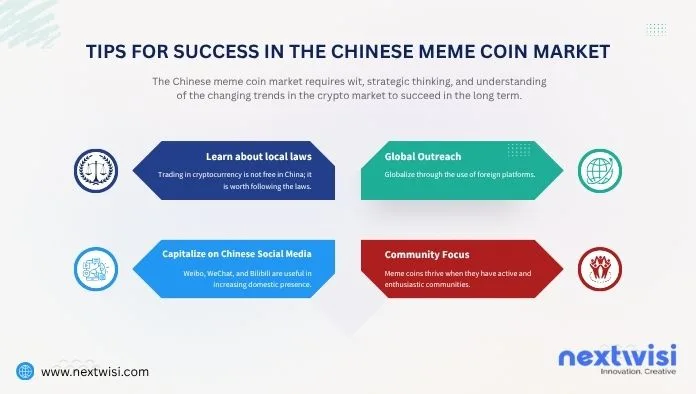
    1. Learn about local laws: Trading in cryptocurrency is not free in China; it is worth following the laws.

    2. Capitalize on Chinese Social Media: Weibo, WeChat, and Bilibili are useful in increasing domestic presence.

    3. Global Outreach: Globalize through the use of foreign platforms.

    4. Community Focus: Meme coins thrive when they have active and enthusiastic communities.

    How a Meme Coin Development Company Can Help

    It can be facilitated by cooperating with a professional meme coin development company:

    • The development of tokens and smart contracts.
    • Hack prevention security audits.
    • Community and marketing strategies.
    • International exchange listing guidance.

    Most Chinese developers work together with other international companies to introduce meme coins that are internationally compliant but still reach the local market.

    Start Your Meme Coin Journey!

    Meme coins are a blend of fun, community, and speculation. The answer to the question about the creation of meme coins in China has shown the increasing role of China in the crypto sphere in the world.

    Anyone can make a meme coin with adequate planning, a concept, effective marketing, and the backing of the community. Collaboration with the professionals guarantees the successful and safe launch. Meme coins are living up to their name, remaking the cryptocurrency world whether it is having fun, community, or potential profits.