Blog

  • Best AI Startups in India (2026) : Top Artificial Intelligence Companies

    Best AI Startups in India (2026) : Top Artificial Intelligence Companies

    Table of Contents

    Introduction: India’s AI Revolution Has Begun

    Best AI Startups in India is rapidly emerging as one of the most powerful AI innovation hubs in the world. With strong government backing, massive engineering talent, increasing venture capital investment, and a multilingual digital population, the country is building world-class artificial intelligence companies.

    From large language models (LLMs) to enterprise AI platforms and geospatial intelligence systems, Indian startups are no longer just service providers — they are product innovators competing globally.

    We explore the best AI startups in India in 2026, categorized by:

    • Foundational & LLM startups
    • Generative AI companies
    • Conversational AI leaders
    • Computer vision innovators
    • AI infrastructure & MLOps platforms
    • Enterprise AI giants

    1. Foundational & LLM AI Startups in India

    Sarvam AI

    Sarvam AI is one of India’s most promising foundational AI startups. The company focuses on building large language models optimized for Indian languages.

    Sarvam AI

    Why Sarvam AI Matters:

    • Builds Indic-focused LLMs
    • Works on sovereign AI infrastructure
    • Focuses on government and enterprise use cases

    India’s digital future requires AI systems that understand Hindi, Tamil, Telugu, Bengali, and other regional languages. Sarvam AI aims to bridge that gap.


    Krutrim

    Krutrim, backed by Ola founder Bhavish Aggarwal, became one of India’s first AI unicorns.

    Krutrim AI

    Key Highlights:

    • Multilingual large language model
    • AI cloud stack
    • Consumer AI assistant ecosystem

    Krutrim is building a full-stack AI ecosystem — from model to infrastructure to applications.

    2. Conversational AI & Generative AI Startups

    Yellow.ai

    Yellow.ai is a global conversational AI company from India offering AI-powered customer service automation.
    Yellow AI
    yellow.ai Logo

    What Makes Yellow.ai Special:

    • Supports 100+ languages
    • Voice and chat AI agents
    • Used by global enterprises

    It competes directly with global AI automation leaders.

    Haptik

    Haptik is one of India’s earliest conversational AI startups and was acquired by Reliance Jio.
    Haptik AI

    Focus Areas:

    • AI chatbots
    • Customer engagement automation
    • Enterprise conversational platforms

    3. Computer Vision & Industry AI Startups

    Mad Street Den

    Mad Street Den builds AI-driven retail intelligence solutions via its platform Vue.ai.

    Mad Street Den

    Capabilities:

    • Visual search
    • Automated product tagging
    • Retail analytics

    SatSure

    SatSure combines satellite imagery and AI for agriculture, insurance, and climate analytics.

    SatSure

    Why It Stands Out:

    • Space-tech + AI
    • Climate intelligence
    • Financial risk modeling

    4. AI Infrastructure & MLOps Startups

    Neysa

    Neysa provides AI-native cloud infrastructure and GPU acceleration for startups and enterprises.
    Neysa
    Neysa

    AI requires compute power — Neysa enables that domestically.

    TrueFoundry

    TrueFoundry simplifies machine learning deployment and infrastructure management.

    TrueFoundry

    Often called “Heroku for ML,” it accelerates AI product launches.

    5. Enterprise AI & Analytics Leaders

    Fractal Analytics
    Fractal Analytics

    Fractal Analytics is a global AI and analytics company serving Fortune 500 clients.

    It represents India’s strength in enterprise-grade AI solutions.

    Why AI Startups in India Are Growing So Fast

    1. Massive Engineering Talent Pool

    India produces over a million engineers annually.

    2. Government AI Push

    The IndiaAI mission and digital public infrastructure encourage AI innovation.

    3. Multilingual Digital Market

    India’s 1.4B population creates demand for localized AI solutions.

    4. Venture Capital & Unicorn Growth

    AI startups are attracting significant domestic and global funding.

    Investment Trends in Indian AI (2026)

    • Surge in Generative AI funding
    • Rise of AI infrastructure startups
    • Increasing demand for enterprise automation
    • Focus on sovereign AI development

    Comparison Table: Best AI Startups in India

    Startup Category Specialization
    Sarvam AI LLM Indic language models
    Krutrim LLM + Cloud Multilingual AI ecosystem
    Yellow.ai Conversational AI AI customer automation
    Haptik Conversational AI Enterprise chatbots
    Mad Street Den Computer Vision Retail AI
    SatSure Geospatial AI Satellite analytics
    Neysa AI Infrastructure GPU cloud
    TrueFoundry MLOps ML deployment
    Fractal Enterprise AI Analytics & AI consulting

    Future of AI Startups in India

    By 2030, India is expected to:

    • Become a global multilingual AI hub
    • Export AI products worldwide
    • Develop sovereign AI infrastructure
    • Produce multiple AI unicorns

    The next global AI giant could very well emerge from Bangalore or Hyderabad.

    FAQs: Best AI Startups in India

    Which is the best AI startup in India?

    Sarvam AI and Krutrim lead in foundational AI, while Yellow.ai dominates conversational AI.

    Are Indian companies building large language models?

    Yes. Sarvam AI and Krutrim are actively building LLMs.

    Which AI startup became a unicorn?

    Krutrim became one of India’s early AI unicorns.

    Is India investing in AI infrastructure?

    Yes. Startups like Neysa and government-backed initiatives are strengthening AI compute capacity.

    Final Thoughts

    India’s artificial intelligence ecosystem is no longer emerging — it is accelerating. With innovation across LLMs, generative AI, computer vision, and enterprise AI platforms, Indian startups are shaping the global AI narrative.

    If you’re an entrepreneur, investor, or tech professional, now is the time to pay attention to the best AI startups in India — because the next global breakthrough may come from here.

  • Sarvam AI: India’s Multilingual Generative AI Startup

    Sarvam AI: India’s Multilingual Generative AI Startup

    Sarvam AI: India’s Multilingual Generative AI Startup Building the Future of AI Infrastructure

    Artificial Intelligence is reshaping industries across the globe. From chatbots and content creation to enterprise automation and voice assistants, AI systems are becoming deeply integrated into everyday digital life. However, most advanced AI technologies have historically been built with English-first datasets and global market priorities. For a country like India — with its massive population and extraordinary linguistic diversity — this creates a significant gap.

    Sarvam AI emerges at this crucial moment.

    Sarvam AI is an India-based generative AI startup focused on building large language models (LLMs) optimized for Indian languages and enterprise use cases. While global AI companies primarily develop English-dominant systems, Sarvam AI is building foundational AI models specifically designed for India’s multilingual population.

    Its mission is clear and ambitious: Build AI infrastructure for India, in Indian languages.


    Understanding the Indian AI Opportunity

    India is one of the fastest-growing digital economies in the world. With over a billion people and rapidly expanding internet access, the country represents a massive technology market. However, India is not linguistically uniform.

    There are 22 officially recognized languages and hundreds of dialects spoken across the country. Millions of internet users prefer interacting in their native languages rather than English. Despite this, many global AI systems perform best in English and struggle with regional nuances.

    This creates a huge opportunity: build AI systems that truly understand Indian languages, cultural context, and regional usage patterns.

    Sarvam AI is positioning itself to capture that opportunity.


    What is Sarvam AI?

    Sarvam AI is a generative AI company focused on building foundational models for Indian languages. Instead of simply creating AI applications on top of existing foreign models, the company aims to develop core AI infrastructure that businesses, governments, and developers can rely on.

    Foundational AI infrastructure includes:

    • Large Language Models (LLMs)
    • Speech recognition systems
    • Text-to-speech technology
    • Enterprise-grade APIs
    • Multilingual AI processing systems

    By focusing on these building blocks, Sarvam AI is not just creating tools — it is building the backbone for India’s AI-driven digital transformation.


    The Founders Behind Sarvam AI

    Sarvam AI was founded by Vivek Raghavan and Pratyush Kumar, both experienced in artificial intelligence research and machine learning systems.

    The leadership team combines deep research expertise with practical knowledge of deploying scalable AI systems. Building large language models requires significant technical capability, including:

    • Advanced machine learning research
    • Data engineering at scale
    • Infrastructure optimization
    • Distributed computing knowledge
    • Enterprise deployment experience

    Strong technical leadership is critical when building foundational AI models. The founders’ backgrounds enable Sarvam AI to focus not only on innovation but also on real-world usability.


    Funding and Investor Confidence

    Sarvam AI has secured funding from established venture capital firms including Lightspeed Venture Partners and Peak XV Partners.

    Investor backing is significant for several reasons:

    1. Training large language models requires expensive computing infrastructure.
    2. Data acquisition and processing demand significant resources.
    3. Hiring top AI researchers and engineers requires capital.
    4. Competing in the AI space demands long-term strategic investment.

    The involvement of experienced investors suggests confidence in India’s AI infrastructure potential and in Sarvam AI’s ability to execute its vision.


    Why Multilingual AI is Critical for India

    India’s internet growth is increasingly driven by non-English users. Tier-2 and Tier-3 cities, as well as rural regions, represent the next wave of digital adoption.

    Many of these users prefer:

    • Hindi
    • Tamil
    • Telugu
    • Kannada
    • Marathi
    • Bengali
    • Gujarati
    • Punjabi
    • Malayalam
    • Odia
    • And other regional languages

    AI systems optimized only for English fail to fully serve this population.

    Multilingual AI is not simply translation. It requires:

    • Understanding regional grammar structures
    • Handling code-mixed language (Hindi + English, Tamil + English, etc.)
    • Recognizing regional accents in speech
    • Managing cultural references
    • Adapting to local business terminology

    Sarvam AI’s India-first strategy directly addresses these challenges.


    Core Focus Areas of Sarvam AI

    1. Large Language Models (LLMs)

    Large Language Models are advanced neural networks trained on massive text datasets. They power chatbots, writing assistants, virtual agents, search tools, and automation platforms.

    Sarvam AI aims to train LLMs using Indian language datasets, ensuring better accuracy and contextual understanding for regional use cases.

    These models can support:

    • Government services
    • Customer support automation
    • Financial advisory systems
    • Content generation platforms
    • Educational tools

    2. Speech-to-Text Systems

    Voice interaction is increasingly important in India, where typing in regional languages can be difficult for many users.

    Speech-to-text systems allow users to speak naturally while AI converts speech into written text. However, accurate recognition requires:

    • Accent adaptation
    • Dialect awareness
    • Noise handling
    • Regional vocabulary support

    Sarvam AI is working to build speech systems that perform reliably across Indian linguistic diversity.

    3. Text-to-Speech Engines

    Text-to-speech technology enables digital systems to communicate verbally. High-quality regional voice output enhances accessibility, especially for users with limited literacy.

    4. Enterprise AI APIs

    Sarvam AI intends to provide APIs that businesses can integrate directly into their platforms. This allows companies to embed multilingual AI features into apps, websites, and digital systems.

    Enterprise applications may include:

    • AI-powered customer support
    • Regional chatbot automation
    • Automated documentation
    • Localized marketing content generation
    • Voice assistants for financial services

    Use Cases Across Industries

    Sarvam AI’s technology has broad applications across multiple sectors.

    Government Digital Services

    Governments increasingly rely on online portals for citizen services. AI that understands regional languages can dramatically improve accessibility.

    Banking and Fintech

    India’s fintech ecosystem is massive. AI chatbots in local languages can improve customer onboarding, support, and fraud detection.

    Education Technology

    Regional AI tutors can help students learn in their native language, improving comprehension and digital inclusion.

    E-Commerce

    Localized AI support systems can help users browse, search, and purchase products in regional languages.

    Media and Content Creation

    Publishers can generate regional content at scale, increasing reach and engagement.


    Sarvam AI vs Global AI Companies

    Global AI companies focus on worldwide markets. Their primary training datasets are heavily English-dominant, with additional support for major international languages.

    Sarvam AI differentiates itself through:

    • India-first strategy
    • Deep regional language optimization
    • Enterprise localization focus
    • Government integration potential

    This localization advantage creates a strong competitive moat within the Indian market.


    Strategic Importance of Sovereign AI Infrastructure

    Countries worldwide are investing in domestic AI capabilities to reduce dependency on foreign technology.

    Sovereign AI infrastructure provides:

    • Data security
    • Regulatory alignment
    • Cultural sensitivity
    • National technological independence

    India’s growing digital economy requires AI systems aligned with domestic needs. Sarvam AI represents a step toward building indigenous AI capability.


    Challenges Sarvam AI May Face

    While the opportunity is large, building foundational AI models is complex.

    Key challenges include:

    • High compute costs
    • Data availability and quality
    • Competition from global AI giants
    • Rapid technological change
    • Talent acquisition

    However, a focused strategy targeting a specific linguistic market gives Sarvam AI clarity and direction.


    The Future Roadmap

    Sarvam AI is expected to:

    • Launch India-focused LLM APIs
    • Expand enterprise integrations
    • Improve multilingual speech systems
    • Collaborate with digital transformation initiatives
    • Strengthen regional language performance

    As AI adoption grows in India, foundational infrastructure providers will become increasingly important.


    Frequently Asked Questions

    What does Sarvam AI do?

    Sarvam AI builds large language models optimized for Indian languages and enterprise AI applications.

    Is Sarvam AI an Indian company?

    Yes, Sarvam AI is an India-based generative AI startup.

    Who founded Sarvam AI?

    Sarvam AI was founded by Vivek Raghavan and Pratyush Kumar.

    Who invested in Sarvam AI?

    Lightspeed Venture Partners and Peak XV Partners are key investors.

    Is Sarvam AI competing with global AI companies?

    Sarvam AI focuses on India-first AI infrastructure, while global companies target worldwide markets.


    Conclusion

    Sarvam AI represents a major shift in India’s AI landscape. Rather than depending entirely on global AI providers, India is beginning to build its own AI infrastructure tailored to its linguistic and cultural diversity.

    As artificial intelligence becomes central to digital services, companies that build foundational AI systems will shape the future economy. Sarvam AI is positioning itself as one of those foundational players in India.

    For entrepreneurs, developers, investors, policymakers, and businesses, this is a company worth watching.

    India’s multilingual future demands multilingual AI — and Sarvam AI aims to build exactly that.

  • Top 10 Best iOS App Development Companies in USA 2026

    Top 10 Best iOS App Development Companies in USA 2026

    The market of high-quality mobile applications is developing very fast, and the companies are actively seeking the addition of strong iOS app development companies in USA to create secure and scalable digital products. The Apple ecosystem demands a strict code of conduct, a good-looking user/user interface, and powerful performance optimization. The use of the appropriate development partner may have a direct effect on the user experience, brand value, and long-term business expansion.

    The 2026 business world is spending on iPhone and iPad applications in the healthcare sector, financial sector, eCommerce, and logistics. With a rise in competition, companies have to partner with the established iOS application development firms in USA which are capable of knowing the guidelines of Apple and developing applications that are stable and innovative at the same time.

    The reason why the USA is an iOS app development hub.

    The United States continues to be at the forefront of mobile technology as well as software innovation around the globe. Numerous iOS application development company in USA provide business-level solutions, sophisticated security systems, and scalable systems. Other new technologies, such as cloud solutions, are also incorporated in these companies to make the apps flexible and capable of supporting high user traffic.

    The USA has a robust infrastructure, a pool of qualified developers, and a well-developed startup community, which means that developing world-class iOS applications is an excellent opportunity. The US-based companies offer the businesses more convenient communication, time zones, and adherence to the international security standards.

    Selection Criteria for Top Companies

    To create this list of the top iOS app development companies in USA, we evaluated firms based on:

    • Swift and Apple skills in the technical field.
    • Successful records on iOS apps.
    • Review of clients and long-term relationships.
    • Scalability and security of applications.
    • Working experience in various sectors.

    These companies stand out for their innovation, reliability, and ability to deliver business-focused mobile solutions.

    Top 10 iOS App Development Companies in USA

    1. Nextwisi Solutions

    Nextwisi Solutions is the first preference among the iOS app development companies in USA, owing to its high level of technicalization and customer orientation strategy. The firm deals with creating a tailor-made iOS application based on business objectives. Their team supplies its clients with close collaboration from idea validation up to post-launch services to guarantee the security, scalability, and performance optimization of apps.

    Nextwisi Solutions is also recognized for keeping the modern digital technologies in the iOS apps that assist the businesses with future-proofing their products. They are a reliable development partner to both start-ups and businesses, as they are able to deliver user-friendly design and advanced backend architecture.

    2. TechAhead

    TechAhead is well known in terms of providing feature-based mobile applications. TechAhead is one of the leading companies in USA that specializes in the development of apps in the iOS system and is characterized by an agile process and an emphasis on innovation. They collaborate with health, financial technology, and retail companies, designing easy-to-use applications that satisfy the requirements of the contemporary users.

    3. Algoworks

    Algoworks offers researched CRM and cloud-integrated enterprise-level solutions for iOS applications. Since it is one of the reliable iOS app development firms in the USA, Algoworks develops applications that meet the long-term business strategies and digital transformation objectives.

    4. Simpalm

    Simpalm is reputed to be a provider of eye-catching and easy-to-use iOS applications. The design-first philosophy enables them to create not only useful but also interesting apps. They cater to clients in the sphere of healthcare, education, and on-demand services.

    5. Space O Technologies

    Space O Technologies has developed thousands of applications all over the world and has a significant position in the USA. Their iOS apps are usually innovative with blockchain development to ensure high data security and transparency. This renders them applicable in finance and logistics as well as enterprise-level solutions.

    6. Naked Development

    Naked Development is concentrated on high-quality app design and product development. Their group engages with startups and established brands to develop apps that are aesthetically appealing and technologically sound. The approach they use to think about their product assists businesses in attaining high user retention.

    7. Orangesoft

    Orangesoft provides full-service iOS app development, such as design and development and maintenance. They also apply intelligent capabilities that run on AI development to make the mobile applications more personal and engaging to the users.

    8. Azumo

    Azumo is a nearshore development firm that has highly skilled engineers. They assist companies to scale development teams within a short time and at the same time preserve the quality of code. Since they have a history of working with enterprise customers, they can be considered a good choice when it comes to long-term mobile projects.

    9. IT Craft

    Since its inception more than twenty years ago, IT Craft has provided scalable and reliable iOS applications. It is their quality assurance and performance maximization that makes them one of the reliable iOs app development companies in USA.

    10. Mercury Development

    Mercury Development is a company that focuses on the development of complicated mobile systems in healthcare, logistics, and financial areas. Their technical skills enable them to be used in large enterprise applications that have high levels of security.

    How to Choose the Right iOS Development Partner

    The choice of the most effective company among the numerous iOS app development companies in USA is determined by what business you want to achieve. Always evaluate:

    • Their exposure to iOS frameworks
    • Relevance to industry portfolio.
    • Scalability of solutions
    • After-sales service and maintenance.
    • Communication transparency

    Your development partner must not just write clean code but must also be able to know your market and how your users behave.

    Conclusion

    The mobile industry is also dynamic, and companies require the services of skilled developers to remain competitive. Collaborating with the appropriate iOS app development company in USA will help you to achieve the high standards set by Apple as well as perform well in terms of performance and user experience.

    Nextwisi Solutions is the best of all the options, as it has good technical competence, customer-oriented service, and innovative development patterns. Whether you are a startup or an enterprise, the type of partner you select will directly influence the amount of success your app will have in the competitive iOS market.

  • Digital Transformation Scale Agile Solutions: Innovation in Contemporary Business

    Digital Transformation Scale Agile Solutions: Innovation in Contemporary Business

    The modern, dynamic digital environment demands that businesses adapt continuously in order to stay relevant and competitive. The digital transformation scale agile solutions concept is assisting organizations to integrate ad hoc technologies with innovative approaches to speed up growth and innovation. Adopting this strategy enables companies to adjust to market needs within the shortest time possible, boost customer experiences, and become more efficient in their work.

    Digital transformation is now a matter of survival and not a choice. Nevertheless, in the absence of Agile practices, the process of transformation may become tedious and unrelated. This is the reason why it is imperative to scale Agile to achieve long-term success.

    What does “digital transformation” mean?

    Digital transformation can be defined as the use of digital technologies in every aspect of a business, and it essentially reduces the way it is run and the value it provides to the consumer. It entails reviewing processes, enhancing systems, and using contemporary tools to develop flawless experiences.

    Organizations adopting digital transformation often focus on automation, cloud adoption, and data-driven strategies. These elements enable companies to respond faster to changes, reduce operational costs, and improve decision-making across all levels, while also leveraging AI development to build intelligent systems and predictive solutions.

    Understanding Agile Methodology

    Agile is an iterative and flexible way of project management and product development. It concentrates on the subdivision of work into smaller cycles, whereby teams will provide value at a faster rate, and they will constantly keep on enhancing processes by providing feedback.

    Agile encourages teamwork, openness, and flexibility, unlike the conventional methodology. It allows teams to react swiftly to alterations so that products and services are consistent with the expectations and trends of customers.

    This approach ensures that businesses can efficiently develop and improve digital products such as web platforms and mobile app solutions, delivering seamless user experiences across devices and platforms.

    Why Digital Transformation Needs Agile at Scale

    The fusion of the digital transformation and Agile methodologies makes sure that the organizations will be able to innovate effectively and still remain flexible. The use of digital transformation scale agile solutions enables organizations to scale their activities within teams and departments without sacrificing speed and quality.

    1. Faster Time to Market

    The agile practices also enable the organization to subdivide the big ones into small deliverables to achieve quicker delivery and ongoing enhancements. It assists the business to release products faster, receive feedback, and improve functions without postponing development schedules.

    2. Customer-Centric Development

    Agile keeps the customer needs at the core of all decisions by incorporating the continuous feedback loops in the development process. This would enable the companies to develop customized customer experiences, enhance satisfaction, and develop long-term customer loyalty.

    3. Enhanced Collaboration Across Teams

    Agile promotes free communication and cross-functional cooperation among the cross-functional teams comprising development, marketing, and operations. This eliminates silos, enhances alignment, and has everyone pull towards a common business direction.

    4. Improved Risk Management

    The division of projects into iterations aids in detecting the possible risks at the initial stage of development. With the help of teams, it is possible to resolve problems faster, minimize failures, and allow a more seamless implementation of digital transformation projects without significant disruptions.

    5. Continuous Improvement and Innovation

    Agile encourages the culture of learning and improvement through frequent feedback, reflections, and performance reviews. This makes sure that companies keep on changing their strategies and keep ahead in an ever-competitive online world.

     Agile Leadership and Agile Leadership Role

    Agile leadership is an important aspect in the successful implementation of transformation strategies. Leaders should also lead teams, motivate innovation, and allow employees to feel empowered to experiment and get better.

    Empowering Teams

    Agile leaders provide autonomy to the teams to make decisions and own up to their work. This enhances accountability and motivation and inspires the employees to offer innovative ideas that will make the business successful.

    Facilitating Collaboration

    Leaders foster transparency and collaboration between departments and other stakeholders by guaranteeing free flow of communication. This assists in the removal of misunderstandings, setting of goals, and enhancing productivity of the entire organization.

    Championing Change

    Digital transformation is something that necessitates organizations to accept change at all levels. Agile leaders facilitate this shift by promoting new technologies, processes, and attitudes and assisting teams to adjust to change and make the transition successfully.

    Providing Clear Vision

    A powerful vision will enable teams to remain focused on long-term goals as they undertake short-term deliverables. Agile leaders establish specific goals, and all the efforts should lead to the organizational transformation process.

    Leading by Example

    Agile values like flexibility, openness, and continuous learning are to be shown by leaders. They lead teams to embrace the same mentality and make a difference toward successful change since they practice the same values themselves.

    Scaling Agile Solutions Across Organizations

    Agile scaling is a critical aspect of enterprises that seek to use transformation in various teams and departments. The digital transformation scale agile solutions approach guarantees uniformity, effectiveness, and coherence throughout the organization.

    Agile Frameworks for Scaling

    Agile frameworks such as Scrum, Kanban, SAFe, LeSS, and DAD offer systematic methods of Agile implementation on a large scale. These frameworks are useful to organizations in organizing various teams, ensuring a smooth flow of work as well as consistency in executing projects.

    Agile Tools and Technologies

    Jira, Trello, and VersionOne are tools helping teams to manage tasks, monitor their progress, and cooperate. These tools offer transparency, enhance accountability, and facilitate easy communication in dispersed teams.

    Cross-Functional Team Structure

    Forming teams that have different skills will make sure that everything in a project is managed effectively. The development, operations, and marketing teams are working together, resulting in quicker delivery and improved results.

    Training and Agile Coaching

    The organization has to invest in constant training and coaching to make employees learn about Agile principles. This facilitates a seamless adoption, increases performance, and allows teams to produce a high quality of work on a regular basis.

    Strong Leadership Commitment

    Leadership should be supported on all levels to scale successfully. The leaders need to invest resources, promote Agile practices, and establish a culture of innovation and constant improvement.

    Best Practices for Implementation

    The best strategies that businesses can embrace to introduce scaled agile solutions successfully include:

    • Focus on building a customer-first approach by continuously collecting feedback, analyzing behavior, and improving products while integrating scalable cloud solution infrastructure to enhance flexibility and performance in a competitive digital marketplace.
    • Consider investing in cloud infrastructure and automation technologies to increase scalability and operational efficiency and facilitate smooth collaboration between teams and departments that are geographically distributed.
    • Act on information to make decisions, streamline operations, and find growth areas that would be consistent with the long-term business goals and market forces.
    • Promote a culture of teamwork and openness to knowledge sharing, open communication, and coordination among teams in the pursuit of shared organizational objectives.
    • Keep a close eye on the performance, review the results, and optimize the strategies to retain the success and the enhancement of efficiency in the digital transformation efforts.

    Conclusion

    In the world characterized by a high rate of change in technology, companies need to embrace new technologies to stay afloat. The integration of digital transformation scale agile solutions enables organizations to achieve flexibility, efficiency, and long-term growth.

    Agile methodology combined with digital transformation can help companies develop a resilient and adaptable business model. This would not only be able to advance the internal processes but also be able to advance the customer experiences as well as be able to generate constant innovation.

    Those organizations that adapt the strategy currently will find it easier to be ahead of the pack in the future to have assured success in the continually changing digital environment.

  • Enterprise Mobile App Development: A Complete Growth Guide for Modern Businesses

    Enterprise Mobile App Development: A Complete Growth Guide for Modern Businesses

    In today’s mobile-driven economy, enterprises can no longer rely only on traditional desktop software or fragmented digital tools. Employees, managers, and customers now expect instant access to systems, real-time updates, and seamless digital experiences. This is where enterprise mobile app development becomes a strategic investment rather than just a technology upgrade.

    From improving internal productivity to enabling smarter customer engagement, enterprise mobile application development helps organizations build secure, scalable, and high-performing mobile solutions tailored to complex business workflows. As companies adopt enterprise mobility and digital transformation strategies, mobile-first systems are becoming the backbone of modern business operations.

    This guide explores what enterprise mobile app development is, why enterprises are adopting it, key app types, core features, development processes, costs, security considerations, and future trends shaping the enterprise digital ecosystem.

    What Is Enterprise Mobile App Development?

    Enterprise mobile app development refers to the creation of custom mobile applications designed specifically for large organizations and business operations. Unlike consumer apps built for entertainment or social interaction, enterprise apps focus on productivity, workflow automation, and system integration.

    These applications are connected to enterprise backend systems such as ERP, CRM, cloud platforms, and internal databases. They are built to handle large volumes of users, complex business logic, and high data security requirements.

    In simple terms, enterprise app development transforms traditional enterprise software into mobile-enabled tools that employees and managers can access anytime, anywhere. This supports enterprise digital transformation by shifting business processes into a connected, mobile-friendly environment.

    Why Enterprises Are Investing in Mobile-First Systems

    Organizations are rapidly adopting enterprise mobility solutions because modern workforces are no longer limited to office desks. Teams work remotely, operate in the field, and collaborate across geographies.

    Mobile-first enterprise systems help businesses achieve:

    • Faster decision-making through real-time access to dashboards and reports
    • Higher productivity with workflow optimization and automation
    • Improved collaboration across departments
    • Better customer service using CRM mobile applications
    • Stronger control over enterprise data management

    A well-designed enterprise mobility strategy ensures that critical business processes are available through secure, scalable mobile platforms that support continuous growth.

    Core Business Problems Solved by Enterprise Mobile Apps

    Many enterprises struggle with outdated systems, disconnected tools, and manual operations. Enterprise mobile apps directly address these challenges:

    1. Workflow Delays

    Automated approvals, digital forms, and real-time notifications reduce bottlenecks and speed up operations.

    2. Data Silos

    Mobile apps integrated with enterprise backend systems unify data across departments into centralized systems.

    3. Communication Gaps

    Enterprise software solutions improve collaboration through shared dashboards, messaging, and task coordination.

    4. Limited Visibility

    Business intelligence mobile apps provide real-time analytics, enabling data-driven decisions.

    By solving these issues, enterprise mobile app development increases operational efficiency and long-term scalability.

    Types of Enterprise Mobile Applications

    Different enterprise needs require different app categories. The most common types include:

    Employee Productivity Apps

    These apps focus on workforce management, attendance tracking, task updates, and internal communication. They improve individual efficiency and reduce administrative workload.

    CRM & Sales Enablement Apps

    CRM mobile applications allow sales teams to access customer data, manage leads, and update deal status in real time. This strengthens customer relationships and accelerates sales cycles.

    ERP & Operations Apps

    ERP mobile apps integrate finance, inventory, HR, and procurement systems into a single platform. They enable managers to monitor operations and approve workflows remotely.

    Business Intelligence & Analytics Apps

    BI mobile apps convert complex enterprise data into visual dashboards and reports. Leaders can track KPIs, detect trends, and adjust strategies instantly.

    Cloud-Based File Management Apps

    These applications support secure document storage, version control, and collaboration across distributed teams using cloud-based enterprise apps.

    Key Features of Enterprise Mobile App Development

    Successful enterprise applications are defined by robust features that ensure security, performance, and usability.

    Data Security & Compliance

    Enterprise security solutions include data encryption, multi-factor authentication, secure APIs, and role-based access control. These features protect enterprise data and help meet enterprise compliance standards.

    Scalability & Performance

    Enterprise app architecture must support growing users, higher data loads, and evolving business needs without performance loss.

    Integration with Enterprise Systems

    Seamless integration with ERP, CRM, and cloud platforms ensures smooth synchronization and real-time updates.

    Offline Access

    Offline mode enables uninterrupted app usage in low-connectivity environments, supporting field operations and remote work.

    Cross-Platform Support

    Cross-platform enterprise apps ensure compatibility across Android, iOS, and tablets, increasing accessibility.

    User Experience

    Enterprise mobile UX/UI focuses on simplicity, clarity, and usability so employees can work efficiently without technical complexity.

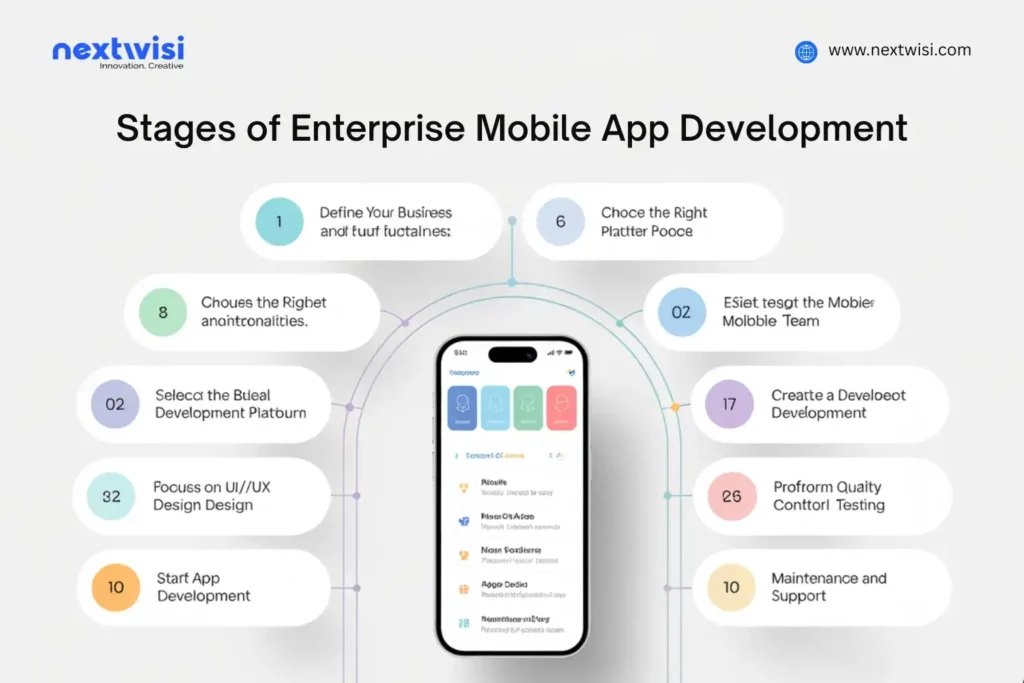
    Enterprise Mobile App Development Process

    The development of enterprise mobile applications follows a structured and strategic approach.

    Enterprise Mobile App Development Process

    Business Requirement Analysis

    This phase defines business goals, workflows, and user roles. Developers study enterprise systems and identify functional needs.

    Technical Architecture Planning

    Designing enterprise app architecture involves selecting platforms, databases, APIs, and cloud infrastructure.

    UI/UX Design for Enterprises

    Designers create intuitive interfaces that align with enterprise workflows and branding.

    Backend & API Integration

    Enterprise backend systems are connected using secure APIs for data synchronization and automation.

    Testing & Quality Assurance

    Apps undergo performance testing, security audits, and usability testing to ensure reliability.

    Deployment & Maintenance

    Post-launch support includes updates, security patches, performance monitoring, and feature enhancements.

    This structured process ensures stable and scalable enterprise software solutions.

    Cost of Enterprise Mobile App Development

    The enterprise app cost depends on complexity, features, and technology stack.

    • Simple apps with limited integrations cost less
    • Medium-complex apps with ERP or CRM integration cost more
    • Advanced apps with AI, analytics, and cloud infrastructure cost significantly higher

    Custom enterprise mobile app development is an investment that delivers ROI through automation, productivity, and long-term scalability. Security, enterprise compliance, and cross-platform support also influence total cost.

    Security in Enterprise Mobile Applications

    Security is a critical factor in enterprise mobile app development. Enterprises deal with confidential customer data, financial records, and internal systems.

    Best security practices include:

    • Data encryption in transit and storage
    • Multi-factor authentication
    • Secure API gateways
    • Role-based authorization
    • Regular security testing
    • Continuous monitoring

    Enterprise security solutions not only prevent breaches but also build customer trust and regulatory compliance.

    Role of AI & Cloud in Enterprise Mobile App Development

    AI and cloud computing play a major role in enterprise digital transformation.

    Artificial Intelligence

    AI enables predictive analytics, smart automation, chatbots, and recommendation engines. It reduces manual workload and improves operational accuracy.

    Cloud-Based Enterprise Apps

    Cloud platforms provide flexible storage, high availability, and faster deployment. They allow enterprises to scale resources dynamically and support global operations.

    Together, AI and cloud computing create a connected, intelligent enterprise digital ecosystem.

    Common Challenges in Enterprise App Development

    Despite its benefits, enterprise mobile app development faces challenges:

    • Legacy system integration
    • Data migration complexity
    • Security risks
    • User adoption resistance
    • Performance optimization

    These challenges can be addressed with modular architecture, strong testing strategies, and continuous training.

    Best Practices for Enterprise Mobile App Development

    Enterprises should follow proven strategies to maximize success:

    • Adopt modular enterprise app architecture
    • Use API-first development
    • Implement security-by-design
    • Focus on enterprise mobile UX/UI
    • Optimize performance for scalability
    • Choose cross-platform frameworks
    • Enable cloud-based enterprise apps
    • Integrate analytics and reporting

    These best practices ensure that enterprise mobility solutions remain future-ready and resilient.

    Future of Enterprise Mobile App Development

    The future of enterprise mobile app development is shaped by innovation and automation.

    Key trends include:

    • AI-powered enterprise applications
    • Low-code and no-code platforms
    • Blockchain-based security
    • IoT integration
    • Advanced data analytics
    • Microservices architecture

    These technologies will further strengthen enterprise digital ecosystems and accelerate business modernization.

    Conclusion

    Enterprise mobile app development is no longer optional for modern organizations. It is a strategic tool that drives productivity, automation, collaboration, and customer engagement. By adopting enterprise mobility solutions, businesses can modernize workflows, strengthen data security, and improve decision-making.

    From enterprise backend systems to cloud-based enterprise apps, mobile platforms are transforming how enterprises operate in a competitive digital environment. With the right architecture, security, and development strategy, enterprise mobile apps become powerful engines of long-term business growth and innovation.

  • AI Chatbot Conversation Archive: Building the Memory Layer of Intelligent Systems

    AI Chatbot Conversation Archive: Building the Memory Layer of Intelligent Systems

    AI has gone way beyond generation of responses. The modern conversational systems drive research platforms, enterprise automation, fintech applications, healthcare portals, SaaS applications, and public-facing digital assistants. There are however numerous AI implementations where conversations are regarded as a one-off instead of intelligence property.

    This is where an AI chatbot conversation archive becomes essential.

    Instead of storing disordered chat logs, contemporary organizations are creating organized conversation archives which are persistent memory systems. These archives make interactions reusable intelligence that will keep learning and explainable AI, regulatory traceability and scalable AI development.

    With the further development of AI systems (to 2026 and further), archiving conversations is not an alternative anymore but a prerequisite.

    Why Conversational Memory Is Now a Core AI Requirement

    The initial models of chatbots were transactional. One of the users posed a question, the system came back with a reply and the dialogue then went into the simple logs. No conversational memory, no continuity in context, no long term intelligence building.

    The contemporary AI systems work differently.

    An effective AI chatbot conversation archive can bring about persistent conversational memory. It records the context of interaction, understanding intent, behavior of response, model state and the decision of the system over time. This organised intelligence has the effect of guaranteeing that artificial intelligence systems:

    • Maintain consistency across sessions
    • Learn from previous interaction patterns
    • Track model evolution
    • Support long-term reasoning
    • Improve user experience continuously

    In the absence of systematic chat archives, AI governance is ineffective, accountability is lost, and continuity in learning becomes impaired. Conversation capture should be viewed by organizations hopeful to be responsible AI as strategic, as opposed to backend storage.

    Architectural Model of an AI Chatbot Conversation Archive

    An intelligent chatbot conversation history is a distributed intelligence layer designed well. It captures real time dialogue interactions, normalizes them and archives them in structured forms to be recalled and analyzed at a later date.

    Every turn in conversation is an organized phenomenon that involves:

    • System response and user input
    • Context references
    • Semantic embeddings
    • Model version
    • Confidence levels
    • Intent classification

    This design is such that despite the changes in AI models, there is a way to make the archived conversations readable and reusable.

    Key Architectural Elements

    1. Event-Based Conversation Capture

    The event recording is done in real-time so that no contextual details are lost.

    2. Semantic Embeddings Creation

    All of the interactions are translated into embeddings that encode tone, meaning, and intent.

    3. Hybrid Storage Systems

    Integrating object storage and the use of the vector databases allow scalable efficient data management.

    4. Vector-Based Retrieval Systems

    Allows semantic searching on the basis of closeness as opposed to precise keywords.

    This is designed to support operational application and research level analysis.

    Semantic Storage and Vector-Based Retrieval

    Large conversational datasets cannot be stored using traditional key word storage. It does not reflect on subtlety, nuance and intent. State-of-art AI chatbot conversation archive systems are based on semantic storage based on vectorized embeddings.

    Every interaction is represented mathematically in a way that it does not lose the meaning. This allows:

    • Conversation search Semantic search
    • Similarity-based retrieval
    • Detection of patterns among different users
    • Uncovering latent user requirements

    In the case of startups, it implies shorter iteration times and evidence-based product-oriented decisions. To businesses, it will imply scalable conversational AI data storage that can promote compliance and innovation at the same time.

    The semantic storage will turn the archive into a passive logging into active intelligence infrastructure.

    Continuous Learning and Feedback Loops

    Among the most mighty advantages of the AI chatbot conversation archive is the fact that it enhances controlled continuous learning.

    Organizations can construct training pipelines out of real-world interactions, instead of training AI models on fixed collections of data. Filtering of conversations archived will identify:

    • Low-confidence responses
    • Failed interactions
    • Unclear types of intent.
    • Edge-case behavior

    These interactions are then subject to a selective annotation – either automated or human checked – and are then reintroduced into training sets under controlled conditions.

    Developed learning procedures involve:

    • Detecting model drift
    • Evaluation of stability of responses
    • Enhancing context retention
    • Avoiding the contamination of data
    • Managing bias accumulation

    This form of feedback loop is more accurate and does not compromise AI control or model integrity.

    Governance, Accountability and Explainable AI

    AIs are becoming increasingly expected to provide a rationalization of their decisions. Regulatory systems require transparency especially in the healthcare, finance and education sectors.

    Traceability in an AI chatbot conversation archive records:

    • Which model version responded
    • What context was available
    • How intent was interpreted
    • Why a particular response was generated

    This allows explainable AI and helps to comply with regulation. Internal audits, ethical reviews, and safety checks are based on archived interaction evidence.

    In an unstructured form of conversation with no archives of planned conversation, defending the actions of AI is challenging – particularly in the controlled setting.

    Strategic Value for Enterprises and Startups

    In addition to compliance, conversation archiving produces quantifiable business value.

    The conversations that have been archived can be analyzed to reveal to organizations:

    • Recurring support errors
    • Product gaps
    • User frustration points
    • Unmet needs
    • Emerging usage trends

    In the course of time, this data develops into proprietary intelligence. It enhances product decision making, minimizes the cost of support and improves the confidence of the investor.

    Structured conversation archives are a competitive advantage to AI-first startups. They make conversational AI not an aspect but an asset of long-term knowledge.

    Privacy, Ethics, and Data Control

    Recording discussions brings ethical issues. Organizations have to strike a balance between intelligence building and user trust.

    Privacy is enforced by designing advanced systems:

    • Semantic anonymization
    • Role-based access control
    • Automated retention policies
    • Sensitive data masking
    • Controlled data growth

    These controls are in place to maintain the storage of conversational AI data as per the world regulatory standards and retain the value of analysis.

    In 2026, AI chatbots conversation archives that adhere to the privacy principle will be required to make ethical AI usage.

    Integration with AI Observability Systems

    Contemporary AI needs observability to oversee the performance and identify any anomalies. Nonetheless, observability tools do not have the capability of capturing history.

    In combination with AI observability systems, conversation archives make it possible to:

    • Long-term trend analysis
    • Drift detection
    • Safety enforcement
    • Cross-model comparison
    • Proactive AI control

    Through comparison, organizations can shift to predictive optimization instead of reactive troubleshooting by comparing live interactions with archived data.

    This integration enhances the reliability of the system and also AI accountability.

    Research and Academic Significance

    To the researchers, chatbot conversations archived offer good longitudinal data. These data sets are indicators of reality biting, changing language and expectations of the users.

    Academics can study:

    • Bias emergence over time
    • Context retention failures
    • Model evolution patterns
    • Response consistency
    • Behavioral drift

    Since archived data records system state and interaction conditions, it makes reproducible research possible, which is essential in the development of AI.

    A conversation history of an AI chatbot then turns into a research infrastructure, rather than a technical byproduct.

    Risks and Long-Term Challenges

    Although conversation archiving has advantages, it also seemingly has challenges that have to be actively managed.

    Key risks include:

    • Bias accumulation over time
    • Poor labeling practices
    • Data contamination
    • Uncontrolled data growth
    • Increased storage costs
    • Concerns on environmental impact

    To avoid degradation in archives, there is a need to have good governance policies, selective retention strategies and good curation procedures.

    The conversation archives should be an active intelligence system rather than a data pool that is not managed.

    The Future: From Archive to Institutional Memory

    In the future, the AI chatbot conversation archive system will become institutional memory layers.

    Instead of keeping the isolated interactions in storage, they will consolidate cross-product, cross-department, and cross-model conversations. This will enable:

    • Cross-model learning
    • Long-term reasoning
    • Knowledge continuity in the organization
    • Time-dependence of knowledge

    AI systems will go beyond the transactional chat responses. They will be able to think on historical converse experience, and establish inane conversational intelligences.

    It is the step towards the realization of reactive chatbots to remember-based AI systems with the ability to think strategically.

    Conclusion

    An AI chatbot conversation archive is far more than a storage mechanism. The memory infrastructure is what makes AI systems accountable, scalable and intelligent.

    It helps to promote continuous learning, empower AI governance, explainable AI, and product decision-making. It offers researchers real world longitudinal information, and enterprises proprietary intelligence benefits.

    Companies that invest in formal conversation archives today are laying the groundwork to strong AI ecosystems tomorrow.

    With the development of artificial intelligence, intelligence will be determined by memory, and the archive of the AI chatbot conversation will determine memory.

  • Affordable AI Avatar Services for Local Businesses: Smart Video Marketing on a Budget

    Affordable AI Avatar Services for Local Businesses: Smart Video Marketing on a Budget

    In the digital marketplace, local businesses currently experience high levels of competition. The customers demand to see exciting videos and personalized communication where they can have quick responses on the websites and social media. Nevertheless, the conventional method of video production is costly and time-consuming. That is why affordable AI avatar services for local businesses are becoming a powerful solution for brands that want professional video marketing without high production costs.

    Through the introduction of AI video generation, digital avatar technology, and the use of automated video creation tools, local companies will now be in a position to produce high-quality videos at very low cost. Businesses do not need to pay actors or rent studios to create engaging marketing content; AI presenter software gives them the opportunity to create the content in minutes using simple scripts.

    What Are AI Avatar Services, and How Do They Work?

    The production of realistic digital presenters is done through AI avatar platforms, artificial intelligence, AI voice synthesis technology, and synthetic media solutions. These avatars have the ability to talk various languages, change tone, and send customized information to various groups of customers.

    Through AI-enhanced content generation, companies just have to input a script, select a style of presenter, and tailor branding features. The auto-generated professional video system uses AI text-to-video and lip-synching technologies to create a video in a realistic manner. This process will save time on production and still retain its brand.

    In the case of local brands with small budgets, low-cost AI avatar services of local businesses result in no longer having to do recurring video shoots to create valuable content to publish on websites and landing pages and promote the brand.

    Why Local Businesses Should Invest in AI Avatar Solutions

    Small and medium-sized enterprises usually find it hard to remain with regular content marketing practices because of the lack of financial and creative capabilities. The solution to these issues is adopting the affordable AI avatar services to be used by local businesses to solve their challenges on automation and scalability.

    To begin with, AI avatars assist in the creation of videos at low costs, and this considerably reduces marketing costs in comparison to the conventional video production techniques. With a limited budget on advertising, businesses are able to make several videos to promote themselves, demonstrate their products, and make announcements.

    Second, the sites allow the execution of content marketing strategies in a scaled manner. Depending on whether the business requires a single video a month or numerous campaigns every week, there will always be the opportunity to produce automated marketing videos because it does not require the involvement of any other production teams.

    Third, customer engagement can be strengthened using the video with the help of AI avatars that provide high-quality and professional communication. The video material has an advantage over the text one and enhances the conversion and brand recognition.

    Practical Use Cases for Local Brands

    Technological companies are not the only ones to use AI-powered avatars. They are convenient resources for retail stores, real estate brokers, medical facilities, eateries, and learning institutions.

    1. Website Introductions and Brand Awareness

    Virtual spokesperson services can be used by businesses to make their homepages have friendly and understandable videos to describe services to the visitors and make them trust them.

    2. Social Media Campaigns and Promotions

    With AI-based video marketing, brands will have the opportunity to post frequent promotional material without arranging frequent shoots. This guarantees regular posting and increased exposure in platforms.

    3. Product Demonstrations and Explainer Videos

    With the assistance of AI-created spokesperson technology, companies will be able to describe features of products, advantages of services, and promotions in a professional and convincing tone.

    4. Training and Internal Communication

    The video automation of SMEs can be applied by local businesses to develop the onboarding tutorials, compliance training, and operation guidance material effectively.

    In both instances, local businesses will have the flexibility, cost reduction, and better marketing performance through affordable AI avatars.

    SEO and Digital Expansion Advantages

    SEO-wise, videos enhance the dwell time and engagement levels of sites. By utilizing AI tools in the marketing of local businesses as part of the marketing strategy, businesses can always release new multimedia content that enhances the search visibility.

    Also, digital marketing of local businesses and personal video communication are even more effective and trustworthy. AI avatars enable businesses to customize messages to target certain groups of customers at no extra production costs.

    Using the assistance of marketing automation tools, companies can share videos with the help of emailing campaigns, landing pages, and advertisements on social media with no difficulties. This would boost brand power and general presence in digital.

    Role of IT Support in AI Avatar Implementation

    Although AI tools are future-proof, it is necessary to integrate them to maximize their performance. Professional IT services are required at this point. Nextwisi Solutions is a reputable IT solutions provider that assists companies in integrating AI solutions into business within their digital ecosystem.

    By leveraging AI integration services, deployment on a cloud, and secure infrastructure planning, Nextwisi will facilitate the easy adoption of budget-friendly AI avatar services for local businesses without any technical inconvenience.

    In addition, Nextwisi assists companies through the services of digital transformation and scalable infrastructure to ensure that the AI-powered marketing approach aligns with the long-term business targets. Through appropriate technical resources, companies can implement enterprise-level AI deployment without any doubt in terms of security and performance level.

    Cost Efficiency and ROI Advantages

    The main benefit of low-cost AI avatar services to the local companies is high ROI. Conventional video production involves the repetitive costs of actors, editing crews, and equipment. Conversely, AI-based solutions also offer subscription-based pricing, which facilitates cost-effective marketing solutions.

    By continually generating leads by use of video marketing, companies will be able to create more leads and generate more conversions without spending more on advertising. AI-driven systems can also be used to A/B test scripts and messaging styles; this enables the brands to optimize campaigns to achieve improved outcomes.

    Due to low-cost video production and automation features, even minor local shops can be able to compete with bigger players regarding professional digital presence.

    The Future of AI Avatar Technology for SMEs

    Digital marketing is becoming increasingly dynamic with the advancement of the interactive AI avatars and personalization algorithms. In the near future, local companies will have the opportunity to send hyper-targeted video messages depending on the behavior and the history of purchases made by the customer.

    With the further development of AI-driven content creation tools, businesses will enjoy a quicker production cycle, increased engagement rates, and loyalty to their brands. The opportunity to use AI avatars at low costs today makes local businesses ahead of the rest of the rivals that use the old marketing models.

    Final Thoughts

    The competition in the digital sphere is growing, and clients want to see attractive material on any brand. Through the integration of AI video generation, virtual spokesperson services, and automatic video creation services, businesses can make a professional marketing video and stay within budgets.

    AI avatars at affordable rates for local businesses are not merely a fad but a future scheduled move towards scalability. With the help of credible IT partners such as Nextwisi Solutions, businesses acquire the technical base on which to integrate AI without difficulties and threats.

    To achieve sustainable growth and stronger involvement, as well as increase ROI, the affordable AI avatar services to local businesses and the adoption of an intelligent local business digital marketing approach are a viable and future-proofed choice for local brands.

  • Compare Pricing for Leading AI Avatar Services: 2026 Guide for Smart Businesses

    Compare Pricing for Leading AI Avatar Services: 2026 Guide for Smart Businesses

    The numerous companies are still analyzing these tools in the wrong dimension as the AI avatar services keep transforming content production, marketing, and business communications. The majority of teams are only interested in the monthly subscription charge, rather than the actual cost of production, cost-per-minute production, the value of automation, and ROI.

    The year 2026 is when AI avatars cease to be an experiment. They are turning into digital collaborators – they can create scalable, multilingual, customized, and real-time video content without the delays and costs of video production in the traditional way.

    This guide will assist you in pricing comparisons regarding the top AI avatar services, in a strategic, ROI-oriented strategy, to ensure you settle on the platform that would provide the best ROI over the long term.

    Why AI Avatar Pricing Requires a New Evaluation Model

    Conventional video production is an expensive and time-consuming process: scripting, shooting, editing, voiceovers, re-shooting, and editing. Even a basic professional video can run up to $200–2000 per project depending on complexity.

    AI avatar platforms are disruptive because they turn the creation of videos into software-based and therefore scalable creation. Rather than subcontracting production crews or editing staff, companies can create professional video content in a matter of minutes – with some cases being a few dollars per video.

    Comparing pricing in the major AI avatar services, the actual objective is to gauge:

    • Cost per video minute
    • Efficiency of credit-based pricing
    • Turnaround time and speed of rendering
    • Automation and API
    • Personal avatars and branding expenses
    • Scalability of the workflow and ROI opportunities

    Those businesses that attain mastery of this evaluation model early enough will create more content cheaper and faster than their competition.

    Overview of Leading AI Avatar Platforms in 2026

    The AI avatar services are specialized in various ways. It is necessary to know where they stand before making comparisons on the price.

    D-ID – Developer-Focused & API-Driven

    D-ID is aimed at teams that are developing interactive and real-time avatar applications. It can be used with Next.js apps, chatbots, and customer engagement systems because of its API-first architecture, which best suits SaaS tools. Entry-level pricing is reasonable, but heavy API usage may be scaled up and is therefore appropriate to a team that builds systems rather than videos.

    Synthesia – Corporate Training & Enterprise Education

    Synthesia continues to be a leading firm in business training, human resource learning, and internal learning. Its grid-based system, professional avatars, and workflow solutions are perfectly suited to big companies. However, companies that require branded characters, custom avatars, or a large number of productions should face elevated pricing.

    HeyGen – High-Quality Marketing & Advertising

    HeyGen is said to be the standard of realistic avatars and quality of facial sync. It is popular among the marketing teams when it comes to ads, promotional videos, multilingual campaigns, and high-conversion creative assets. Although the price is a bit higher than the entry-level tools, the visual quality and conversion capabilities are worth the extra money.

    Snaplama & Budget UGC Tools – Fast, Affordable Content

    In the case of UGC creators and real estate agents as well as DTC brands, low-cost alternative platforms such as Snaplama provide low-cost and fast-generation short-form videos. These are speed, low-cost, and social-ready output-focused tools, making them the best to list videos, TikTok content, and high-speed campaigns.

    Colossyan, Elai.io & DeepBrain AI – Business & Internal Messaging

    These applications facilitate business communication, onboarding, scenario-based training, and personalized business video messages. They provide organized pricing models, demos, and workflow that is business-friendly.

    How to Compare Pricing for Leading AI Avatar Services the Right Way

    Rather than looking at the apparent pricing, appraise platforms with the real cost-of-ownership data.

    1. Cost-Per-Minute or Credit Efficiency

    There are those tools that are charged on a video-minutes basis, a credits basis, an exports basis, or a word-count basis. Turn all the pricing models into cost-per-finished-minute to give a fair comparison of the real output value.

    2. Rollover & Usage Policies

    Unused video minutes are lost within a month, and therefore an organization can pay to have an unused capacity. Small rollover platforms tend to be more profitable in the long run.

    3. Watermarking & Branding Limitations

    The watermarks can be common in lower-tier plans and are therefore not suitable in professional marketing. Include the cost of plans that permit exporting clean and brand-ready.

    4. Custom Avatar Pricing

    Others, like some companies, offer custom avatars at $1,000 and beyond in one transaction or as part of the premium plan. Take into account the necessity of branded avatars for long-term authority and recognition.

    5. Rendering Speed & Production Efficiency

    A quicker rendering saves on turnaround and manpower. When spending months at the production stages, the saved time can be hundreds of hours.

    ROI Comparison: AI Avatars vs Traditional Video Production

    In order to know ROI, take a practical example:

    • Human editor cost: $50/hour
    • Time taken per video: 3 hours.
    • Cost per video: $150

    Assuming that an AI avatar platform can produce comparable content within $3-7, the companies will save 140+ dollars per video.

    Creating 10 videos a week would save the company more than 70,000 annually, and it would get a chance to create more output production and shorter publishing periods.

    That is why AI video production ROI is turning into an important measure for marketing teams, agencies, and content-based brands.

    Industry Use Cases: Real Estate, UGC & DTC Marketing

    Real Estate Video Marketing

    AI avatars are increasingly being created by real estate professionals to develop:

    • Videos of property walkthroughs
    • Individualized buyer communications
    • Listing announcements
    • Multilingual tours

    The ability to create a video of the property in 30 seconds at a cost of 2 dollars gives it massive ROI against employing videographers or production crews.

    UGC & Direct-to-Consumer Brands

    Avatar videos in UGC style make brands scale:

    • Social media ads
    • Influencer-style campaigns
    • Product explainers
    • Retargeting creatives

    This enables small work teams to operate as large content studios – without recruiting creators or video editors.

    Automation ROI: Zapier, HighLevel & CRM Integration

    The actual financial benefit arises when AI avatar services can be linked to the processes of automation.

    Zapier Integration

    Using Zapier, businesses can:

    • Activate personalized videos on CRM new leads
    • Automated onboarding videos
    • Deliver instant follow-ups

    HighLevel Unlimited AI Pricing Context

    With HighLevel, AI avatars may be included in a fully automated sales and marketing funnel. Every new lead could be offered an individual AI video – enhancing the involvement and increasing the rates of conversion at the low cost of production.

    Automation makes the avatars’ pricing a compounding ROI engine and not a recurring expense.

    Technical Advantage: API Tokens, Next.js & Future Video Systems

    Next.js applications, dashboards, SaaS platforms, and interactive websites are becoming modern and getting integrated with AI avatars. Rather than staid web pages, brands are creating video-based, conversational online experiences.

    We are entering an era where:

    • The API tokens are made of units of digital labor
    • Video interfaces substitute the stagnant web content
    • Websites become interactive-enabled avatar driven
    • Avatars are digital brand ambassadors that brands use

    Digital engagement in the long term will be dominated by companies that consider AI avatars as infrastructure as opposed to novelty tools.

    Common Pricing Mistakes Businesses Still Make

    Comparing AI avatar platforms, a number of teams get into preventable pitfalls:

    •  Comparing websites based on monthly cost
    •  Disregarding the credit consumption rates
    •  Selecting plans with watermarks
    •  Undervaluing the cost of custom avatars brands
    •  Failure to plan the production volume
    •  The absence of automation workflow integration

    Intelligent teams consider lifetime ROI, rather than short-term affordability.

    The Future of AI Video & Digital Workforces

    The avatars of AI are a major transformation of the digital workforce architecture. With the advancement in technology, the quality of video is enhanced as the cost of production is reduced.

    Future-oriented organizations will:

    • Monitor performance such as employee performance
    • Count interaction and turnover per avatar character
    • Automation pipelines and optimization of API
    • Use avatars as digital selling agents

    The actual strategic dilemma is not to use AI avatars anymore – it is a question of how well you use it.

    Conclusion: Making the Right AI Avatar Investment for 2026

    When comparing the pricing of major AI avatar services, keep in mind that it is not only a tool you are purchasing, but the voice and face, as well as scalability, of the future of your brand.

    Whether you select:

    • Synthesia for enterprise training
    • HeyGen for marketing performance
    • D-ID for API-driven systems
    • Snaplama for UGC and real estate content

    The step that is the most crucial is beginning to create scalable AI video workflows at present.

    Cease to think like a tool buyer.
    Begin to think like a designer of digital colleagues and search robots.

  • Top 10 Best Programming Frameworks for App Development in 2026

    Top 10 Best Programming Frameworks for App Development in 2026

    The selection of an appropriate programming framework is among the key choices in contemporary application development. The framework that you choose influences the performance, scalability, security, speed of development, and maintainability of your app. With the growing number of business ventures involved in mobile and web application development, selecting the top 10 best programming frameworks for app development has become essential for building fast, reliable, and future-ready digital products.

    Programming frameworks can be used to simplify the development of an app on mobile, a web application, an enterprise platform, or a SaaS product by providing a set of reusable components, standardized structures, and in-built tools. This guide will discuss the top 10 best programming frameworks to develop the app in 2025, their main features, their strengths, and the best case of their use.

    What Are Programming Frameworks for App Development?

    App development programming frameworks are designed platforms that offer libraries, tools, and best practices to assist application developers to create applications more effectively. Rather than having to write all the programs manually, frameworks can provide an already established feature to speed up the process of coding, develop high-quality software, and guarantee scalability.

    The current models embrace various development requirements such as frontend UI development, backend logic, cross-platform mobile applications, APIs, and enterprise-scale solutions. While the appropriate choice of framework enables businesses to cut down on the time of development, control costs, increase security, and provide better user experiences.

    How to Choose the Best Programming Framework for App Development

    Prior to choosing a framework, it is always good to evaluate your business objectives, technical needs, and abilities of the team. These are the main aspects to be taken into consideration:

    • Type of App: Mobile, web, desktop, or cross-platform.
    • Specifications of Performance: Speed, responsiveness, and stability.
    • Scalability: Capacity to sustain an increasing number of users and capabilities.
    • Development Knowledge: Language and ecosystem understanding.
    • Support in the Community: Access to documentation, updates, and plugins.
    • Security & Reliability: Vulnerability protection.
    • Long-Term Maintenance: Update and improveability.

    Choosing the right decision will make your app be competitive, flexible, and economically viable in the long term.

    Top 10 Best Programming Frameworks for App Development

    1. React – Best for Dynamic Web Applications

    One of the best programming frameworks for developing an app is React, which is used to create a high-performance and interactive user interface. React is a reusable, component-based architecture developed by Meta, which makes applications easy to scale, modular, and reusable.

    Best for: web applications, dashboards, and single-page apps.

    Key Benefits: Fast rendering, large ecosystem, reusable UI components.

    2. React Native – Best for Cross-Platform Mobile Apps

    React Native allows mobile application developers to code in one JavaScript codebase and create apps on both iOS and Android. It presents almost native performance at a lower cost of development time.

    Best for: cross-platform mobile apps

    Key Benefits: Common code base, rapid development, and native-like performance.

    3. Flutter – Best for High-Performance UI Apps

    Flutter is an open-source library by Google that enables them to create visually rich mobile and web applications in a language named Dart. The rapidity of its rendering engine makes it smooth in animation and constant across platforms.

    Best: Mobile applications, cross-platform applications, graphical user interfaces.

    Key Advantages: Single codebase, beautiful UI, high performance.

    4. Angular – Best for Large-Scale Enterprise Web Apps

    Angular is a full-fledged front-end framework that is served by Google. It has in-built routing, form handling, testing, and dependency injection tools, which makes it suitable for application at an enterprise level.

    Best for: Enterprise web apps, large development teams

    Key Benefits: Structured architecture, scalability, strong tooling

    5. Vue.js – Best for Lightweight and Flexible Projects

    Vue.js is a progressive JavaScript library that is characterized by simplicity, flexibility, and simple integration. It is optimal when dealing with a startup and businesses that require rapid development within a small complexity range.

    Best for: Lightweight web apps, startups, scalable frontends

    Key Benefits: Easy learning curve, flexible architecture, fast performance

    6. Node.js – Best for Scalable Backend Development

    Node.js is a JavaScript runtime environment that is used extensively to build scalable backend systems on a server side. It is also suitable in real-time applications such as chat applications, streaming platforms, and APIs due to its non-blocking nature.

    Best for: Backend services, real-time apps, APIs

    Key Benefits: High scalability, fast execution, large package ecosystem

    7. Ruby on Rails – Best for Rapid Development

    Ruby on Rails is a full-fledged backend framework that was developed under the philosophy of convention over configuration. It is fast-tracked through cutting down on repetitive coding work and imposing clean project structures.

    Best for: MVPs, startups, rapid prototyping

    Key Benefits: Fast development, clean codebase, strong community

    8. Ionic – Best for Hybrid Mobile Apps

    Ionic enables developers to develop mobile hybrid applications in HTML, CSS, and JavaScript. It also has a seamless integration with such formats as Angular and React and therefore is a popular option when it comes to low-cost mobile development.

    Best for: Hybrid apps, MVPs, cost-efficient mobile projects

    Key Benefits: Cross-platform compatibility, reusable UI components

    9. .NET Core – the most suitable one to use in enterprise and secure applications.

    NET core is an open-source, cross-platform architecture by Microsoft that supports building applications based on C#, securely and with high performance. It has been popular as an enterprise solution that needs stability and sustainability.

    Best for: Enterprise systems, APIs, backend services

    Key Benefits: Security, scalability, Microsoft ecosystem integration

    10. Salesforce Experience Cloud – Best for CRM-Driven Apps

    Salesforce Experience Cloud is intended to construct client portals, partner dashboards, and web apps based on data in the Salesforce environment. It suits the companies that are using Salesforce CRM.

    Best for: Customer portals, enterprise CRM applications

    Key Benefits: Secure data integration, enterprise-level automation

    Comparing the Top Programming Frameworks for App Development

    All these 10 best programming frameworks used in creating an app have their own benefits based on a project, and they are:

    • Best for Web Apps: React, Angular, Vue.js
    • Best for Mobile Apps: Flutter, React Native, Ionic
    • Best for Backend Development: Node.js, Ruby on Rails, .NET Core
    • Best for Enterprise Solutions: Angular, .NET Core, Salesforce Experience Cloud
    • Best for Startups & MVPs: Vue.js, Rails, Ionic

    The most appropriate framework is based on your performance needs, team expertise, budget, and the long-term product roadmap.

    Why Choosing the Right Framework Matters

    The choice of the appropriate programming framework can have a tremendous effect on the success of your product. The right framework assists in better development speed, high security, and easier maintenance and allows your application to scale with your business.

    The top 10 best programming frameworks for app development help businesses reduce technical debt, accelerate time-to-market, and deliver seamless user experiences. The inappropriate choice of the framework, though, can also cause performance problems, rewrites at a high cost, and insufficient scalability.

    Future Trends in Programming Frameworks for App Development

    With the changing technology, the programming frameworks keep on changing according to the new needs. There are some emerging trends, which include:

    • Increased focus on cross-platform development
    • Smart developer products and robots
    • Better performance optimization of mobile and web applications
    • Increased use of serverless and cloud-native
    • Better support of progressive web applications (PWAs)

    To keep up with these trends, it is important that your development stack is up-to-date and competitive.

    Final Thoughts: Selecting the Best Programming Framework for Your App

    The top 10 best programming frameworks for app development provide powerful tools to build modern, scalable, and high-performance applications. The strengths of each framework lie in their individual differences, and it is up to the individual to select the best option based on the objectives of the project, the technicalities, and the long-term outlook.

    When you desire to make your mobile or web application future-ready, one of the strategic choices is to select the appropriate programming framework that will define the performance, scalability, and success of your product. With the ability to match technology decisions and business requirements, you would develop faster, more secure, and scaled-up applications.

  • Best Sales Talent Recruiter Positions in Artificial Intelligence Organizations

    Best Sales Talent Recruiter Positions in Artificial Intelligence Organizations

    The rapid growth of artificial intelligence is transforming global industries, from healthcare and finance to manufacturing and eCommerce. As AI solutions become more complex and competitive, organizations now depend heavily on skilled sales professionals who can explain technical products in simple business terms. This has created strong demand for the best sales talent recruiter positions in artificial intelligence organizations, making recruitment one of the most strategic functions in the AI sector.

    In contrast to the conventional hiring process, AI sales recruiting demands extensive knowledge of technology, market forces, and customer demands. Firms are not anymore in a hunt for generic sales personnel. Rather, they desire professionals that would sell machine learning platforms, predictive analytics solutions, and enterprise AI solutions. That is why the role of specialized recruiters has turned into a major necessity of AI-driven companies.

    Why Artificial Intelligence Companies Need Specialized Sales Recruiters

    Artificial intelligence organizations are very technical and dynamic. They have products that frequently entail intricate algorithms, cloud systems, and decision systems that depend on data. A recruiter in this area has to comprehend the technical and the commercial strategy.

    The artificial intelligence organizations are recruiting for the best sales talent positions that are aimed at selecting candidates that integrate business development capabilities along with technical consciousness. These recruiters become an interface between the engineering groups and the revenue objectives. They assist organizations to create sales teams that can communicate AI value propositions in a way that businesses of all types understand.

    Also, AI markets are competitive and international. The supply of skilled AI sales personnel is quite low, and this aspect implies that recruiters would have to be competitive in acquiring the best talents. This renders the recruitment functions more strategic than ever.

    Key Responsibilities of Sales Talent Recruiters in AI Organizations

    The work of recruiters in artificial intelligence firms is far more than mere duties of recruitment. They have strategic workforce planning and talent branding.

    Knowing AI product offerings is one of the big responsibilities. The recruiters should be aware of the functionality of the AI software, automation platforms, and data intelligence to assess the candidates appropriately. They also work hand in hand with hiring managers to create sales role requirements in terms of business goals.

    Sourcing niche candidates is another critical role in the most successful sales talent recruiter jobs in artificial intelligence organizations. This consists of the people who have worked in SaaS sales, B2B technology markets, and enterprise solution selling. Recruiting agencies employ niche hiring systems, professional networking, and online recruitment solutions to connect with qualified applicants at the global level.

    They also control pipelines of interviews, behavioral testing, and testing of communication skills. Technical knowledge is not as critical in the recruitment of AI sales as cultural fit and adaptability.

    Essential Skills Required for AI Sales Talent Recruiters

    The recruiters within the AI organizations need to have a combination of skills that is unique. There must be technical literacy. Although they are not required to write a code, they should be familiar with the principles of artificial intelligence, like machine learning, automation, and predictive analytics.

    Good communication skills are also necessary. Recruiters should be capable of clarifying to the applicants complex sales positions in a manner that will be convincing. They also need to bargain pay packages and control expectations in competitive labor markets.

    Another important requirement is data-driven decision-making. Most recruiters in artificial intelligence companies monitor successes in hiring, candidate engagement, and performance with the help of analytics. This is in line with the overall AI culture of data usage to make things better.

    Artificial intelligence organizations also require flexibility in the recruiter roles that involve the best sales talent. The AI companies are dynamic, and the staffing requirement may vary fast depending on the funding cycles, product release, and market trends.

    Types of Sales Roles Recruited in Artificial Intelligence Organizations

    The jobs that sales recruiters in AI companies are recruiting for include a broad spectrum of jobs. These are business development executives, enterprise sales managers, account executives, and solution consultants.

    Other recruiters focus on recruiting in a startup setting, and the candidates have to be flexible and growth-minded. The other ones are centered on enterprise AI companies that need the sales procedures to be systematized and the clientele management on a large scale.

    In most instances, the most desirable sales talent recruiter jobs in artificial intelligence companies are those relating to hiring people that know both SaaS selling and artificial intelligence applications. Such hybrid positions become particularly useful due to the combination of digital selling techniques and technical knowledge of products.

    Recruitment Challenges in AI Sales Hiring

    Recruiting AI companies with sales professionals does not have a standard solution. Shortage of qualified candidates is one of the greatest challenges. Several salespeople have no prior experience with artificial intelligence products, so the training and onboarding need to be more complicated.

    The competition of the employers is another problem. The same pool of sales talent competes with the startups in AI, tech giants, and consulting firms. To attract the best candidates, recruiters will have to make their company an appealing employer brand.

    There is also the issue of cultural fit. Innovation, experimentation, and quick decision-making are common in AI organizations. Recruiters have to make sure that candidates are able to fit this environment and at the same time achieve revenue targets.

    These difficulties render the most desirable sales talent recruiter jobs in artificial intelligence firms exceedingly useful and strategic in the businesses.

    How Artificial Intelligence Is Transforming Recruitment Itself

    Oddly, the recruitment process is also being transformed by artificial intelligence. Various AI companies employ artificial intelligence to screen resumes, match candidates, and schedule interviews.

    A recruiter in an AI firm tends to use machine learning to target the high-potential candidates in a shorter time. Predictive analytics will be able to estimate the success of candidates on the basis of skills, experience, and behavioral patterns.

    This gives a certain atmosphere of hiring and recruiting to AI and at the same time utilizes AI in their individual recruiting. The most appropriate roles in artificial intelligence companies that involve recruiting the best sales talent involve being conversant with online hiring and recruitment technology solutions.

    Career Growth in AI Sales Talent Recruitment

    The market of AI sales recruitment is growing at a tremendous pace. The recruiters may take on senior talent acquisition roles, HR strategy roles, or workforce planning leadership roles.

    As a result of experience, those most successful employees in the top sales talent recruiter roles in artificial intelligence companies can move over to global hiring manager or technology sales recruitment consultant.

    The business potential is also good because the talent of sales in AI-driven business is highly valued in this career path. Companies are ready to spend a lot of money on recruiters who manage to provide good candidates every time.

    Future Outlook for Sales Recruiter Positions in AI Companies

    The future of AI sales recruitment is bright. Due to the increased use of artificial intelligence in business practices, the demand for talented sales teams will remain the same.

    Recruiters will be more influential in determining the way AI products reach into the hands of customers. Their effort will determine the increase in revenue, customer satisfaction, and success of the market in the long term.

    Strategic hiring, talent branding, and workforce analytics will become the chief priorities of the best sales talent recruiting groups in artificial intelligence companies. These functions will not be limited to conventional recruitment but will be part of the business development strategy.

    Conclusion

    Artificial intelligence companies need to have highly qualified salespeople who would sell the value of the innovations. In order to develop such teams, the companies rely on specialized recruiters who know the technology and the sales strategy.

    Artificial intelligence organizations seek the best sales talent recruiter roles, which are technical awareness, strategic hiring, and relationship management. Such positions are crucial towards bridging the gap between advanced AI solutions and the practical needs of the business.

    These roles of recruiters will only grow as the markets of AI spread worldwide. Those organizations investing in effective recruitment plans will have an advantage, and individuals working as AI sales recruitment professionals will have a future and a place of opportunity in this dynamic field.