Category: AI Agents

Discover blogs on AI Agents, exploring how intelligent systems automate tasks, enhance decision-making, and revolutionize modern technology.

  • AI Agents in Pharmacovigilance: The Future of Intelligent Drug Safety Operations

    AI Agents in Pharmacovigilance: The Future of Intelligent Drug Safety Operations

    The field of pharmacovigilance (PV) has been experiencing a new age where manual handling of cases, sluggishness of literature search and repetition of report writing are swiftly being supplanted by smart, autonomous systems. The AI agents in pharmacovigilance, which is able to comprehend, decide, and perform complex drug safety chores with astonishing precision, are among the most innovative ones.

    The pharmaceutical industry, where each adverse event, patient report and signal counts, is including these agents in assisting organizations to scale greater in without affecting the compliance and quality. The transition to AI agents in pharmacovigilance is taking place faster than it has ever been as regulatory expectations are becoming stricter across the world.

    As the use of Ai Ml Development practices increases, pharma companies are finally realizing the potential of automation which knows science, safety regs, and world reporting requirements.

    What Exactly Are AI Agents in Pharmacovigilance?

    Pharmacovigilance AI agents are smart, objective, software technology capable of reading, understanding, and processing drug safety information and adherence to SOPs, regulations, and human supervision. In contrast to the performance of traditional RPA bots that rely on templates or can use fixed clicks, these agents learn language, context, and PV jargons.

    These agents can:

    • Miners extract safety data in emails, forms, PDFs, scans and call transcripts.
    • Process information on adverse events in unstructured narratives.
    • Code terms that are related to MedDRA and WHO Drug dictionaries.
    • Detect duplicates
    • Write up stories and follow-up letters.
    • Help in ICSR development and testing.
    • Examine safety databases on abnormal trends.

    This intelligent action is the result of an integration of both an LLM reasoning, domain-specific prompts, rule engines, and verified connectors. Several sophisticated systems do go so far as to apply Ai Agent development frameworks to create agents collaborative, explainable, and reliable enough to be used in regulated processes.

    How AI Agents in Pharmacovigilance Work: A Deep Dive

    Pharmacovigilance AI agents execute reasoning pipelines, which replicate human PV processes, but are executed exponentially faster. Their workflow includes:

    1. Perception

    Examples of these channels include emails, portals, E2B(R3) messages, scanned forms or transcripts of call center calls. Visual and audio are transformed into readable text with OCR and speech recognition.

    2. Understanding

    Agents retrieve all necessary safety information such as reporter, patient, suspect product, adverse event, and timelines using advanced NLP, domain prompts, MedDRA vocabulary, WHO Drug coding rules, and a PV-specific knowledge base.

    3. Decision & Policy Compliance

    The agent employs SOP-driven policies including seriousness, expectedness, regulatory timelines, pregnancy exposure regulations, and logic of prioritization of cases.

    4. Action & System Updates

    Safety databases, such as Argus, Vault Safety, or LifeSphere are updated by agents. They also develop ICSRS, generate letters, duplicate search, and literature screening scheduled.

    5. Verification & Human-in-the-Loop

    Protect Confidence scoring is used to make sure that the output is of high accuracy before proceeding with it. Safety scientists are given cases with all the details to either escalate them to complexity or ambiguity.

    These steps should be safe, proven and acceptable in an enterprise context. Therefore, companies tend to implement AI and have strong Cybersecurity solutions in place to secure patient information and system integrity.

    Core Features of Modern AI Agents in Pharmacovigilance

    To be trusted in GxP settings, pharmacovigilance AI agents need to have a range of required functionalities:

    Multichannel Case Intake

    ICSRs are retrieved using OCR and speech-to-text by agents by extracting ICSRs in emails, portals, social channels, partner gateways, and call centers, providing complete and accurate intake across a wide range of reporting sources.

    Domain-Aware Extraction

    Agents recognize the most relevant safety factors with the help of MedDRA term suggestions, anticipatedness checks, and standardized templates, which allow retrieving accurate information about clinical importance but with a high level of variability in case descriptions.

    Deduplication

    AI agents use probabilistic matching on demographics, product specifics and dates and evental patterns to identify probable duplicate cases earlier on to avoid downstream processing needless effort.

    Policy Enforcement

    The agents will apply automatic rules of regional reporting timelines, seriousness, and expectedness logic, which will maintain the uniformity of policy compliance and minimize compliance errors during the entire case management lifecycle.

    System Integration

    Agents are fully compatible with the use of Argus, Vault Safety, EDC, CTMS, CRM, literature solutions, and dashboards, and to integrate agile multi-region pharmacovigilance implementations to secure cloud environments.

    Conversational Interfaces

    AI safety desks connect with patients and HCPs using chat and voice services, collect missing data, clarify information, and answer the general safety-related questions in an efficient way.

    Quality Controls & Audit Trails

    All actions are logged, change history, exceptions, and rationale are recorded, and it allows quality to be seen transparently, and the audit substantially supported in the inspection or other regulatory inspections.

    The advantages of AI Agents in Pharmacovigilance

    The most notable benefit of AI agents in the pharmacovigilance field will be the capacity to produce quantifiable benefits within a short period of time. Organizations report:

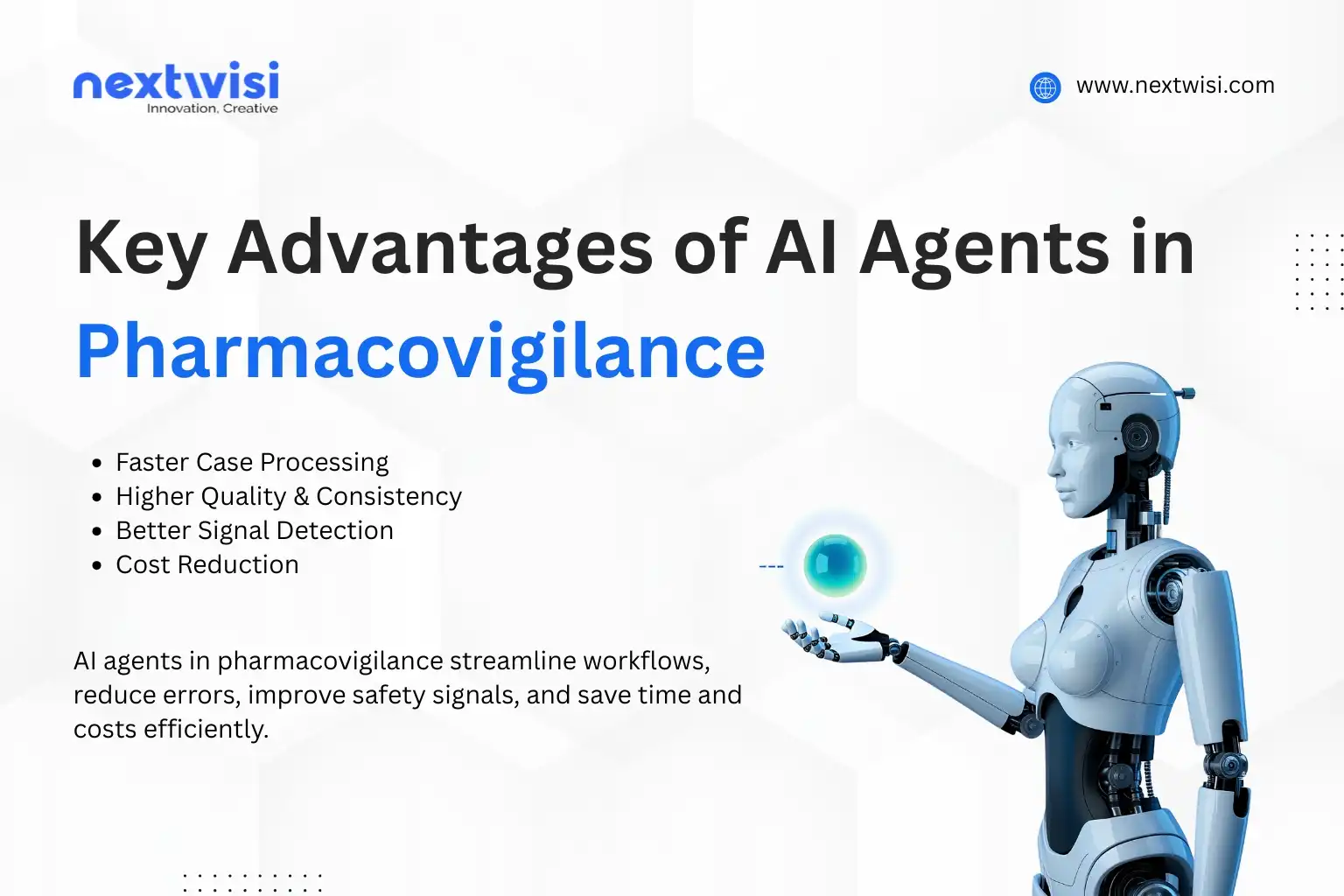
    1. Faster Case Processing

    AI agents simplify the intake and automate the extraction and help safety teams to meet the stringent global deadlines with higher operational efficiency and uniformity.

    2. Higher Quality & Consistency

    Normalization of narrative drafting, proper MedDRA coding, early duplicate identification can reduce QC failures considerably, and will guarantee quality data is consistently available down the road in the workflow, and more generally, the outcomes of regulatory submissions improve.

    3. Better Signal Sensitivity

    The AI agents can extend the surveillance capacity without more labor, enhance literature and database coverage, better trend recognition, and early detection of new drug safety signals.

    4. Cost Reduction

    Repetitive pharmacovigilance activities are also automated, leading to a 25-45% cost per case reduction which can be repurposed by companies to meaningful safety efforts and operational enhancements.

    5. Regulatory Compliance

    Full audit trails, automated policy checks and controlled system updating enhance compliance, limit CAPAs and decrease chances of regulatory inspection results or document discrepancies.

    6. Enhanced Employee Experience

    AI has the potential to improve the job satisfaction and productivity of safety scientists because it alleviates the necessity of manual data entry and allows the safety scientist to be involved in causality assessment, signal evaluations, and strategic safety decision-making.

    Real-World Use Cases of AI Agents in Pharmacovigilance

    Pharmacovigilance is the area of AI agent adoption in organizations across the globe in the whole safety workflow. Examples of high-impact use cases are:

    1. ICSR Intake Automation

    AI agents authenticate MRRC, get all essential data, evaluate seriousness, find gaps, and create draft cases with confidence rates, which will result in a faster and accurate intake and less work on the case manually.

    2. WHO Drug Coding Assistant & MedDRA.

    Agents propose appropriate MedDRA PTs, justify coding choices, handle the diversity of dictionary versions and auto-map WHO-DD drug names, enhancing the accuracy of coding, adherence and reducing repetitive manual terminology operations.

    3. Literature Surveillance

    Agents search PubMed, Embase, Google Scholar and in-house libraries, and sift pertinent abstracts, determine likely ICSRs, harvest safety information, and save much time in literature screening.

    4. Duplicate Detection

    With the help of probabilistic algorithms, rules and text similarity checks, AI agents find the duplicate cases at the early stages of work, avoiding the unwarranted processing, enhancing the quality of the dataset, and preserving the correct safety statistics.

    5. Follow-Up Automation

    Agents will create follow-up questionnaires, detect missing information, send reminders, and cross-channel communications, which will help guarantee reporter engagement and increase the overall follow-up rates.

    6. Signal Detection Prep

    Agents query FAERS, EudraVigilance and internal databases, assemble measures, identify trends and prepare concise signal summary, so the safety teams can be quickly ready to discuss signal review.

    7. Aggregate Reporting Support.

    Agents compile PSUR/PBRER tables, reconcile narratives, verify consistency, manage timelines, and document, simplifying the complex aggregate reporting processes and saving a lot of man power.

    Why AI Agents in Pharmacovigilance Outperform Traditional Automation

    The conventional RPA bots are restricted because they use pre-defined templates and strict policies. Conversely, AI pharmacovigilance agents:

    • Interpret non-structured stories.
    • Adapt to new formats
    • Put policies into context.
    • Escalate intelligently
    • Dynamically use several tools.
    • Feedback to learn continuously.

    This renders AI agents more robust, scalable and reliable in complex safety processes.

    Conclusion

    The emergence of AI agents in the pharmacovigilance is transforming the future of drug safety. These domain-sophisticated systems do everything, including ICSR intake to signal preparation, literature screening, coding and reporting- with no regulatory compliance or audit-ready operations. With the improvement of these agents in accordance with the needs of life sciences organizations, safety teams have more time to engage in scientific thought and decision-making, which are patient-centered.

    Businesses that start using AI agents in pharmacovigilance today will be at the forefront of the decade of effective, precise, and global scale pharmacovigilance procedures.

  • Conversational AI in Healthcare: Future of Smart Patient Care

    Conversational AI in Healthcare: Future of Smart Patient Care

    The healthcare industry is changing at a greater pace than ever as it requires a sense of real-time access, improved interaction with patients, and the ability to change operationally. As the pressure on hospitals, clinics, and digital health platforms increases, companies are turning to intelligent technologies that may aid in automating the communication process, as well as in making the experience of patients personal. Conversational AI in healthcare is one of the strongest innovations that drive this change.

    In its simplest form, conversational AI in healthcare involves the application of smart chatbots and voice-activated virtual assistants to replicate the natural human dialogue. Such AI-based tools can respond to the questions of patients, handle appointments, and offer health advice and support clinical processes. Conversational AI is currently becoming significant in transforming the modern healthcare provision as demands for fast and convenient medical interactions continue to grow.

    Why Conversational AI is Reshaping Modern Healthcare

    Conventional healthcare procedures have a high reliance on manual processes, paperwork, and queues. This usually causes frustrations to the patients, administrative overloads, and misuse of resources. These issues can be solved with the emergence of conversational AI in healthcare, as it provides patients and healthcare systems with more personalized communication that is faster and smarter.

    Healthcare professionals no longer have to provide 24/7 support to the extent of overloading human resources. Automated systems can provide patients with answers in real time and allow them to make appointments, get medication prescriptions, and get health education. The change is assisting the organizations in creating patient-centered models of care and enhancing the operations.

    Top 10 Powerful Use Cases of Conversational AI in Healthcare

    1. Intelligent Appointment Scheduling and Reminders

    Automated appointment management is one of the most viable applications of conversational AI in the healthcare industry. Smart chatbots enable patients to make appointments, reschedule appointments, and cancel appointments without calling reception desks.

    Messages or voice assistants can also provide patients with proactive reminders and make the rate of no-show significantly lower. This provides a better scheduling flow and enhances the general trust of the patients to the healthcare systems.

    2. AI-Driven Symptom Assessment and Smart Triage

    Development of AI and ML is a keyword that was employed to carry out this search.

    The initial point of care is being changed by AI-driven symptom checkers. Patients are able to speak to the system about their symptoms, and the system poses pertinent follow-up questions to determine urgency.

    In the background of this process is AI/ML development, in which the patterns of symptoms are analyzed by machine learning models and the situation is classified into risk levels. This assists in directing the patients to emergency care or primary consultation or even to self-care areas, avoiding unnecessary visits to hospitals.

    3. Medication Adherence and Treatment Support

    Among the largest reasons for poor treatment outcomes are missed medications. Using Conversational AI in Healthcare, smart chatbots will notify them about their medicine consumption.

    These systems are able to modify reminders, depending on the behavior of patients and health data. They also inform the patients when they need to refill the prescriptions so that they are not left without treatment. In the long run, this enhances compliance and recovery rates.

    4. Real-Time Lab Results and Secure Health Updates

    Waiting for lab results can be stressful for patients. Conversational AI systems now provide real-time updates as soon as test results are available. This reduces anxiety and improves transparency.

    With AI agent development, advanced AI agents are designed to securely handle patient data, authenticate users, and deliver sensitive medical information safely. These intelligent agents maintain privacy while offering quick and clear communication.

    5. 24/7 Virtual Health Assistants

    Virtual health assistants powered by conversational AI in healthcare provide support round the clock. Patients can ask questions about symptoms, treatment plans, or medical procedures at any time.

    At the same time, strong cybersecurity solutions are integrated into these systems to protect personal health information. Secure architectures ensure that patient conversations, medical histories, and prescriptions remain confidential and protected from unauthorized access.

    6. Automated Patient Feedback and Experience Analysis

    Feedback provided by patients is critical in enhancing the quality of healthcare. Conversational AI systems automate the review and satisfaction rating procedures by utilizing chat surveys.

    Healthcare organizations are able to store, process, and analyze high amounts of patient feedback in real time using scalable cloud services. This enables health care teams to understand the gaps in the services, enhance care delivery, and improve the experience of the patients.

    7. Mental Health Support and Emotional Monitoring

    Mental healthcare is characterized by the unavailability and social stigma. Conversation AI in healthcare industry is a secure and confidential area where people can share their feelings and get help.

    An AI chatbot can help users learn breathing exercises and stress-coping methods as well as monitor their mood. With time, the system will learn and recognize the emotional trends and recommend professional assistance as necessary. This enhances the access of mental wellness, particularly in remote or underserved communities.

    8. Insurance Claims and Billing Assistance

    Medical billing may be daunting and difficult for most patients. Conversational AI systems assist patients in knowing the insurance benefits, deductibles, and claims procedures.

    AI chatbots guide users through the claim filing process step by step, respond to billing questions in real time, and minimize reliance on call centers. The application of this will enhance financial transparency and administrative overheads for the healthcare providers.

    9. Chronic Disease Management Through Smart Check-Ins

    There are chronic diseases like diabetes, asthma, and hypertension, which need continuous monitoring. Conversational AI in healthcare assists patients in controlling such conditions by way of daily or weekly check-ins.

    AI systems involve questions concerning the symptoms, medication use, nutrition, and exercise. The system gives customized lifestyle suggestions based on the feedback. Such continuous involvement increases patient responsibility and enhances disease management in the long run.

    10. Preventive Care and Health Education

    It is cheaper than emergency treatment to preventive care. Chatbots remind about vaccinations and screenings, as well as checkups, as timely as possible.

    They are also able to deliver tailored information in terms of age, medical history, and lifestyle. Patients are more informed and active concerning their health, decreasing future health hazards and hospitalization.

    Business Benefits of Conversational AI in Healthcare

    Not only is the use of conversational AI in healthcare enhancing patient care, but it is also providing healthcare organizations with high business value.

    Hospitals and clinics have:

    • Lower operational costs
    • Less reliance on massive support staff.
    • Faster response times
    • Increased rates of patient satisfaction.
    • Improved care consistency

    Through the help of automation, repetitive processes in healthcare can be given less attention as the staff is able to concentrate on serious cases of patients and other complicated medical conditions.

    The Future of Conversational AI in Healthcare

    The future of Conversational AI in Healthcare is very bright. With more sophisticated AI models, such systems will provide additional personalized medical advice, predictive health, and real-time behavioral change.

    Conversational AI will be used in the future to integrate with wearable devices, electronic health records, and tools of remote monitoring. This will establish an interdependent healthcare ecosystem where the support to the patients will be proactive rather than reactive.

    The healthcare facilities that will be at the forefront in investing in conversational AI technologies will have a massive competitive edge due to the ability to provide quicker, smarter, and more human-like online healthcare services.

    FAQs

    Q.1 What is conversational AI in healthcare?

    People use it to schedule appointments, check symptoms, educate patients, remind them of medications, and provide real-time assistance with the help of intelligent chatbots and virtual assistants.

    Q.2 Which are typical applications of conversational AI in healthcare?

    The most common applications are patient triage, management of chronic diseases, billing support, mental health support and preventive care reminders.

    Q.3 What is the greatest advantage of conversational AI in the medical field?

    The greatest advantage is the enhanced patient accessibility and interaction and the decrease in the operational workload and healthcare expenses.

    Q.4 Can AI chatbots be safe in healthcare?

    Yes, AI chatbots provide privacy of patients, ensure safe data management, and adequate communication systems as long as they are constructed with effective security frameworks.

  • Deep Agents: The Future of AI in Research and Automation

    Deep Agents: The Future of AI in Research and Automation

    Artificial intelligence (AI) is a rapidly developing area, and among the most current innovations in recent years, the development of deep agents can be listed. Deep agents, compared to shallow AI agents, can plan, store context, and perform complex and multi-step tasks over longer periods, unlike shallow AI agents, which only work in a single loop and use a tool to respond to input. They are a combination of structured planning, subagents, detailed system prompts, and a persistently maintained file system that helps to maintain memory, organization, and coherence. It is a combination that allows them to deal with long-horizon tasks like research, coding, analytics, and enterprise workflow automation with considerably greater efficiency and precision than traditional LLM loops.

    Advantages of Deep Agents

    The biggest benefit of deep agents is that they can be able to think long term and handle complex workflows without losing important context or accuracy. These agents do what shallow systems tend to fail to accomplish, which is to break big goals into small steps.

    Key Points:

    • Deep agents apply systematic planning tools to keep the workflow clear so that long tasks are always organized and rational during the multi-step processes in the most efficient way.
    • Sub-agents provide deep agents with the ability to delegate and delegate specific tasks, with each module working intensively to provide a part of a larger solution.

    Overcoming Memory Limitations with AI Agent Development Company

    One of the greatest weaknesses of naive AI agents is the absence of memory. They only use the context presented in the discussion, and it becomes impossible to remain consistent when it comes to the multi-hour tasks. Deep agents address this issue by use of a persistent virtual file system. Their note taking, keeping drafts, and shared data storage constitute a memory that can be shared across tasks and subagents. This system serves as a digital office where information may be stored, accessed, and updated, and the agent can repeat the actions previously performed, fix the mistakes, and enhance the accuracy as time passes. Even an AI agent development company will be able to rely on these frameworks to create custom agents for clients in healthcare, finance, logistics, software development, or scientific research. This is necessary in research, coding, and other work processes that take a long time.

    Importance of Detailed System Prompts

    The other characteristic of deep agents is that they use a highly detailed system prompt. In contrast to shallow agents, which use limited information to drive and maintain their operation, deep agents have a detailed blueprint teaching them how to utilize the tools, how to team with sub-agents, design workflows, and organize arguments. These cues usually consist of step-by-step illustrations, behavioral guidelines, and outlined directions for carrying out a given task. This makes the agent more predictable and intelligent even in situations where the agent is required to be creative and multi-step in solving problems or making complex decisions. In the absence of this formal mentoring, an LLM, however sophisticated, will tend to revert to superficial or intermittent behavior.

    Combining Planning, Subagents, and File Systems with AI/ML Development

    Planning, sub agents, and file systems enable deep agents to operate on the high complexity goals of research, coding, and enterprise automation. They are efficient, coherent and dynamically change their strategies. Integrating ai ml development tools further enhances predictive intelligence, workflow automation, and decision-making capabilities.

    Key Points:

    • Persistent file system means that deep file system agents can hold past knowledge and keep context, allowing long process execution without the loss of information.
    • Structured system prompts encourage deep agents to act in a manner that is predictable and enhances the accuracy of tasks in research, during multi-file coding, and in enterprise automation processes.
    • Sub-agents enable a breakdown of complicated goals, which provide deep agents with modular attention, quicker on-task execution, and enhanced quality in multi-step problem-solving.

    Frameworks for Building Deep Agents

    Such frameworks as deepagents have simplified the development of deep agents for developers and organizations. They offer a base such as a system prompt, planning tool, file system, as well as sub-agent support. It is customizable to particular industries or activities in a modular way, which makes it possible to create enterprise solutions that are capable of managing sophisticated research, coding, analytics, or workflow automation. This democratization of deep agents is transforming the approach of long-duration AI workflows and automations by businesses.

    Real-World Applications of Deep AI Agents

    Deep Agents for Research

    Deep agents make research more radical through the combination of planning, collaboration of sub-agents, and persistent memory. They process, summarize, and reconstruct big data sets with high-quality and contextual research products and in a time-saving, highly precise, and persistent manner.

    Deep Agents for Coding

    Deep agents in coding processes are autonomous developers. They design project outlines, test bugs, synchronize multi-file repositories, and ensure consistency across the long duration of development, further enhancing speed and reliability output.

    Transforming Industries with Deep AI Agents

    Deep agents are application of industries to be more effective in running workflows with long-term horizons and multi-steps. They are able to perform tasks in a very precise and steady manner with persistent memory, structured system prompts and cooperating sub-agents. Deep agents enhance productivity, lessen mistakes, and streamline decision-making in various sectors of the enterprise comprising research, coding, enterprise automation, and analytics, changing how businesses use AI intelligence to conduct vital operations.

    Rising Significance of Deep AI Agents in Business

    The significance of deep agents is also increasing because companies need AI that would handle complex workflows in a reliable manner. Their capacity to plan and execute, as well as store knowledge in long-term work, is becoming more critical in research, automation, coding, and analytics. By combining these systems, productivity will be high, there will be less error and scalability of performance, and even more so when other tools of AI/ML development are integrated to reach a greater level of intelligence, prediction, and automation.

    Conclusion

    Deep agents are a significant improvement in AI intelligence, allowing high-complexity tasks to be done over a very long period and with clarity and consistency. They are masters in research, coding, and automation of an enterprise through the use of planning tools, detailed system prompts, unrelenting file systems, and subagents. An Ai agent development company provides open-source frameworks such as DeepAgents and services, which are easier to adopt. It is the time of long-horizon AI, and deep agents are reinventing autonomous functionality.