The current software development environment is such that change is not an isolated phenomenon but is always present. The expectations of customers change quickly, the technologies appear on a regular basis, and the market situation may change without prior notice. Traditional software development models are not always successful in such a dynamic environment at presenting solutions that are relevant in the long run. It is this challenge that has made many organizations embrace adaptive software development as a much more real and forward-looking practice.
ASD is a development approach that values flexibility, learning, and collaboration more than any kind of planning and fixed requirements. Rather than thinking that everything about the project can be determined initially, ASD embraces the uncertainty and leverages it as a force of constant improvement. This is particularly successful in sophisticated and innovation-based software projects.
This post discusses what is Adaptive Software Development, its relevance, the functionality of this approach, and how a business can capitalize on it by adopting this method.
What is Adaptive Software Development?
Adaptive Software Development is an agile-based software development approach that is made to manage the uncertainty, complexity, and frequent change. It is aware that software projects seldom follow a linear course and that the specifications tend to change as the project is developed.
Instead of putting teams in rigid plans, Adaptive Software Development enables solutions to develop and change with a short development cycle. The new insights gained after each cycle allow improving the product and the process. This process of learning allows the ultimate software to be in line with actual user requirements and business objectives.
In its essence, ASD revolves around three major concepts, which are continuous learning, open collaboration, and quick adaptation. These are factors that can make the teams react positively to a change of circumstances without setbacks.
Why Adaptive Software Development is Essential in Modern Projects
Software projects of modern times have their problems, which were not present ten years ago. Businesses have to have faster responses, compete in the globe, and have the highest user demands. These models of traditional development usually do not work due to the assumptions of stability and predictability, which are not very common in the modern environment.
The concept of adaptive software development enables organizations to keep up with competition, as it enables an organization to change scope, design, and priorities as new information arises. This scalability minimizes the risk of creating obsolete and outdated software. ASD does not resist change but views change as important feedback that enhances the results.
Through uncertainty, Adaptive Software Development turns unpredictability into a source of strategic advantage and not a constraint.
Core Philosophy of Adaptive Software Development
Adaptive Software Development has its philosophy based on the notion that learning is more precious than strict control. Rather than focusing on trying to remove uncertainties, ASD encourages teams to experiment and learn through real-world feedback.
Teamwork is very essential in this philosophy. A close relationship between developers, stakeholders, and clients is implemented to ensure they understand each other and are in agreement. The iterative development guarantees that working software is made available on a timely basis so that early validation and further constant improvement can be made.
Risk is also addressed differently in ASD. Instead of delaying risk assessment, the teams detect and implement solutions to possible problems at an earlier stage, which lowers the chances of major failures later in the project.
Adaptive Software Development Life Cycle
The Adaptive Software Development lifecycle is designed out of three linked stages, namely, speculation, collaboration, and learning. These are not a sequence of steps but an activity that is repeated in the project as long as the project persists.
Speculation Phase
The speculation phase substitutes conventional long-term planning with the flexible setting of goals. Teams embracing the idea that predictions are not always perfect concentrate on the interpretation of high-level objectives, constraints, and potential risks.
At this stage, teams test various possibilities and get ready to change instead of binding themselves to the set requirements. This will enable faster responses to situations in which assumptions have been wrong or when new opportunities come about.
Collaboration Phase
Active development occurs in the collaboration stage. The cross-functional teams would convene to design, construct, and test software in close contact with the stakeholders.
Teams do not respond to strict directions but keep changing as the requirements, technology, and expectations of the users keep evolving. Constant cooperation makes it stay in line with the business objectives and makes the development process quicker and easier to solve the problems.
Learning Phase
Adaptive software development is based on the learning stage. Teams retrospect, examine their positive and negative outcomes, and learn lessons to be used in subsequent cycles.
The brief design, construction, and test periods enable the teams to get to learn about minor failures and not massive ones. This process of continuous learning helps to enhance software quality, reinforces the performance of the team, and increases long-term flexibility.
Advantages of Adaptive Software Development
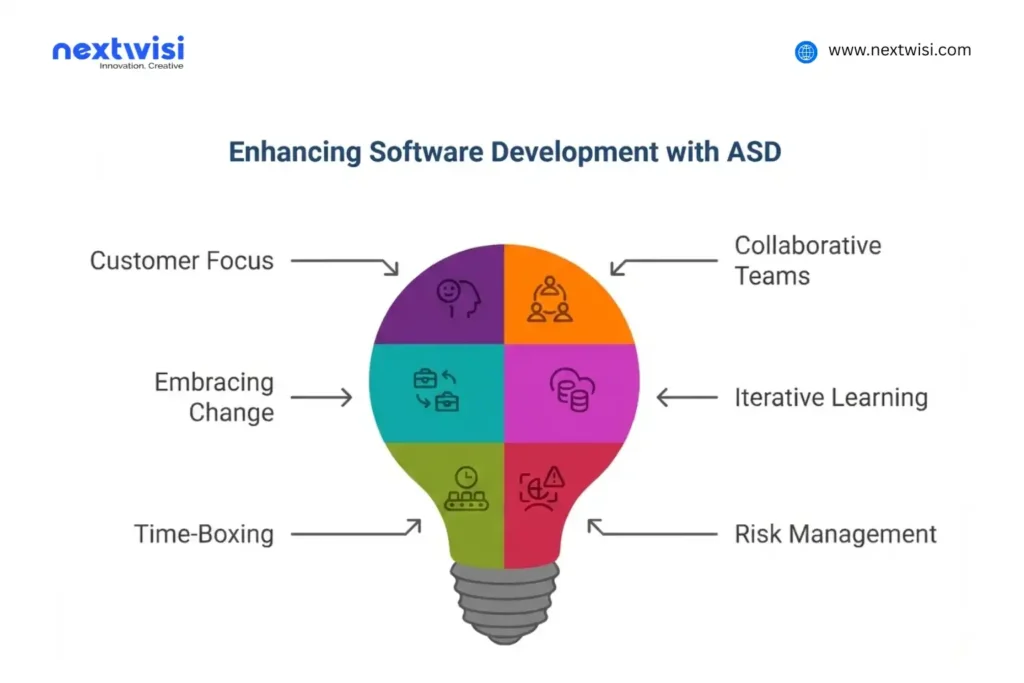
Adaptive software development is a method that has a number of benefits that render it a good fit in contemporary software projects.
- It is very flexible, and the teams can change focus without much disturbance and wastage of time.
- It allows quicker response to changes in the market, customer response, and shifting business needs.
In addition to these essential advantages, ASD will also enhance teamwork because it promotes transparency and collective responsibility among the team members. High-value features are prioritized in teams; hence, there is increased resource use, and inefficiencies are minimized.
The level of client satisfaction is enhanced since the stakeholders are not left out during the project. Frequent reviews will make sure that the final product is very similar to what is expected. Also, early testing and proactive risk management can minimize late-stage failures that are expensive in cost.
How Adaptive Software Development Enhances Quality and Efficiency
Adaptive software development is compatible with the current engineering methods like automated testing and continuous integration. The automation holds that frequent changes do not affect the stability and performance.
Constant validation and feedback enable the teams to deliver updates rapidly without failing quality. Such a compromise of speed and reliability is what makes ASD an effective method of scalable and long-term software solutions.
Through constant improvement of the process and the product, Adaptive Software Development assists a team in attaining greater productivity without compromising quality.
When Should Organizations Use Adaptive Software Development?
Adaptive software development works well, especially when the project requirements are uncertain or variable. It also fits well when the product is innovative, the application is customer-focused, and the industry is dynamic.
With ASD, organizations that embrace learning, flexibility, and collaboration usually perform better as compared to traditional development models. Adaptive software development is the method of choice when predictability is not that important and flexibility is.
Business Impact of Adaptive Software Development
In business terms, Adaptive Software Development promotes long-term expansion, as it allows achieving quicker innovation and a more appropriate response to customer demands. It minimizes the chances of making investments in features that are no longer value-adding and assists organizations in reacting proactively to competitive pressures.
ASD also enhances morale within a team and decision-making by being able to foster a culture of learning and collaboration. The results of this cultural change are usually better software and more environmentally friendly development activities.
Final Conclusion
Adaptive software development is not merely a modern approach; it is a way of thinking that is created according to the instability of the digital world of the present day. Flexibility, constant learning, and collaboration are the core principles of ASD, which helps organizations to develop software that changes as the business context and customer expectations shift.
Firms using adaptive software development also have a competitive advantage in providing scalable, high-quality, and future-ready software solutions. Nevertheless, the real success of ASD is pegged on collaborating with an efficient technology partner who comprehends both corporate objectives and innovative engineering culture.
Nextwisi Solutions is unique at this point. Being a reliable provider of software development services, they assist companies in creating, developing, and expanding dynamic software solutions aligned with the dynamic demands of the market. Nextwisi Solutions with its innovative, collaborative, and agile delivery approach, would enable organizations to transform change into opportunity and attain digital success in the long term.