Category: Mobile App Development

Read insightful blogs on mobile app trends, development, design, and strategies driving innovation across Android and iOS platforms.

  • Top 10 Mobile App Development Companies in Atlanta (2026 Guide)

    Top 10 Mobile App Development Companies in Atlanta (2026 Guide)

    Atlanta has fast transformed into one of the fastest-developing technology centers in the US. The city is also the home to innovative startups, Fortune 500 businesses, and a thriving digital ecosystem. The need to have high-quality mobile applications is growing by the day as businesses continue to adopt the digital transformation.

    Organizations of all types, including fintech startups and logistics firms as well as eCommerce brands, are putting money into mobile applications to enhance customer interactions and facilitate operations. This has prompted the appearance of numerous competent mobile application development companies in Atlanta that offer innovative and scalable digital solutions.

    You need to select the right development partner in case you are going to develop a mobile application in your business. You need to make the best decision so we have included a list of the best mobile app development companies in Atlanta based on the technical experience, innovative nature, and track record.

    Why Atlanta is a Growing Hub for Mobile App Development

    Atlanta has experienced tremendous growth in its technology in the past decade. The city has a good ecosystem to promote innovation, entrepreneurship, and the creation of digital products.

    There are some forces that have been accumulated that have made Atlanta increasingly popular as a technology hub:

    Strong Tech Ecosystem

    Atlanta has many technology firms, startups, and digital firms that are involved in software engineering, mobile application development, and cloud computing solutions.

    Availability of talented Developers

    The city has brilliant software engineers, UI/UX designers, and mobile app developers who bring experience in new technology such as Flutter, React Native, Swift and Kotlin.

    Rapid Startup Growth

    The startup ecosystem in Atlanta is rapidly expanding, with investors and other entrepreneurs expressing interest in creating new innovative digital products.

    Mobile Technology Adoption at the Enterprise

    Big companies and middle-sized organizations are investing big in mobile applications in an attempt to promote their productivity, customer experience, and business growth.

    Due to such reasons, companies are currently seeking credible mobile app developing firms in Atlanta to transform their ideas into formidable mobile applications.

    The Ultimate Guide to Finding the Best Mobile App Development Company in Atlanta

    The choice of development partner may have a huge influence on the success of your mobile application. Before contracting an agency to develop a mobile application, there are various considerations that a business must make.

    Portfolio and Industry Experience

    There should be a review of the past projects of the company to know their experience in making mobile apps in various industries.

    Technical Expertise

    assure the development team of knowledge of the current technologies, including:

    • The development of iOS and Android apps.
    • Development of Flutter and React Native.
    • Cloud integration
    • Machine learning solutions and AI.

    Client Reviews and Reputation

    The testimonials and reviews by the clients aid in assessing the trustworthiness and reliability of a mobile app development firm.

    Development Process

    A clear and responsive development process assures the increased communication, speedier delivery, and enhanced quality of the product.

    Post-Launch Support

    There is a need for constant updating and maintenance of mobile applications. A well-rounded development company will offer long-term technical support.

    The 10 Mobile App Development Companies in Atlanta

    Atlanta is the location where there are numerous trusted mobile app development companies that provide the quality of digital solutions. A list of the leading mobile application development companies in Atlanta that assist businesses in converting ideas into opportunities that can be scaled has been carefully curated as listed below .

    1. Nextwisi Solutions

    Nextwisi Solutions is among the top mobile application development firms that are famous for the provision of innovative and scalable business solutions digitally across the globe. The firm focuses on developing high-performance mobile applications to enable startups, businesses, and emerging brands to speed up their digitalization.

    Nextwisi Solutions has a solid team of skilled developers, designers, and technology advisors to offer end-to-end services to mobile application developers in accordance with current business needs and demands.

    The agile development approach the company uses allows it to develop an efficient project management approach and deliver faster and high-quality mobile products.

    Key Services

    • Personal mobile application.
    • iOS and Android apps development.
    • Cross-platform application development.
    • User interface and experience design and product strategy.
    • Enterprise e-development.
    • Maintenance and support of mobile app.

    Reasons to Select Nextwisi Solutions

    The main reason why businesses turn to Nextwisi Solutions is their high technical capabilities, open communication, and willingness to provide scalable mobile applications. Their team is concentrated on developing new digital products that enhance the user experience and business development.

    2. Zazz

    The company under consideration is Zazz, a popular mobile application development firm in Atlanta that offers business solutions through innovative applications to businesses in different fields. The company undertakes custom mobile app development, product design, and enterprise software development.

    Their group is directed towards producing user-friendly mobile applications that are consistent with the current trends of digitalization and customer satisfaction.

    3. AppStudio

    AppStudio, a technology consulting and mobile app development company, is a company that provides comprehensive digital solutions. The company assists companies to design, develop, and introduce mobile applications to enhance operational effectiveness and customer interaction.

    Their services involve mobile application development, web application development, enterprise solution development, and digital transformation consulting.

    4. ChopDawg

    ChopDawg is an established mobile application development company that has earned a reputation regarding the quality of mobile applications and digital products. They are experts in the development of scalable programs for startups, enterprises, and expanding businesses.

    They specialize in mobile application design, product strategy, and software development through the use of modern technologies.

    5. WeGotCode

    WeGotCode is an Atlanta-based software development firm, which has specialized in the development of custom applications and solutions related to digital transformation. Their development team collaborates hand in hand with businesses in building mobile apps, which facilitate better operational efficiency and customer experience.

    They offer services like mobile application development, integration of software, and enterprise technology consulting.

    6. Blue Fletch

    Blue Fletch is a business enterprise mobility firm that deals with mobile application development for major organizations. Their team develops secure, scalable, and high-performance mobile solutions for businesses that are in complex enterprise environments.

    They specialize in Android development, mobile strategy consulting, and enterprise mobility management.

    7. Rightpoint

    Rightpoint is a digital consultancy firm that provides services of mobile application development and solutions of customer experience. They assist companies to develop strong mobile applications that build digital interactions and optimize operation processes.

    Their group brings together design thinking, technology know-how, and strategic consultancy in order to provide new digital products.

    8. Intuitio Labs

    Intuitio Labs is a software engineering company specializing in the provision of innovative and effective digital services. They have a team of designers and developers who work together in coming up with high-quality mobile applications that will address business objectives.

    The company focuses on the design of mobile apps, web development, and enterprise software development.

    9. Xebia

    Xebia is a technology consulting company based in the world with experiences in software engineering, cloud computing and development of mobile applications. The company assists startups and businesses to develop scalable digital products, through modern development structures and technologies.

    Their team is dedicated to provision of high-performance and reliable applications that facilitate business innovation.

    10. Buckhead Apps

    Buckhead Apps is an application development company that develops the mobile apps that are easy to use and navigate. Their business partners are startups, businesses and non profit organizations, with whom they develop mobile solutions that enhance the experience of users and improve business growth.

    Their development team aims at providing new mobile experiences with superior design and technology.

    Mobile App Development Cost in Atlanta

    Mobile app development in Atlanta is affected by the cost in terms of complexity, features and the technology applied in the project.

    The approximate cost estimate is as follows:

    • Basic Mobile App: $15,000 – $30,000
    • Medium Complexity App: $30,000 – $80,000
    • Enterprise Mobile Application: 80, 000 to 150, 000 or above

    The ultimate cost of the development depends on a few factors, such as application features, complexity of the UI/UX design, the backend infrastructure, and integrations with third parties.

    The companies with the experience in mobile app development should be approached to get the cost estimates correctly based on their project needs.

    Atlanta Trends of Mobile App Development

    The mobile app industry is dynamic and developing as the new technologies and changing user demands emerge. The modern development trends are on the increase in Atlanta businesses in order to remain competitive.

    The mobile app development trends are some of:

    Automated Artificial Intelligence

    Mobile application powered by AI offers smart automation, recommendations, and better user experience.

    Cross-Platform Application Development

    Flutter and React Native are some of the technologies that can be used by developers to create a mobile application that can operate efficiently across different platforms.

    Cloud-Based Applications

    Cloud integration enhances scalability, data storage and performance of applications.

    Internet of Things (IoT)

    Smart mobile applications triggered by IoT connect smart devices and deliver real-time data to them.

    Blockchain Applications

    Secure transactions, digital identity management, and financial applications are becoming popular and finding their use in blockchain technology.

    The reasons why businesses invest on mobile applications.

    Mobile apps have turned out to be an indispensable component of the current business strategies. Mobile apps are technologies that companies use to gain a stronger digital presence and customer experience.

    Key benefits include:

    • Better interaction with customers.
    • Increased brand visibility
    • Increased revenue possibilities.
    • Business process automation.
    • Live analytics and data intelligence.

    As the mobile technology keeps increasing, companies investing in quality mobile application easily have a huge competitive edge.

    Reason to hire Nextwisi Solutions to develop a mobile app

    Nextwisi Solutions is a reputable technology partner of companies that can require innovative mobile app development services. The company concentrates on providing tailored digital solutions, which resonate with business goals and expectations by the users.

    Their group of professionals includes technical skills, strategic analysis and innovative design to create m-application that is scalable and fosters success in the long term.

    Nextwisi makes the development experience smooth, starting with conceptualizing the idea through to the final launch through to after-sales services, helping companies to realize their ideas into a strong digital product.

    Conclusion

    Atlanta is still developing into a large technological center whereby there are many companies that provide quality mobile app development services. Identifying an appropriate development partner is important to the success of developing a powerful mobile application that addresses the business objectives and provides an outstanding user experiences.

    The mobile apps of the companies mentioned above have gained a good reputation of providing quality and innovative mobile apps. Nextwisi Solutions is among them and is the most experienced in developing scalable, user-friendly, and future-oriented mobile applications.

    Through collaboration with the appropriate mobile application development firm, companies have access to additional growth and competitiveness in the current digital environment.

    Frequently Asked Questions

    1. Which is the most favorable mobile application development firm in Atlanta?

    There are numerous mobile app development firms within the market, but the reputable firms such as Nextwisi Solutions have been associated with providing scalable and innovative mobile applications.

    2. What is the cost of building a mobile application in Atlanta?

    The development of mobile apps will cost an average of $15,000 to 150,000 based on features, complexity and development technology.

    3. What is the time frame of creating a mobile application?

    The average duration of most mobile apps to develop is 3 to 6 months depending on the project scope, design requirements and the testing process.

    4. What technologies are applied to the development of mobile apps?

    Popular technologies are Swift, Kotlin, Flutter, React Native, Node.js and cloud backend frameworks.
  • Top Tips to Choose the Best Mobile App Development Company

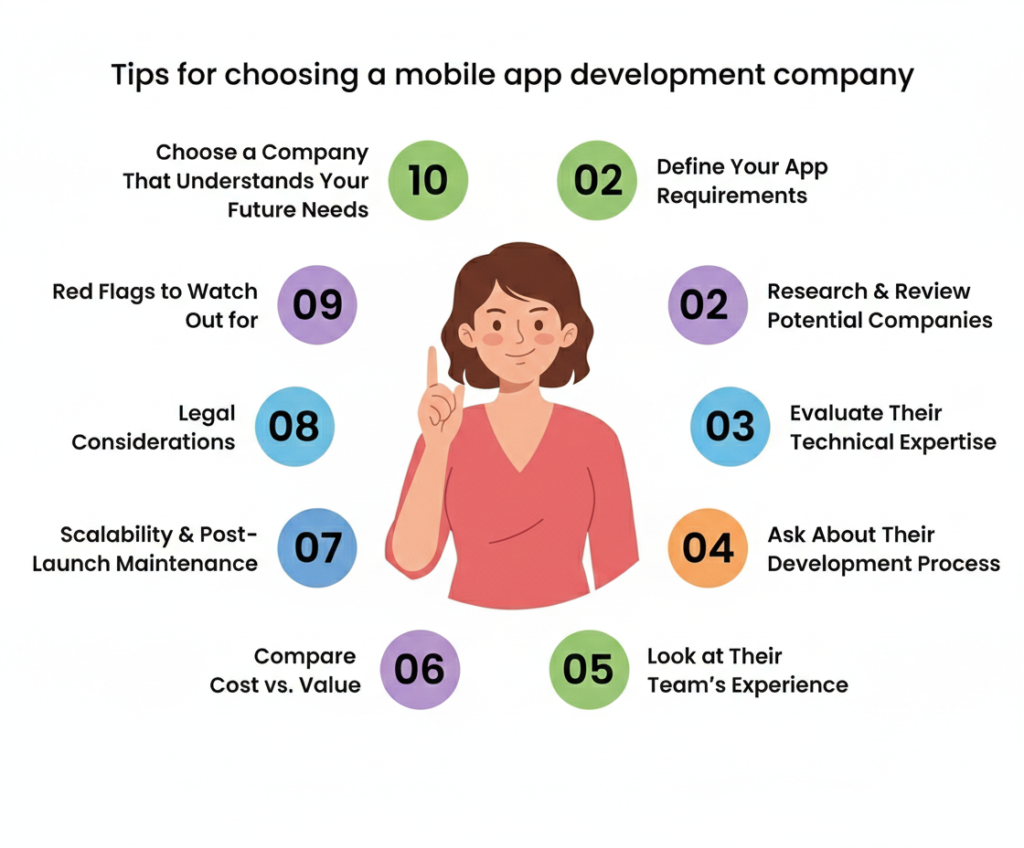
    Top Tips to Choose the Best Mobile App Development Company

    In today’s digital landscape, mobile app development has become essential for business growth. With millions of smartphones in use globally, every organization needs a robust mobile presence. Whether you’re planning iOS development, Android development, or cross-platform solutions, selecting the right mobile app development company is crucial for success.

    The mobile app market is experiencing unprecedented growth. According to industry analysts, the global market for mobile application development is projected to reach unprecedented heights in the coming years. This expansion creates opportunities for businesses to reach customers through mobile platforms, but choosing the right partner requires careful consideration and strategic evaluation.

    Market Growth and Technology Evolution

    The app development services industry encompasses various specializations, from native development to progressive web app development. Companies can choose between different approaches, including React Native app development, Flutter development, and traditional native approaches. Each technology offers distinct advantages for different business requirements.

    The competitive landscape of software development continues to evolve with emerging technologies. Many businesses now explore hybrid approaches, combining native app development with web app development to maximize reach and minimize development time. This hybrid strategy allows organizations to deploy applications across multiple platforms efficiently while maintaining quality and performance standards.

    Strategic Advantages of Professional App Development Companies

    Partnering with experienced app development professionals offers multiple advantages that extend beyond simple coding.

    Advanced Technology Expertise

    Leading development firms specialize in diverse technology stacks. If you need React Native app development, your partner should demonstrate proven expertise. These companies employ engineers skilled in modern frameworks like React Native, Flutter, and other progressive technologies. Whether targeting iOS app development or Android app development, experienced teams bring technical mastery that ensures high-quality deliverables. Companies like Nextwisi Solutions showcase a comprehensive IT solutions portfolio spanning web development, app development, cloud solutions, and blockchain development, demonstrating versatility across modern technology domains.

    Business Focus and Growth

    Outsourcing to a mobile app development company allows your internal team to concentrate on core business operations. Your executive team can focus on strategic growth, market expansion, and customer relationship management while professional developers handle technical implementation. This division of labor accelerates business growth and improves operational efficiency across your organization. Choosing the right partner means accessing specialized expertise in multiple domains simultaneously.

    Industry Recognition and Specialization

    Top-tier mobile app development companies earn recognition through consistent delivery of excellence and innovation. Look for partners with industry certifications, awards, and client testimonials that validate their expertise. The best firms maintain specializations across multiple technology domains from web app development to progressive web apps to native solutions. This specialization ensures they understand nuanced requirements for each platform and can recommend optimal solutions tailored to your business needs. Recognition from industry bodies and satisfied clients is a strong indicator of reliability and quality standards.

    Key Evaluation Criteria for Selection

    Selecting the right mobile app development partner requires systematic evaluation across several critical dimensions. Here’s what you should assess:

    Portfolio and Experience

    Review completed projects carefully. Look for examples demonstrating iOS development and Android app development expertise. Examine applications they’ve built for companies in your industry. Request case studies showing how they’ve solved specific technical challenges. Ask whether they have experience with native app development, cross-platform development, or specialized technologies like React Native app development. A strong portfolio demonstrates versatility and proven execution capability across diverse project types and industries.

    Technical Capabilities and Service Breadth

    Assess the company’s technical depth across relevant platforms.

    • Do they understand progressive web app development?
    • Can they manage custom app development projects?
    • Do they have specialists in enterprise app development?

    The best companies maintain teams skilled in multiple disciplines, from mobile app development to web app development, and often extend into cloud solutions and other emerging technologies. They stay current with emerging frameworks and industry best practices, ensuring your solution remains competitive and future-proof.

    Communication and Collaboration

    Effective partnerships depend on clear communication. The ideal app development services provider maintains transparent processes, regular updates, and responsive support. They should explain technical concepts in business terms, involve you in decision-making, and respect project timelines. Look for companies that demonstrate genuine interest in your success, not just in completing contracts. Strong communication combined with comprehensive service offerings ensures successful project delivery.

    Platform-Specific Development Approaches

    Different projects require different technological approaches. Native app development provides optimal performance for iOS app development and Android development but requires separate codebases. Cross-platform solutions like React Native app development reduce development costs and timelines by using a single codebase across platforms.

    Software development companies increasingly recommend hybrid strategies combining native and cross-platform approaches. For web app development, progressive web apps offer an alternative to traditional mobile applications, providing app-like experiences through browsers. Custom app development might incorporate web app development elements alongside native components, optimizing for your specific business requirements and user expectations. Beyond traditional app development, consider partners offering blockchain development services, as blockchain technology increasingly supports secure transactions and decentralized applications.

    Understanding Investment and Timeline

    App development services pricing varies significantly based on complexity, features, and technology choices. React Native app development typically costs less than building separate native applications for iOS and Android separately. Web app development costs differ from mobile app development, offering alternative solutions for different business models.

    Request detailed cost breakdowns covering design, development, testing, and post-launch support. Reputable app development companies provide transparent pricing with clear milestones and deliverables. Partners like Nextwisi Solutions offer comprehensive service packages combining web development, app development, cloud solutions, and blockchain development, providing flexible pricing models that scale with your requirements. The cheapest option rarely provides the best value prioritize quality and reliability over minimum cost.

    Making Your Final Selection

    After evaluating mobile app development companies against these criteria, you should have a clear picture of the best fit. Consider these final checkpoints:

    • Does the company demonstrate expertise in your required platform (iOS development, Android development, or cross-platform)?
    • Have they successfully delivered similar mobile app development projects?
    • Do they understand your business objectives and industry challenges?
    • Can they deliver timely results without compromising quality?
    • Will they provide ongoing support and maintenance?
    • Do they offer comprehensive IT solutions, including web app development and cloud solutions?
    • Are they equipped to handle emerging technology needs like blockchain development?

    The right mobile app development company becomes a strategic partner invested in your success. Whether you need React Native app development, native solutions, web app development, or hybrid approaches, your partner should combine technical excellence with business acumen and diverse service offerings.

    Conclusion

    Choosing a mobile app development company is one of the most important technology decisions your organization will make. Take time to evaluate options thoroughly, ask detailed questions, and assess both technical capabilities and cultural fit. The right app development services provider will deliver solutions that drive business growth while exceeding quality expectations.

    Whether you’re pursuing iOS development, Android development, React Native app development, or integrated web app development, selecting an experienced, reliable partner ensures your success in today’s competitive digital marketplace. Look for companies that offer comprehensive IT solutions spanning multiple technology domains, positioning you for long-term success and innovation.

    Ready to start your app development project?

    Contact Nextwisi Solutions today to discuss your vision and explore comprehensive IT solutions tailored to your business needs.

  • Hire React Native Developers: Your Complete Guide to Cross-Platform App Success

    Hire React Native Developers: Your Complete Guide to Cross-Platform App Success

    Building mobile applications today presents a critical choice: Develop separately for iOS and Android, doubling your costs and timeline, or embrace a smarter approach. When you hire React Native developers, you unlock the power of cross-platform development-building sophisticated applications for both platforms using a single codebase.

    React Native has revolutionized mobile app development. This JavaScript-based framework enables development teams to create high-quality applications for iOS and Android simultaneously, reducing costs by 30-40% while accelerating time-to-market. Whether you’re a startup validating an idea or an enterprise scaling operations, hiring skilled React Native developers is one of the smartest investments you can make.

    This guide covers everything you need to know about hiring React Native developers-from understanding the framework’s capabilities to evaluating developer skills, exploring pricing models, and best practices for project success.

    What Is React Native and Why Does It Matter?

    React Native is an open-source framework that allows developers to build truly native mobile applications using JavaScript and React principles. Instead of creating separate iOS and Android applications, developers write code once and deploy across both platforms.

    The framework’s power lies in its efficiency. Because React Native uses a single codebase, development costs drop dramatically. Updates, bug fixes, and feature additions happen once instead of twice. Your development team can be smaller-JavaScript developers can work across both platforms without needing specialized iOS and Android experts.

    Key advantages of React Native include:

    • Performance: Leverages graphics processing units for fast, responsive applications
    • Open Source: Full access to documentation and continuous community improvements
    • Flexibility: Applications work seamlessly across multiple platforms
    • Reusable Code: Single codebase shared between iOS and Android (typically 70-90% code sharing)
    • Hot/Live Reloading: Developers see changes instantly, dramatically improving productivity

    Why Choose React Native for Your Mobile Project?

    The business case for React Native is compelling.

    Cost-Effective Development: React Native projects typically cost 30-40% less than native development. You’re building once, not twice, maintaining one codebase, not two.

    Faster Development Cycles: With a rich ecosystem of pre-built components and libraries, development accelerates significantly. What takes months in native development might take weeks in React Native.

    Reduced Maintenance Costs: Ongoing maintenance becomes simpler and cheaper. Security patches, feature additions, and updates happen once, not twice.

    Quick Market Launch: In competitive markets, speed matters. React Native enables you to validate your product, gather feedback, and iterate faster than traditional approaches.

    Ideal for Multiple Use Cases:

    • E-commerce platforms with user authentication, payments, and push notifications
    • Delivery apps requiring real-time tracking and GPS integration
    • MVPs for startup validation with limited budgets
    • Enterprise applications handling complex functionality
    • Financial apps requiring security and reliability
    • Startup solutions operating on lean resources

    React Native is particularly valuable for organizations prioritizing cost-effectiveness, rapid development, and multi-platform support.

    The React Native Development Process: What to Expect

    Understanding the development journey helps you set realistic expectations and manage timelines effectively.

    Stage 1: Requirements Gathering – Your team meets with React Native developers to discuss vision, objectives, and technical requirements. This establishes scope and initial timeline estimates.

    Stage 2: SRS Documentation – Software Requirements Specification creates a detailed blueprint. Everyone-clients, developers, QA teams-understands exactly what the application should accomplish.

    Stage 3: Project Architecture – Technical teams establish the foundation: development environment setup, code organization standards, and configuration of development and production pipelines.

    Stage 4: Design Creation – UI/UX designers and developers collaborate to create responsive, beautiful interfaces that perform smoothly on all devices.

    Stage 5: Development – Developers write code implementing features, integrating APIs, connecting backend services, and building the complete application.

    Stage 6: Testing – Quality assurance involves functional testing, performance optimization, cross-platform compatibility checking, and bug fixing.

    Stage 7: Deployment – Final stage involves preparing for App Store and Play Store submission, setting up monitoring, and managing launch.

    Essential Skills to Look for in React Native Developers

    Not all developers claiming React Native expertise are equally qualified. Look for these essential skills:

    Core Technical Competencies:

    • Strong JavaScript (ES6+) expertise-modern JavaScript is fundamental
    • Deep React and React Native framework knowledge
    • TypeScript proficiency for larger projects
    • State management understanding (Redux, Context API)
    • RESTful APIs integration and backend connectivity
    • Firebase or equivalent service integration
    • Performance optimization techniques
    • Cross-platform debugging abilities
    • Native modules integration when platform-specific features are needed

    Soft Skills Matter:

    • Problem-solving approach and creative thinking
    • Clear communication and regular updates
    • Team collaboration abilities
    • Attention to detail
    • Continuous learning mindset

    Experience Levels:

    • Senior developers (12+ years): $3,000+/month-valuable for complex projects and technical leadership
    • Middle developers (6+ years): $1,700/month-solid experience for independent work
    • Junior developers (3+ years): $1,500/month-cost-effective for straightforward tasks

    Realistic Timelines and Development Factors

    When you hire React Native developers, understanding timeline expectations prevents disappointment.

    Simple applications with basic features typically take 2-3 months. Complex applications with custom native modules, advanced UI/UX, and extensive integrations require 6+ months.

    Factors affecting duration:

    • Project complexity and feature richness
    • Design sophistication and custom animations
    • Number of third-party integrations
    • Testing requirements and security considerations
    • Custom native module development

    React Native accelerates development compared to native alternatives. Projects taking 3 months with separate iOS and Android development might complete in 5-6 months with React Native-a significant advantage.

    Hiring Models: Flexibility for Your Needs

    Different situations demand different engagement approaches:

    Full-Time Model (160 hours/month): Best for long-term projects requiring consistent focus. Includes dedicated developer, project manager, QA, and 24*7 support. Typical cost: $1,500-$3,000/month depending on developer experience.

    Part-Time Model (4+ hours/day): Ideal for supplementing existing teams or specific features. Weekly billing offers flexibility for variable workloads.

    Hourly Model: Perfect for urgent needs, specific tasks, or proof-of-concept work. Maximum flexibility with rates typically $18-$150/hour.

    Project-Based Model: For well-defined projects with clear scope, using milestone-based billing provides budget certainty and clear accountability.

    Why Hire React Native Developers From Nextwisi Solution

    At Nextwisi Solution, we’ve spent 12+ years perfecting React Native development and building lasting client partnerships. Here’s what sets us apart:

    Proven Credentials: We’ve delivered projects across 20+ industries with 75+ React Native experts and a remarkable 98% client retention rate. Our experience spans 30+ countries, supporting businesses of all sizes.

    Rapid Talent Acquisition: With 17K+ pre-vetted candidates, we hire remote React Native developers in just 2-3 weeks. Senior developers can start immediately if timelines demand urgency.

    Transparent Pricing: Developer salaries are clearly separated from administrative fees. You know exactly what you’re paying and why. No hidden costs.

    Full Operational Support: Beyond development, we handle legal compliance, payroll management, HR support, and administrative complexity. You focus on business while we manage the operational details.

    Dedicated Project Management: Your project manager maintains sharp focus on timelines and budgets, ensuring nothing falls through cracks. Communication happens primarily through Slack with responsive support.

    Long-Term Success: Our 90% employee retention rate means developers stay engaged and motivated. Monthly performance evaluations identify issues early, ensuring consistent quality.

    Comprehensive Services: While React Native is our specialty, we also offer mobile app development, blockchain solutions, cloud migration, and enterprise IT services.

    Client-Centric Approach: We deliver complete transparency from planning through deployment. In-house expertise ensures on-time delivery without nasty surprises. We’re flexible, open to changes, and focused on smart business decisions.

    Real Results: What Clients Say

    Our clients consistently highlight our communication, flexibility, and problem-solving abilities. One technical leader noted we delivered exactly what was requested with trustworthy, technically skilled teams. Another mentioned they appreciate our willingness to adapt while respecting budget constraints and delivering on time within budget.

    Clients praise our communication approach-90% happening through Slack with no missed questions or oversights-and our ability to think outside the box and make smart business decisions.

    Best Practices for Successful React Native Projects

    Clear Requirements: Invest time understanding what your application must do. Detailed specifications prevent wasted effort and rework.

    Experienced Teams: Combine React Native developers with QA professionals, project managers, and designers. Diverse expertise prevents problems.

    Regular Communication: Establish communication channels-daily standups, weekly reviews, and transparent progress updates keep everyone aligned.

    Code Quality: Focus on reusable code, performance optimization, and cross-platform testing from day one.

    Comprehensive Testing: Don’t skip testing to save time. Cross-platform compatibility, performance testing, and user acceptance testing catch problems before launch.

    Maintenance Planning: Prepare for post-launch support, including monitoring, bug fixes, and feature updates.

    FAQs About Hiring React Native Developers

    1. Why hire dedicated React Native developers?

    Professional developers bring years of experience, best practices knowledge, and up-to-date expertise with latest trends and technologies. They accelerate development and prevent costly mistakes.

    2. How much does React Native development cost?

    Costs depend on experience level, project complexity, and location. Expect $1,500-$3,000/month for experienced developers or $18-$150/hour. React Native typically costs 30-40% less than native development.

    3. Can React Native handle complex applications?

    Yes. React Native manages complex, large-scale applications effectively. For highly resource-intensive features, developers can implement native modules using Swift or Java for optimization.

    4. What timeline should I expect?

    Simple apps take 1-1.5 months, complex applications require 3+ months. Timeline depends on project scope, design complexity, and integrations required.

    5. What skills matter most?

    Look for JavaScript (ES6+) expertise, React/React Native framework knowledge, TypeScript proficiency, API integration experience, and strong problem-solving abilities.

    The Future of React Native

    React Native continues gaining enterprise adoption as organizations recognize its efficiency advantages. The framework remains at the forefront of cross-platform development, with constant improvements, growing library ecosystem, and expanding community contributions. Career opportunities for React Native developers remain strong with competitive salaries and growth paths.

    Taking Action: Your Next Steps

    The evidence is clear: React Native delivers cost-effective, fast, high-quality mobile applications. The question isn’t whether React Native works-it does, across thousands of projects globally. The question is: who will you partner with?

    Look for partners bringing expertise, transparency, and proven accountability. Look for developers who communicate clearly, deliver on time, and genuinely care about your success. Choose partners focused on outcomes, not just billable hours.

    Your next successful mobile app starts with hiring the right React Native developers. Take action today. Clarify your requirements, reach out to experienced partners, and start building the application your business needs.

    The future of your mobile strategy is just a conversation away.

  • Top 10 Mobile App Development Companies in USA 2026

    Top 10 Mobile App Development Companies in USA 2026

    The mobile app ecosystem continues to evolve rapidly, and businesses are investing heavily in digital products to stay competitive. Choosing the right mobile app development company in the USA can significantly impact the success of your application.

    From custom mobile apps and enterprise software to cross-platform applications and AI-powered mobile solutions, the companies listed below are known for innovation, strong engineering teams, and consistent product delivery.

    Top Mobile App Development Companies in the USA 2026

    1. Nextwisi Solutions

    Nextwisi Solutions is emerging as one of the top mobile app development companies in the USA, recognized for delivering scalable digital products for startups and enterprises. The company specializes in custom mobile app development, cross-platform apps, and enterprise mobile solutions using modern frameworks such as Flutter, React Native, and cloud-native architectures.

    With a strong focus on UX/UI design, performance optimization, and future-ready development, Nextwisi helps businesses launch high-quality mobile applications that drive user engagement and long-term growth. Their expertise in AI-powered apps, backend architecture, and secure cloud integrations makes them a trusted partner for businesses building next-generation digital products.

    2. Blue Label Labs

    Blue Label Labs is a popular mobile app development company in the USA known for helping startups transform ideas into scalable digital products. The company focuses on product strategy, cross-platform mobile apps, and cloud-based backend systems that enable businesses to build reliable applications quickly.

    Their team works closely with founders and enterprises to design intuitive UX/UI interfaces and modern mobile experiences, making them a strong choice for brands looking to achieve product-market fit with their mobile platforms.

    3. Dogtown Media

    Dogtown Media is widely recognized for building secure mobile applications for healthcare, IoT, and regulated industries. Their expertise in AI/ML mobile solutions, medical technology apps, and IoT integrations allows organizations to create innovative applications with high security standards.

    The company focuses on enterprise-grade architecture and compliance-friendly development, making them a trusted development partner for healthcare startups, research institutions, and organizations working with sensitive user data.

    4. WillowTree

    WillowTree is one of the most respected digital product development companies in the USA, delivering premium mobile experiences for global brands. The company specializes in native iOS and Android app development, UX engineering, and customer experience strategy.

    Their teams focus on building high-performance enterprise mobile applications with strong backend systems, ensuring scalability and long-term product stability for companies operating at a global level.

    5. Zco Corporation

    Zco Corporation has been a leading custom mobile app development company for decades, providing solutions for businesses ranging from startups to large enterprises. Their expertise includes AR/VR applications, game development, and custom mobile platforms.

    With strong experience in 3D technologies, cloud infrastructure, and AI integrations, Zco delivers advanced digital experiences for industries such as entertainment, education, and enterprise software development.

    6. ArcTouch

    ArcTouch focuses on building innovative mobile applications powered by emerging technologies such as AI, blockchain, and IoT. The company delivers both native mobile apps and cross-platform solutions using Flutter and React Native.

    Their engineering teams collaborate with organizations to develop custom digital products, smart device integrations, and scalable backend systems, making them an excellent choice for businesses looking to build future-ready mobile applications.

    7. Simpalm

    Simpalm is known for delivering user-centric mobile applications and web solutions for businesses seeking efficient and reliable development services. The company specializes in native Android apps, iOS development, and cross-platform mobile frameworks.

    Their design-first approach ensures intuitive UX/UI experiences, while their development teams focus on building scalable backend systems and cloud-based applications for startups and growing companies.

    8. Intellectsoft

    Intellectsoft is a global technology company offering enterprise mobile app development and advanced digital transformation services. Their team builds cloud-native applications, AR/VR mobile platforms, and AI-powered enterprise software for organizations worldwide.

    With a strong emphasis on scalable architecture, DevOps processes, and cloud infrastructure, Intellectsoft helps large businesses modernize their digital ecosystems and create secure mobile applications.

    9. Dom & Tom

    Dom & Tom is a technology consultancy that specializes in building custom mobile apps, enterprise digital products, and scalable backend systems. Their engineering teams focus on API-driven architectures, modern app frameworks, and cloud integrations.

    The company works with startups and enterprises to create high-performance mobile platforms designed to improve operational efficiency and enhance customer engagement.

    10. Hidden Brains

    Hidden Brains is an award-winning mobile and Web development company delivering solutions across industries, including healthcare, finance, and eCommerce. Their expertise includes AI/ML applications, IoT platforms, and enterprise mobile software.

    By combining advanced technologies with strong product engineering, Hidden Brains helps businesses create reliable digital ecosystems that support long-term growth and innovation.

    How to Choose the Best Mobile App Development Company in USA

    Before selecting a development partner, businesses should evaluate several factors:

    1. Technical Expertise

    Ensure the company has experience in native iOS apps, Android apps, cross-platform frameworks, and AI-powered mobile solutions.

    2. Portfolio & Case Studies

    A strong portfolio demonstrates the company’s ability to deliver scalable mobile applications and enterprise digital products.

    3. Communication & Transparency

    Effective communication ensures smooth collaboration, faster development cycles, and better project management.

    4. Post-Launch Support

    Reliable companies provide maintenance, updates, and performance optimization after the mobile app is launched.

    Conclusion

    Selecting the right mobile app development company in the USA is crucial for building a successful digital product. The companies listed above are recognized for their engineering excellence, innovative technologies, and scalable mobile solutions.

    Among them, Nextwisi Solutions stands out as a reliable partner for businesses looking to build high-quality mobile applications, AI-powered platforms, and cross-platform digital products.

    By comparing companies through platforms, businesses can confidently choose the best development team for their next mobile app project.

  • Top 10 Best iOS App Development Companies in USA 2026

    Top 10 Best iOS App Development Companies in USA 2026

    The market of high-quality mobile applications is developing very fast, and the companies are actively seeking the addition of strong iOS app development companies in USA to create secure and scalable digital products. The Apple ecosystem demands a strict code of conduct, a good-looking user/user interface, and powerful performance optimization. The use of the appropriate development partner may have a direct effect on the user experience, brand value, and long-term business expansion.

    The 2026 business world is spending on iPhone and iPad applications in the healthcare sector, financial sector, eCommerce, and logistics. With a rise in competition, companies have to partner with the established iOS application development firms in USA which are capable of knowing the guidelines of Apple and developing applications that are stable and innovative at the same time.

    The reason why the USA is an iOS app development hub.

    The United States continues to be at the forefront of mobile technology as well as software innovation around the globe. Numerous iOS application development company in USA provide business-level solutions, sophisticated security systems, and scalable systems. Other new technologies, such as cloud solutions, are also incorporated in these companies to make the apps flexible and capable of supporting high user traffic.

    The USA has a robust infrastructure, a pool of qualified developers, and a well-developed startup community, which means that developing world-class iOS applications is an excellent opportunity. The US-based companies offer the businesses more convenient communication, time zones, and adherence to the international security standards.

    Selection Criteria for Top Companies

    To create this list of the top iOS app development companies in USA, we evaluated firms based on:

    • Swift and Apple skills in the technical field.
    • Successful records on iOS apps.
    • Review of clients and long-term relationships.
    • Scalability and security of applications.
    • Working experience in various sectors.

    These companies stand out for their innovation, reliability, and ability to deliver business-focused mobile solutions.

    Top 10 iOS App Development Companies in USA

    1. Nextwisi Solutions

    Nextwisi Solutions is the first preference among the iOS app development companies in USA, owing to its high level of technicalization and customer orientation strategy. The firm deals with creating a tailor-made iOS application based on business objectives. Their team supplies its clients with close collaboration from idea validation up to post-launch services to guarantee the security, scalability, and performance optimization of apps.

    Nextwisi Solutions is also recognized for keeping the modern digital technologies in the iOS apps that assist the businesses with future-proofing their products. They are a reliable development partner to both start-ups and businesses, as they are able to deliver user-friendly design and advanced backend architecture.

    2. TechAhead

    TechAhead is well known in terms of providing feature-based mobile applications. TechAhead is one of the leading companies in USA that specializes in the development of apps in the iOS system and is characterized by an agile process and an emphasis on innovation. They collaborate with health, financial technology, and retail companies, designing easy-to-use applications that satisfy the requirements of the contemporary users.

    3. Algoworks

    Algoworks offers researched CRM and cloud-integrated enterprise-level solutions for iOS applications. Since it is one of the reliable iOS app development firms in the USA, Algoworks develops applications that meet the long-term business strategies and digital transformation objectives.

    4. Simpalm

    Simpalm is reputed to be a provider of eye-catching and easy-to-use iOS applications. The design-first philosophy enables them to create not only useful but also interesting apps. They cater to clients in the sphere of healthcare, education, and on-demand services.

    5. Space O Technologies

    Space O Technologies has developed thousands of applications all over the world and has a significant position in the USA. Their iOS apps are usually innovative with blockchain development to ensure high data security and transparency. This renders them applicable in finance and logistics as well as enterprise-level solutions.

    6. Naked Development

    Naked Development is concentrated on high-quality app design and product development. Their group engages with startups and established brands to develop apps that are aesthetically appealing and technologically sound. The approach they use to think about their product assists businesses in attaining high user retention.

    7. Orangesoft

    Orangesoft provides full-service iOS app development, such as design and development and maintenance. They also apply intelligent capabilities that run on AI development to make the mobile applications more personal and engaging to the users.

    8. Azumo

    Azumo is a nearshore development firm that has highly skilled engineers. They assist companies to scale development teams within a short time and at the same time preserve the quality of code. Since they have a history of working with enterprise customers, they can be considered a good choice when it comes to long-term mobile projects.

    9. IT Craft

    Since its inception more than twenty years ago, IT Craft has provided scalable and reliable iOS applications. It is their quality assurance and performance maximization that makes them one of the reliable iOs app development companies in USA.

    10. Mercury Development

    Mercury Development is a company that focuses on the development of complicated mobile systems in healthcare, logistics, and financial areas. Their technical skills enable them to be used in large enterprise applications that have high levels of security.

    How to Choose the Right iOS Development Partner

    The choice of the most effective company among the numerous iOS app development companies in USA is determined by what business you want to achieve. Always evaluate:

    • Their exposure to iOS frameworks
    • Relevance to industry portfolio.
    • Scalability of solutions
    • After-sales service and maintenance.
    • Communication transparency

    Your development partner must not just write clean code but must also be able to know your market and how your users behave.

    Conclusion

    The mobile industry is also dynamic, and companies require the services of skilled developers to remain competitive. Collaborating with the appropriate iOS app development company in USA will help you to achieve the high standards set by Apple as well as perform well in terms of performance and user experience.

    Nextwisi Solutions is the best of all the options, as it has good technical competence, customer-oriented service, and innovative development patterns. Whether you are a startup or an enterprise, the type of partner you select will directly influence the amount of success your app will have in the competitive iOS market.

  • Enterprise Mobile App Development: A Complete Growth Guide for Modern Businesses

    Enterprise Mobile App Development: A Complete Growth Guide for Modern Businesses

    In today’s mobile-driven economy, enterprises can no longer rely only on traditional desktop software or fragmented digital tools. Employees, managers, and customers now expect instant access to systems, real-time updates, and seamless digital experiences. This is where enterprise mobile app development becomes a strategic investment rather than just a technology upgrade.

    From improving internal productivity to enabling smarter customer engagement, enterprise mobile application development helps organizations build secure, scalable, and high-performing mobile solutions tailored to complex business workflows. As companies adopt enterprise mobility and digital transformation strategies, mobile-first systems are becoming the backbone of modern business operations.

    This guide explores what enterprise mobile app development is, why enterprises are adopting it, key app types, core features, development processes, costs, security considerations, and future trends shaping the enterprise digital ecosystem.

    What Is Enterprise Mobile App Development?

    Enterprise mobile app development refers to the creation of custom mobile applications designed specifically for large organizations and business operations. Unlike consumer apps built for entertainment or social interaction, enterprise apps focus on productivity, workflow automation, and system integration.

    These applications are connected to enterprise backend systems such as ERP, CRM, cloud platforms, and internal databases. They are built to handle large volumes of users, complex business logic, and high data security requirements.

    In simple terms, enterprise app development transforms traditional enterprise software into mobile-enabled tools that employees and managers can access anytime, anywhere. This supports enterprise digital transformation by shifting business processes into a connected, mobile-friendly environment.

    Why Enterprises Are Investing in Mobile-First Systems

    Organizations are rapidly adopting enterprise mobility solutions because modern workforces are no longer limited to office desks. Teams work remotely, operate in the field, and collaborate across geographies.

    Mobile-first enterprise systems help businesses achieve:

    • Faster decision-making through real-time access to dashboards and reports
    • Higher productivity with workflow optimization and automation
    • Improved collaboration across departments
    • Better customer service using CRM mobile applications
    • Stronger control over enterprise data management

    A well-designed enterprise mobility strategy ensures that critical business processes are available through secure, scalable mobile platforms that support continuous growth.

    Core Business Problems Solved by Enterprise Mobile Apps

    Many enterprises struggle with outdated systems, disconnected tools, and manual operations. Enterprise mobile apps directly address these challenges:

    1. Workflow Delays

    Automated approvals, digital forms, and real-time notifications reduce bottlenecks and speed up operations.

    2. Data Silos

    Mobile apps integrated with enterprise backend systems unify data across departments into centralized systems.

    3. Communication Gaps

    Enterprise software solutions improve collaboration through shared dashboards, messaging, and task coordination.

    4. Limited Visibility

    Business intelligence mobile apps provide real-time analytics, enabling data-driven decisions.

    By solving these issues, enterprise mobile app development increases operational efficiency and long-term scalability.

    Types of Enterprise Mobile Applications

    Different enterprise needs require different app categories. The most common types include:

    Employee Productivity Apps

    These apps focus on workforce management, attendance tracking, task updates, and internal communication. They improve individual efficiency and reduce administrative workload.

    CRM & Sales Enablement Apps

    CRM mobile applications allow sales teams to access customer data, manage leads, and update deal status in real time. This strengthens customer relationships and accelerates sales cycles.

    ERP & Operations Apps

    ERP mobile apps integrate finance, inventory, HR, and procurement systems into a single platform. They enable managers to monitor operations and approve workflows remotely.

    Business Intelligence & Analytics Apps

    BI mobile apps convert complex enterprise data into visual dashboards and reports. Leaders can track KPIs, detect trends, and adjust strategies instantly.

    Cloud-Based File Management Apps

    These applications support secure document storage, version control, and collaboration across distributed teams using cloud-based enterprise apps.

    Key Features of Enterprise Mobile App Development

    Successful enterprise applications are defined by robust features that ensure security, performance, and usability.

    Data Security & Compliance

    Enterprise security solutions include data encryption, multi-factor authentication, secure APIs, and role-based access control. These features protect enterprise data and help meet enterprise compliance standards.

    Scalability & Performance

    Enterprise app architecture must support growing users, higher data loads, and evolving business needs without performance loss.

    Integration with Enterprise Systems

    Seamless integration with ERP, CRM, and cloud platforms ensures smooth synchronization and real-time updates.

    Offline Access

    Offline mode enables uninterrupted app usage in low-connectivity environments, supporting field operations and remote work.

    Cross-Platform Support

    Cross-platform enterprise apps ensure compatibility across Android, iOS, and tablets, increasing accessibility.

    User Experience

    Enterprise mobile UX/UI focuses on simplicity, clarity, and usability so employees can work efficiently without technical complexity.

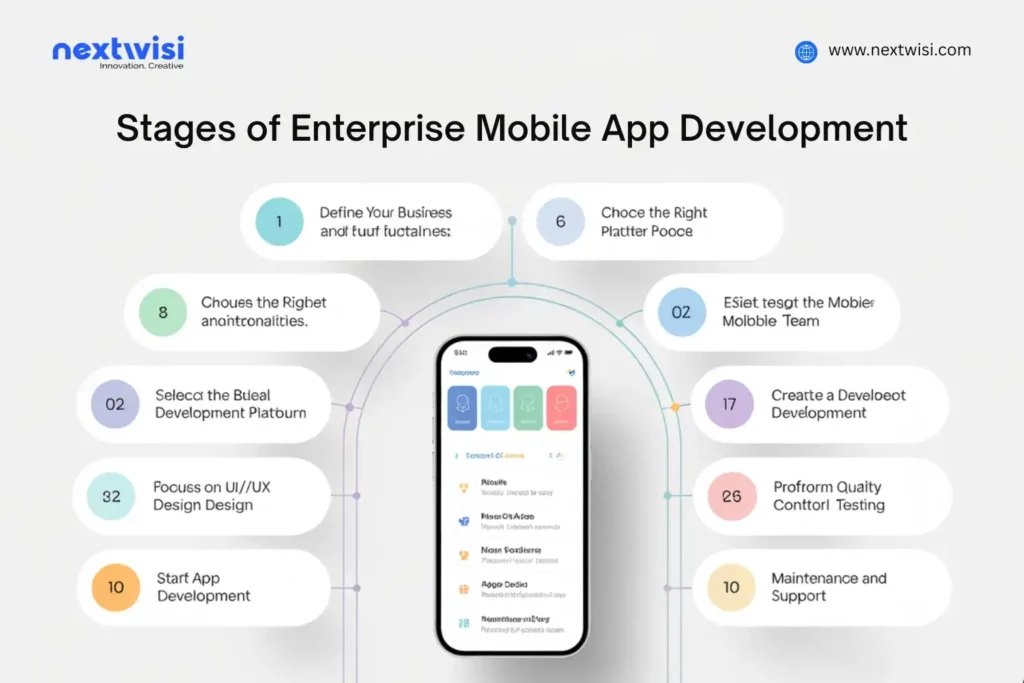
    Enterprise Mobile App Development Process

    The development of enterprise mobile applications follows a structured and strategic approach.

    Enterprise Mobile App Development Process

    Business Requirement Analysis

    This phase defines business goals, workflows, and user roles. Developers study enterprise systems and identify functional needs.

    Technical Architecture Planning

    Designing enterprise app architecture involves selecting platforms, databases, APIs, and cloud infrastructure.

    UI/UX Design for Enterprises

    Designers create intuitive interfaces that align with enterprise workflows and branding.

    Backend & API Integration

    Enterprise backend systems are connected using secure APIs for data synchronization and automation.

    Testing & Quality Assurance

    Apps undergo performance testing, security audits, and usability testing to ensure reliability.

    Deployment & Maintenance

    Post-launch support includes updates, security patches, performance monitoring, and feature enhancements.

    This structured process ensures stable and scalable enterprise software solutions.

    Cost of Enterprise Mobile App Development

    The enterprise app cost depends on complexity, features, and technology stack.

    • Simple apps with limited integrations cost less
    • Medium-complex apps with ERP or CRM integration cost more
    • Advanced apps with AI, analytics, and cloud infrastructure cost significantly higher

    Custom enterprise mobile app development is an investment that delivers ROI through automation, productivity, and long-term scalability. Security, enterprise compliance, and cross-platform support also influence total cost.

    Security in Enterprise Mobile Applications

    Security is a critical factor in enterprise mobile app development. Enterprises deal with confidential customer data, financial records, and internal systems.

    Best security practices include:

    • Data encryption in transit and storage
    • Multi-factor authentication
    • Secure API gateways
    • Role-based authorization
    • Regular security testing
    • Continuous monitoring

    Enterprise security solutions not only prevent breaches but also build customer trust and regulatory compliance.

    Role of AI & Cloud in Enterprise Mobile App Development

    AI and cloud computing play a major role in enterprise digital transformation.

    Artificial Intelligence

    AI enables predictive analytics, smart automation, chatbots, and recommendation engines. It reduces manual workload and improves operational accuracy.

    Cloud-Based Enterprise Apps

    Cloud platforms provide flexible storage, high availability, and faster deployment. They allow enterprises to scale resources dynamically and support global operations.

    Together, AI and cloud computing create a connected, intelligent enterprise digital ecosystem.

    Common Challenges in Enterprise App Development

    Despite its benefits, enterprise mobile app development faces challenges:

    • Legacy system integration
    • Data migration complexity
    • Security risks
    • User adoption resistance
    • Performance optimization

    These challenges can be addressed with modular architecture, strong testing strategies, and continuous training.

    Best Practices for Enterprise Mobile App Development

    Enterprises should follow proven strategies to maximize success:

    • Adopt modular enterprise app architecture
    • Use API-first development
    • Implement security-by-design
    • Focus on enterprise mobile UX/UI
    • Optimize performance for scalability
    • Choose cross-platform frameworks
    • Enable cloud-based enterprise apps
    • Integrate analytics and reporting

    These best practices ensure that enterprise mobility solutions remain future-ready and resilient.

    Future of Enterprise Mobile App Development

    The future of enterprise mobile app development is shaped by innovation and automation.

    Key trends include:

    • AI-powered enterprise applications
    • Low-code and no-code platforms
    • Blockchain-based security
    • IoT integration
    • Advanced data analytics
    • Microservices architecture

    These technologies will further strengthen enterprise digital ecosystems and accelerate business modernization.

    Conclusion

    Enterprise mobile app development is no longer optional for modern organizations. It is a strategic tool that drives productivity, automation, collaboration, and customer engagement. By adopting enterprise mobility solutions, businesses can modernize workflows, strengthen data security, and improve decision-making.

    From enterprise backend systems to cloud-based enterprise apps, mobile platforms are transforming how enterprises operate in a competitive digital environment. With the right architecture, security, and development strategy, enterprise mobile apps become powerful engines of long-term business growth and innovation.

  • Top 10 Best Programming Frameworks for App Development in 2026

    Top 10 Best Programming Frameworks for App Development in 2026

    The selection of an appropriate programming framework is among the key choices in contemporary application development. The framework that you choose influences the performance, scalability, security, speed of development, and maintainability of your app. With the growing number of business ventures involved in mobile and web application development, selecting the top 10 best programming frameworks for app development has become essential for building fast, reliable, and future-ready digital products.

    Programming frameworks can be used to simplify the development of an app on mobile, a web application, an enterprise platform, or a SaaS product by providing a set of reusable components, standardized structures, and in-built tools. This guide will discuss the top 10 best programming frameworks to develop the app in 2025, their main features, their strengths, and the best case of their use.

    What Are Programming Frameworks for App Development?

    App development programming frameworks are designed platforms that offer libraries, tools, and best practices to assist application developers to create applications more effectively. Rather than having to write all the programs manually, frameworks can provide an already established feature to speed up the process of coding, develop high-quality software, and guarantee scalability.

    The current models embrace various development requirements such as frontend UI development, backend logic, cross-platform mobile applications, APIs, and enterprise-scale solutions. While the appropriate choice of framework enables businesses to cut down on the time of development, control costs, increase security, and provide better user experiences.

    How to Choose the Best Programming Framework for App Development

    Prior to choosing a framework, it is always good to evaluate your business objectives, technical needs, and abilities of the team. These are the main aspects to be taken into consideration:

    • Type of App: Mobile, web, desktop, or cross-platform.
    • Specifications of Performance: Speed, responsiveness, and stability.
    • Scalability: Capacity to sustain an increasing number of users and capabilities.
    • Development Knowledge: Language and ecosystem understanding.
    • Support in the Community: Access to documentation, updates, and plugins.
    • Security & Reliability: Vulnerability protection.
    • Long-Term Maintenance: Update and improveability.

    Choosing the right decision will make your app be competitive, flexible, and economically viable in the long term.

    Top 10 Best Programming Frameworks for App Development

    1. React – Best for Dynamic Web Applications

    One of the best programming frameworks for developing an app is React, which is used to create a high-performance and interactive user interface. React is a reusable, component-based architecture developed by Meta, which makes applications easy to scale, modular, and reusable.

    Best for: web applications, dashboards, and single-page apps.

    Key Benefits: Fast rendering, large ecosystem, reusable UI components.

    2. React Native – Best for Cross-Platform Mobile Apps

    React Native allows mobile application developers to code in one JavaScript codebase and create apps on both iOS and Android. It presents almost native performance at a lower cost of development time.

    Best for: cross-platform mobile apps

    Key Benefits: Common code base, rapid development, and native-like performance.

    3. Flutter – Best for High-Performance UI Apps

    Flutter is an open-source library by Google that enables them to create visually rich mobile and web applications in a language named Dart. The rapidity of its rendering engine makes it smooth in animation and constant across platforms.

    Best: Mobile applications, cross-platform applications, graphical user interfaces.

    Key Advantages: Single codebase, beautiful UI, high performance.

    4. Angular – Best for Large-Scale Enterprise Web Apps

    Angular is a full-fledged front-end framework that is served by Google. It has in-built routing, form handling, testing, and dependency injection tools, which makes it suitable for application at an enterprise level.

    Best for: Enterprise web apps, large development teams

    Key Benefits: Structured architecture, scalability, strong tooling

    5. Vue.js – Best for Lightweight and Flexible Projects

    Vue.js is a progressive JavaScript library that is characterized by simplicity, flexibility, and simple integration. It is optimal when dealing with a startup and businesses that require rapid development within a small complexity range.

    Best for: Lightweight web apps, startups, scalable frontends

    Key Benefits: Easy learning curve, flexible architecture, fast performance

    6. Node.js – Best for Scalable Backend Development

    Node.js is a JavaScript runtime environment that is used extensively to build scalable backend systems on a server side. It is also suitable in real-time applications such as chat applications, streaming platforms, and APIs due to its non-blocking nature.

    Best for: Backend services, real-time apps, APIs

    Key Benefits: High scalability, fast execution, large package ecosystem

    7. Ruby on Rails – Best for Rapid Development

    Ruby on Rails is a full-fledged backend framework that was developed under the philosophy of convention over configuration. It is fast-tracked through cutting down on repetitive coding work and imposing clean project structures.

    Best for: MVPs, startups, rapid prototyping

    Key Benefits: Fast development, clean codebase, strong community

    8. Ionic – Best for Hybrid Mobile Apps

    Ionic enables developers to develop mobile hybrid applications in HTML, CSS, and JavaScript. It also has a seamless integration with such formats as Angular and React and therefore is a popular option when it comes to low-cost mobile development.

    Best for: Hybrid apps, MVPs, cost-efficient mobile projects

    Key Benefits: Cross-platform compatibility, reusable UI components

    9. .NET Core – the most suitable one to use in enterprise and secure applications.

    NET core is an open-source, cross-platform architecture by Microsoft that supports building applications based on C#, securely and with high performance. It has been popular as an enterprise solution that needs stability and sustainability.

    Best for: Enterprise systems, APIs, backend services

    Key Benefits: Security, scalability, Microsoft ecosystem integration

    10. Salesforce Experience Cloud – Best for CRM-Driven Apps

    Salesforce Experience Cloud is intended to construct client portals, partner dashboards, and web apps based on data in the Salesforce environment. It suits the companies that are using Salesforce CRM.

    Best for: Customer portals, enterprise CRM applications

    Key Benefits: Secure data integration, enterprise-level automation

    Comparing the Top Programming Frameworks for App Development

    All these 10 best programming frameworks used in creating an app have their own benefits based on a project, and they are:

    • Best for Web Apps: React, Angular, Vue.js
    • Best for Mobile Apps: Flutter, React Native, Ionic
    • Best for Backend Development: Node.js, Ruby on Rails, .NET Core
    • Best for Enterprise Solutions: Angular, .NET Core, Salesforce Experience Cloud
    • Best for Startups & MVPs: Vue.js, Rails, Ionic

    The most appropriate framework is based on your performance needs, team expertise, budget, and the long-term product roadmap.

    Why Choosing the Right Framework Matters

    The choice of the appropriate programming framework can have a tremendous effect on the success of your product. The right framework assists in better development speed, high security, and easier maintenance and allows your application to scale with your business.

    The top 10 best programming frameworks for app development help businesses reduce technical debt, accelerate time-to-market, and deliver seamless user experiences. The inappropriate choice of the framework, though, can also cause performance problems, rewrites at a high cost, and insufficient scalability.

    Future Trends in Programming Frameworks for App Development

    With the changing technology, the programming frameworks keep on changing according to the new needs. There are some emerging trends, which include:

    • Increased focus on cross-platform development
    • Smart developer products and robots
    • Better performance optimization of mobile and web applications
    • Increased use of serverless and cloud-native
    • Better support of progressive web applications (PWAs)

    To keep up with these trends, it is important that your development stack is up-to-date and competitive.

    Final Thoughts: Selecting the Best Programming Framework for Your App

    The top 10 best programming frameworks for app development provide powerful tools to build modern, scalable, and high-performance applications. The strengths of each framework lie in their individual differences, and it is up to the individual to select the best option based on the objectives of the project, the technicalities, and the long-term outlook.

    When you desire to make your mobile or web application future-ready, one of the strategic choices is to select the appropriate programming framework that will define the performance, scalability, and success of your product. With the ability to match technology decisions and business requirements, you would develop faster, more secure, and scaled-up applications.

  • How to Start Metaverse Game Development Business

    How to Start Metaverse Game Development Business

    The gaming industry is quickly being revolutionized with the convergence of virtual reality, blockchain technology, and NFTs, and with persistent digital worlds. Today, entrepreneurs and studios are actively exploring how to start metaverse game development business models that go beyond traditional gaming. Games in the metaverse are not merely entertainment-based platforms but entirely fully functioning virtual economies in which players can socialize, trade in digital assets, and gain value in the real world.

    If you are planning to understand how to start a metaverse game development business successfully, this detailed guide will help you with platforms, technology stacks, monetization strategies, and growth potentials, while maintaining scalability and user experiences as the core.

    What Is a Metaverse Game Development Business?

    A metaverse game development company is dedicated to the creation of immersive, interactive, and decentralized game worlds. These worlds enable players to own digital properties and trade NFTs and creator-led economies. Understanding how to start a metaverse game development business requires clarity about Web3 gaming, token economies, and virtual world design.

    Metaverse games are based on blockchain technology, combining AR/VR experiences and virtual collaboration. They provide both long-term interaction and availability of several sources of revenue, unlike the old games.

    Future Revenue & Market Size of Metaverse Game Development

    How to Start Metaverse Game Development Business

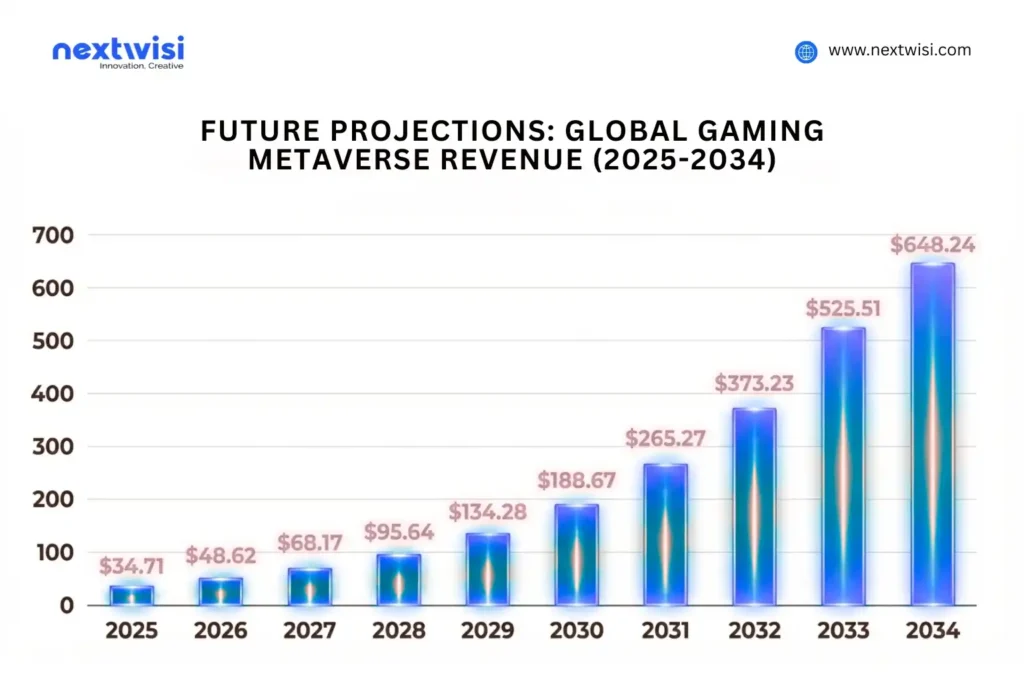
    The market share of metaverse game development is projected to increase by colossal folds within the following decade as a result of blockchain-based gaming, non-fungible tokens, and immersive AR/VR experiences. The global gaming metaverse revenue is expected to increase both in 2025 to $34.71 billion and in 2034 to almost $648.24 billion, as demonstrated in the image indicating the presence of a strong upward trend. This fast growth is driven by play-to-earn, creator economies, virtual real estate, and brand partnerships. These estimates would suggest that entrepreneurship looking at the viability of setting up metaverse game development business will be profitable and scalable over time. Early investment enables businesses to dominate market share and develop communities that are loyal, as well as monetize virtual assets within a fast-paced Web3 gaming ecosystem.

    Why Metaverse Gaming Is a Profitable Opportunity

    Before diving into how to start a metaverse game development business, it is essential to understand why this sector is growing rapidly. Metaverse gaming enables persistent worlds where users return daily, invest time, and spend money.

    Key benefits include:

    • Global 24/7 access to virtual marketplaces
    • In-game asset ownership with NFT
    • Reward systems are based on play-to-earn or tokens
    • Vigorous community-based development
    • Virtual events and brand collaborations

    All these characteristics transform metaverse gaming into a business model of the future.

    Step 1: Define Your Game Concept and Audience

    The first step in learning how to start a metaverse game development business is defining your game’s purpose and target audience. You need to define whether your game is MMORPG-based, simulation-based, world-building-based, or play-to-earn-centered.

    Develop a memorable player profile through the analysis of:

    • Age group and lifestyle
    • Technical preparations of VR glasses or crypto wallets
    • Preferred gaming genres
    • Earning, socializing, or exploration motivation

    Targeting the right audience would guarantee increased decent involvement and retention.

    Step 2: Choose the Right Metaverse Platform

    The choice of platform is a key issue in the development of the business plan regarding the way to begin developing metaverse games. All metaverse platforms serve target customers, tools, and monetization models.

    Popular platforms include:

    • The Sandbox is an NFT-heavy and virtual real estate game.
    • Decentraland to crypto-native users.
    • Roblox has user-generated content and a younger audience.
    • Otherside high-fidelity Unreal Engine-based games.

    Consider platforms on blockchain compatibility, community size, development tools, and device accessibility.

    Step 3: Build the Right Technology Stack

    The start of the metaverse games development business is based on technology. A powerful stack is a guarantee of scalability, security, and immersive gameplay.

    Among the necessary technologies are:

    • Smart contract and tokenization blockchain sites.
    • Digital asset trading marketplaces.
    • AR/VR creation of immersion.
    • NPCs and automated artificial intelligence.
    • Avatar and environment modeling in 3D.

    Increased privacy and security can be achieved through the implementation of decentralized cloud computing and crypto wallets.

    Step 4: Design Immersive User Experience

    User experience defines success when learning how to start a metaverse game development business. Gamers desire to have real interactions, avatars that can be customized, and smooth navigation in the virtual worlds.

    Enhance experience by:

    • Designing 3D interactive spaces.
    • Enabling owners of assets with NFTs.
    • Combination of AR and VR gadgets.
    • Getting personalized with AI.

    The entertaining experience will make it more interactive and enhance the virtual economy.

    Step 5: Metaverse Game monetization strategies

    The monetization concept is important in starting business planning of developing metaverse games. Metaverse games have numerous sources of revenue other than in-app purchases.

    The efficient monetization concepts are :

    • NFT land and asset sales
    • Play-to-earn token rewards
    • Subscriptions and battle passes.
    • Skins and accessories of avatars.
    • Brand associations and sponsored events.

    The monetization model is balanced, which will not negatively impact the experience of players.

    Step 6: Community Building and Marketing

    Community is the development driver of how to start business of developing metaverse game. Effective metaverse games are based on successful and dynamic communities.

    The important marketing channels involve:

    • Real-time communication by Discord.
    • Twitter/X to update and partner.
    • YouTube and Twitch to provide previews of the gameplay.
    • Telegram and Reddit to Web3 audiences.

    The regular content, AMAs, and beta access will ensure users are engaged at an early stage.

    Step 7: Launch MVP and Scale Gradually

    A minimum viable product is a brilliant strategy when establishing a business of developing a metaverse game. Core mechanics and user value should be shown in your MVP.

    Include:

    • Basic world map or hub.
    • Character customization.
    • A single mission or quest to play.
    • Feedback system.

    Scaling should come after launch, based on community feedback, seasonal events, and scaling through DAO-based governance.

    The Role of Blockchain Development Partners

    A metaverse game needs technical skills to build. Collaboration with established companies can make it easier to start business implementation of the development of metaverse games. Such companies as Nextwisi Solutions offer blockchain development, NFT integration, and scalable Web3 architecture to enable businesses to live smarter.

    Security and performance can be guaranteed, and there is flexibility to be innovative with the right development partner.

    Future Scope of Metaverse Game Development

    Creator economies, decentralized governance, and immersive technologies are the future of metaverse gaming. Those entrepreneurs who know how to begin business with developing metaverse games nowadays will have a competitive advantage in the digital economy tomorrow.

    With the increasing virtual worlds, the advertising, education, and enterprise collaborations will increase.

    Conclusion

    Learning how to start metaverse game development business is not just about building a game only , it is about creating a sustainable virtual ecosystem. Metaverse gaming has the potential to be a highly profitable business with a proper platform, technology stack, monetization strategy, and community focus.

    Should you be willing to venture into this space, Nextwisi Solutions could help you on your way with end-to-end metaverse and blockchain development solutions. Immersive, decentralized, and community-driven – that is the future of gaming, and it is time to start creating it.

  • How to Choose the Right Mobile App Development Company

    How to Choose the Right Mobile App Development Company

    The selection of a mobile app development company is among the most significant made by any company intending to develop a digital product. A mobile app is not merely a technical resource, but a business investment that is long term and influences user experience, revenues and brand trust. Most of the businesses do not succeed due to the reason that they have hurried this decision without considering the technical expertise, development process and long run support capabilities. This is an elaborate guide on how to choose the right mobile app development company based on the experience, technology, communication, scalability and overall reliability.

    Why Choosing the Right Mobile App Development Company Is Important

    The mobile application can be the main point of contact between a company and the customers. It determines the extent to which users experience your brand, experience services with services and long-term loyalty.  Choosing the right mobile app development company ensures your application is designed for performance, security, scalability, and future growth. An effective development partner realizes the changing user behavior, industry demands and new technologies such that a business is not required to build up costly rewrites, security vulnerabilities and bottlenecks within the performance as months and years progress.

    Key Factors to Consider When Choosing a Mobile App Development Company

    When companies are learning how to select the correct mobile app development company, they have to consider several technical and strategic aspects rather than the costs or the schedules. Formal analysis assists in fostering the development partner to manage the existing needs and facilitate the growth of business in the future.

    How to Choose the Right Mobile App Development Company

    Experience is particularly significant in cases where the applications require good backend logic, integrations and user workflows like web applications development, the concepts of scalability, performance, and security play significant roles in the overall system reliability.

    Experience and Industry Knowledge

    Experience in the industry indicates the capability of a company to deal with the real-life situations, changing needs and intricate developmental situations. An organization that has a good track record has the knowledge of how to transform business objectives into scalable mobile solutions.

    • Check portfolios thoroughly to assess the quality of the apps, level of usability and uniformity of apps across various industries and platforms.
    • Learn specific case studies to know how technical problems were resolved and business goals were accomplished successfully.
    • Choose companies that have experience in the industry they are operating in since they are more knowledgeable about compliance requirements and expectations of the users.

    Established teams minimize the risks of development.

    Technical Expertise and Technology Stack

    Technical skills can ascertain the degree of reliability, scalability and future viability of your mobile app. The appropriate mobile application developing firm suggests technologies that support your business objectives and not imposing on you unwarranted tools or structures.

    Mobile app development companies and backend systems, API, and cloud infrastructure providers can provide solutions that are integrated together and capable of performing well, as the user count grows and the needs for more features emerge.

    • Make sure there is a proficiency in native Android and iOS development to make it work at optimal levels and offer platform-specific functionalities.
    • Test cross-platform framework experience to assist in quicker development and multi-device compatibility.
    • Evaluate the backend development expertise, such as databases, APIs, cloud hosting, and third-party integrations.

    The right technology stack allows scaling in the long term.

    Understanding the Mobile App Development Process

    A clear development process signifies professionalism, accountability and quality control. Having a clear understanding of how requirements are analyzed, features developed and applications delivered should be clearly understood when selecting a development partner.

    Development Methodology and Workflow

    A well-organized working process guarantees transparency, flexibility, and uniform development during the development lifecycle. Organisations that adhere to the contemporary approaches will be able to embrace change without affecting either quality or time schedules.

    Such is particularly essential to such sophisticated solutions as Progressive Web App Development, where performance optimization, offline capabilities, and cross-platform responsiveness should be planned and technically precise.

    • The requirement analysis aligns the business goals, the technical feasibility as well as the user requirements at the very outset.
    • There is faster iteration, flexibility and continuous improvement of development in agile development methodology.
    • Well-set milestones assists in monitoring the progress, scope control as well as avoiding unnecessary delays.

    Formalized work processes enhance predictability and trust.

    Communication and Project Management Practices

    Business and development teams should collaborate well and this is only possible through clear communication. A lack of effective communication usually results in confusion, the failure to meet deadlines, and poor performance.

    The role of communication is even more imperative when the businesses expect to develop long-term platforms like SaaS Application Development Services where constant updates, developments of features and management of users need to be in constant arrangement.

    • Project managers are dedicated, and they make sure that there are regular updates, a properly distributed responsibility, and that issues are resolved more quickly.
    • Frequent progress reports ensure transparency in terms of delivery schedules, deliverables, and the risks involved.
    • Team coordination across teams, Task tracking and documentation The collaboration tools enable task tracking, documentation and team coordination.

    Effective communication is what makes everything be on track.

    Importance of UI UX Design in Mobile Applications

    The design of the UX will have a direct impact on the way people will be engaging with your application and how they will be able to use it in the long run. Even applications with a lot of features may come to a halt when the navigation is quite challenging to understand, or the interactions are not intuitive.

    The businesses should be aware of the fact that the effective UI UX design balances the usability, accessibility, and the visual appeal in the gadgets and in the screen sizes before assessing the design capabilities.

    • The user-oriented design enhances the navigation flow, readability, and consistency of interaction across devices.
    • Information consistency in the UI enhances brand recognition and brings familiarity to the users of the application.
    • Planned user journeys enhance engagement, retention and general customer satisfaction.

    Success of the app is highly dependent on the quality of design.

    Cost Transparency and Budget Planning

    Cost evaluation is a crucial part of understanding how to choose the right mobile app development company. Businesses should focus on long-term value instead of selecting partners based solely on low pricing.

    App Development Cost Estimation

    A professional development company provides transparent, structured, and organized cost estimates without concealed costs and vague assumptions.

    • The pricing must be according to the complexity of apps, platforms, features, integrations and development schedules.
    • Break downs of costs ensure the businesses budget and allocate resources effectively.
    • Very low pricing means that quality, security, and scalability are frequently compromised.

    Clear pricing minimizes risks of finance.

    Development Timeline and Delivery Commitments

    Development timelines show the level of realism in the way a company plans and manages projects. Impractical promises tend to lead to haste development and technical instability.

    • This is achieved by clearly established timelines that would coordinate the development with marketing and launch strategies.
    • Deadlines that are realistic give enough time to test, optimize and assure quality.
    • Punctual delivery is a sign of good management of projects and seasoned teams.

    Credible timelines safeguard the quality of long-term apps.

    Security, Testing, and Quality Assurance Standards

    Security and quality assurance is necessary in order to secure the user data and ensure the stability of the application. Failure to consider these factors may result in information leakages and loss of reputation.

    Security and testing must be included in all stages of development of companies before the finalization.

    • User sensitive data is secure with the aid of data encryption and secure authentication.
    • Multi-platform and multi-device testing are the necessary tests that assure the same performance in different environments.
    • Continuous quality assurance detects problems in the initial stages and minimizes post launch failures.

    Development based on security-first instills trust.

    Post-Launch Support and Long-Term Scalability

    The deployment of the applications is the start of its lifecycle and not its end. Success in the long term is pegged on on-going improvements and plan of scaling.

    Maintenance, Updates, and Growth Support

    Continuous support means that applications are in a usable condition, competitive and flexible with the changing business requirements.

    • The bugs, performance and compatibility with the operating system are addressed through regular updates.
    • Scalable architecture facilitates the growth of number of users, data and addition of features without hitch.
    • Companies like Nextwisi Solutions focus on long-term partnerships by delivering scalable and future-ready app solutions.

    Ongoing support secures investments in business.

    Common Mistakes to Avoid When Selecting a Development Partner

    The knowledge of the pitfalls assists companies in making right decisions and eliminating risks that do not make sense when choosing their partners.

    At the initial stage before finalizing a development company, it is possible to save time and costs by identifying warning signs.

    • Low pricing is a factor that can lead to a compromise of quality in companies when they are chosen on the basis of low pricing.
    • The act of neglecting the support after launch makes the features obsolete and security problems remain unaddressed.
    • The lack of good communication leads to misunderstanding and lack of congruency.

    By not committing these errors one will be guaranteed of improved results.

    Final Conclusion

    Understanding how to choose the right mobile app development company , businesses can make future-oriented decisions that are certain. The preferred partner is one with technical skills, open procedures, excellent communication, powerful security measures, and effective post-launch support. Effective assessment reduces the risks and maximizes the long-term value.

    The Nextwisi Solutions is a reliable partner that provides secure, scaled, and user-friendly mobile applications that can match the constantly changing business objectives and strategies in digital transformation.

  • Cross Platform Mobile App Development Frameworks Guide 2026

    Cross Platform Mobile App Development Frameworks Guide 2026

    The development of mobile apps is no longer a frivolous spending of modern business seeking to go digital. Nevertheless, it can be quite costly to develop native applications on Android and iOS separately, and the development process may last longer and be accompanied by complicated maintenance issues.

    It is into this platform that cross platform mobile app development has come in as a viable and future-proof solution. Allowing developers to develop applications on the basis of the same codebase allows businesses to save time-to-market and ensure similar functionality across platforms.

    With the growing competition in the global markets such as the USA, UK, Australia and Canada, it is no longer a question but a requirement to adopt cross-platform strategy.

    What Is Cross Platform Mobile App Development?

    Cross platform mobile app development is a type of development process that enables applications to be used in different operating systems with the use of common source code. Rather than developing native applications isolatedly, developers use cross-platform frameworks to assemble or bridge code with high efficiency.

    This approach makes the development lifecycle much easier and provides a way of delivering mobile applications at a quicker pace without compromising on usability or performance.

    Why Cross Platform Mobile App Development Matters in 2026

    By 2026, companies are supposed to introduce digital products with more speed and at cost-efficient and scalable prices. Cross-platform development serves the purposes of these objectives directly by decreasing redundancy and enhancing operational agility.

    The main advantages of business using cross-platform solutions are:

    • Cross platform mobile app development allows organizations to reduce overall development costs by maintaining a single shared codebase instead of hiring separate Android and iOS teams.
    • Businesses can reach a broader audience simultaneously across Android and iOS platforms, improving brand visibility and accelerating user acquisition globally.
    • Platform consistency in user interfaces will improve customer relationships, brand recognition and reduce the long term maintenance of applications.

    Native App Development vs Cross Platform App Development

    Native and cross-platform development debate is still a controversial topic, yet the contemporary frameworks have helped reduce the performance and usability gap to a minimum.

    ParameterNative AppsCross Platform Apps
    CostHigh due to separate developmentLower due to shared code
    Code ReusabilityPlatform-specificSingle reusable codebase
    Development SpeedSlowerFaster and more efficient
    MaintenanceComplexSimplified and centralized
    PerformanceFully optimizedNear-native with modern frameworks

    The native development emphasizes performance specific to the platform whereas the cross platform mobile application development emphasizes efficiency, scalability and optimization of costs.

    Challenges in Cross Platform Mobile App Development

    cross platform mobile app development

    Cross-platform development has a number of technical and operational issues that should be considered carefully even despite its benefits.

    Key Challenges Include:

    • The different operating systems, screen sizes, and hardware configurations might pose compatibility problems that will need a considerable amount of testing in different environments as well as different devices.
    • Functional constraints may be caused by limited access to hardware-specific features, particularly when an application needs deep integrations through the OS.
    • This can be caused by performance bottlenecks when abstraction layers exist between native and non-native components and are especially pronounced in graphics intensive or real-time applications.
    • It may be challenging to keep up with the regular updates of operating systems, since structures will always have to adjust to be compatible and fixed.

    Though these are the challenges, they are very minimal compared with the long-term advantages of cross platform development.

    Advantages of Cross Platform Mobile App Development

    The popularity of cross-platform development has been increasing due to its apparent business and technical benefits.

    Major Benefits Include:

    • A cross platform mobile app development allows a business to exploit maximum audience reach by implementing the application on Android, iOS and web platform using a single application.
    • Lower cost of development and operation assists startups and enterprises to distribute budgets fairly in their efforts to avoid undermining the quality of applications or scalability.
    • Shortened development cycles enable organizations to introduce products at a faster pace, react to market dynamics, and be competitive in swiftly changing digital landscapes.
    • Maintenance is simplified such that updates, bug fixes, and improvements are not copied in the efforts to maintain two or more platforms.
    • Code reusability reduces duplication of development efforts, is time saving, resource saving and maintenance cost saving in the long run.
    • The continuous integration of the cloud offers portability, data synchronization and protection, inter-platform and inter-devices.
    • Similar UI and UX enhance familiarity, engagement, and satisfaction to the user no matter the operating system.

    Programming Languages and Cross Platform Frameworks

    Programming LanguageCross Platform Frameworks
    JavaScriptReact Native, Ionic, NativeScript
    DartFlutter
    C#Xamarin
    JavaCodename One
    PythonKivy, BeeWare

    Best Cross Platform Mobile App Development Frameworks in 2026

    1. Xamarin

    Xamarin which is supported by Microsoft is written in C# and.NET, offering application development capability of enterprise scale, and with great code-sharing.

    cross platform mobile app development

    Pros of Xamarin:

    • Xamarin allows developers to reuse a large chunk of application code across platforms, shortening development time and allowing high performance and stability.
    • On the one hand, Xamarin is especially appropriate in large enterprises and in complex ecosystems of applications because of integration with Microsoft tools and cloud services.

    Cons of Xamarin:

    • Enterprise use The cost of licensing may be expensive and it is not suitable to start-ups or projects with very limited financial resources.
    • Native development might be necessary to provide an excellent user experience with applications of high UI or graphics.

    2. React Native

    React Native is an app development technology that is still popular because of its flexibility, JavaScript framework, and a strong developer community.

    cross platform mobile app development

    Pros of React Native:

    • React Native makes development faster and easier since developers can view changes in real-time with the use of hot reloading and save a lot of time during iteration.
    • Big open-source ecosystem offers wide range of libraries, plugins and community support in solving problems more quickly.

    Cons of React Native:

    • There are still some high-level features that cannot be implemented in software; this brings complexity to applications that need specialized hardware.
    • Depending on the Android devices and complicated user interfaces, debugging may be time consuming.

    3. Flutter

    Flutter has received substantial uptake because it has a widget-based design and has a consistent way of rendering its UI.

    Pros of Flutter:

    • Flutter is based on one rendering platform, which makes it uniform to design and provides smooth animations on all platforms without depending on native elements.
    • It is perfect in the case of MVP as it ensures that business ideas can be more rapidly validated with less cost of development.

    Cons of Flutter:

    • Flutter applications are also likely to have higher file sizes than native ones, which can affect the speed of downloading.
    • Lack of support on non-mobile platforms such as the Android TV and Apple TV is also a weakness.

    How to Choose the Right Cross Platform Framework

    The choice of the proper framework is related to the technical needs of your project, the time frame, and the long-term objectives.

    Important Factors to Consider:

    • The expertise of the development team is also essential, since its knowledge of certain frameworks directly affects its productivity and quality of use.
    • The requirement of the framework of learning curve, tooling, and maintenance should be aligned with the budget constraints and delivery timelines.
    • One of the areas that should be considered is the performance expectation and scalability requirements particularly of enterprise or data-intensive applications.

    Best Practices for Cross Platform Mobile App Development

    • Ensuring consistency of UI across platforms with predefined system of design enhances the usability and a foreseeable user experience.
    • Near-native responsiveness can be reached through optimization of application performance, by reducing the unneeded abstraction levels.
    • Clean, modular and testable code writing enhances maintainability and minimizes technical debt in the longer-term.
    • Thorough testing on devices, screen size, and operating systems will make sure there is reliability on the application before deployment.

    Future of Cross Platform Mobile App Development

    Emerging technologies and changing business demands are the forces behind the cross platform mobile app development in the future.

    Key Trends Shaping the Future:

    • The artificial intelligence will be used to improve personalization and automated testing and predictive analytics in cross-platform applications.
    • The integration of the Internet of Things will support the flow of communication between mobile applications and connected devices across the industries.
    • Low-code and no-code will provide a faster way to develop and enable solutions to cross-platforms to be used by non-technical people.
    • Cloud-native architecture will enhance security, scaling, and performance with lowering complexity of infrastructure.

    Conclusion

    Cross platform development has been seen to be more than just a cost-saving option , it has become a strategic advantage to contemporary business. As cross platform mobile app development frameworks such as Flutter, React Native and Xamarin mature at an alarming rate, cross platform development allows developers to launch faster, save money, and maintain uniform digital experiences.

    The selection of the appropriate framework will be based on the objectives of the business, technical needs and scaling purposes. By cooperating with an established cross-platform mobile application development firm, the informed decision-making will be guaranteed and make the venture a success in the long run.