Tag: Blockchain

  • Role of Blockchain in Supply Chain Management

    Role of Blockchain in Supply Chain Management

    The past 10 years have seen a very fast development of supply chain management. Against this backdrop, what was a simple linear flow of the goods has now become a sophisticated, interdependent ecosystem of manufacturers, suppliers, logistics providers, regulators, and consumers. As trade and customer pressures intensify across the globe and the need to be more transparent increases, conventional supply chain systems are finding it hard to manage. This is the area where blockchain technology is becoming an empowering force of trust, visibility, and efficiency of operation in supply networks.

    Blockchain is no longer considered to be linked only with cryptocurrencies. It is redefining the way data are captured, distributed, and checked in business today. In supply chain management it serves as a single source of the truth that can be trusted by all the stakeholders, and friction and uncertainty is minimized with every step in the process.

    Understanding Blockchain Beyond the Hype

    In its simplest form, blockchain is a distributed electronic registry authenticating transactions in more than one system in a secure and immutable manner. All transactions are time-stamped and checked by the participants in the network and are included in a chain of records that can never be changed in the future. This architecture eliminates the necessity of centralized control, and data integrity is preserved.

    In the case of supply chains, this implies that information about the origin of the products, their shipping status, quality checks, and transfers of ownership can be stored permanently and accessed in real time. Blockchain development has become a viable strategy that many enterprises are looking into as a way of modernizing the stagnant supply chain processes and ensuring the sustainability of their operations in the long term.

    Why Traditional Supply Chains Face Growing Challenges

    The new supply chains are global, inter-temporal, and inter-regulative. Although globalization has enhanced scalability and cost reduction, it has also come with some such risks as data silos, counterfeit goods, shipment delays, and compliance failures.

    One of the largest pain points includes the lack of end-to-end visibility. In case of fragmented data in more than one system, decision-makers can hardly react quickly to disruption. Paperwork, slowness in reporting, and poor incompatible data standards only contribute to more operational inefficiencies and loss of money.

    Blockchain in supply chain management addresses these issues by enabling seamless data sharing while maintaining accountability among all participants.

    Transparency and Trust Through Shared Ledgers

    An efficient supply chain is based on transparency. Blockchain produces a common registry where all the authorised members can access the same validated data. This avoids conflict by having wrong records, and it fosters trust among partners that might not have a close relationship among themselves.

    Blockchain solutions, when integrated with the newest cloud solutions, will be able to achieve scalability and provide real-time access to key supply chain data. The integration enables the businesses to track the shipments, inventory level, and the performance of the suppliers within one digital space and enhance coordination and responsiveness.

    Enhancing Traceability From Source to Consumer

    One of the most useful advantages of blockchain in supply chain management is traceability. The product can be traced back to the sourcing stage of raw material until the ultimate delivery stage, with all the stages being registered on the ledger. This is particularly significant with such industries as food, pharmaceuticals, and luxury goods, where the level of authenticity and safety is paramount.

    With a full product history, any company can easily know the origin of defects, recalls can be handled better, and it can demonstrate compliance with the regulatory regulations. This is also beneficial to the consumers who get insight into the sources of products and their production, which enhances brand trust.

    Automation and Operational Efficiency

    Blockchain also allows automation, which is done by smart contracts, or self-executing contracts, which are activated by other conditions being satisfied. As an example, payment may be made automatically after delivery of goods and verification of goods, which will save time and administrative overheads.

    Blockchain can be incorporated in digital ecosystems where the creation of apps is involved, as user-facing platforms can enable stakeholders to monitor the movements of shipments, authorize transactions, or get access to compliance information in real time. Such automation minimizes errors by humans and speeds up supply chain operations without loss of control.

    Cost Reduction Across the Supply Network

    Hidden costs that may arise due to inefficiencies in supply chains are usually excess inventory, manual reconciliation, and dispute resolution. Blockchain saves these costs by excluding the middlemen and paperwork.

    This is because all parties operate on the same verified data , therefore the reconciliation process is cut drastically. This results in reduced operational costs, quicker turnaround time, and increased profitability in the long run. Financial implications of adopting blockchain in the long run may be high, particularly for large and multi-tier supply chains.

    Supporting Sustainability and Ethical Practices

    Businesses around the world have developed the concept of sustainability as a priority. Blockchain assists organizations to monitor their supply chains in the areas of environmental impact, ethical sourcing, and labor practices. Authenticated information simplifies reporting sustainability measures and achievement of ESG.

    Companies can ensure that they act responsibly and prevent greenwashing by storing the carbon footprint, the origins of the materials, and the certifications of suppliers in a blockchain. Such openness builds trust and helps in long-term brand value amongst the stakeholders.

    Security and Data Integrity Advantages

    The safety of blockchain is ensured by the decentralized structure and cryptographical authentication. After data is written, it cannot be changed without the agreement of the network, and it becomes incredibly hard to commit fraud and modify data.
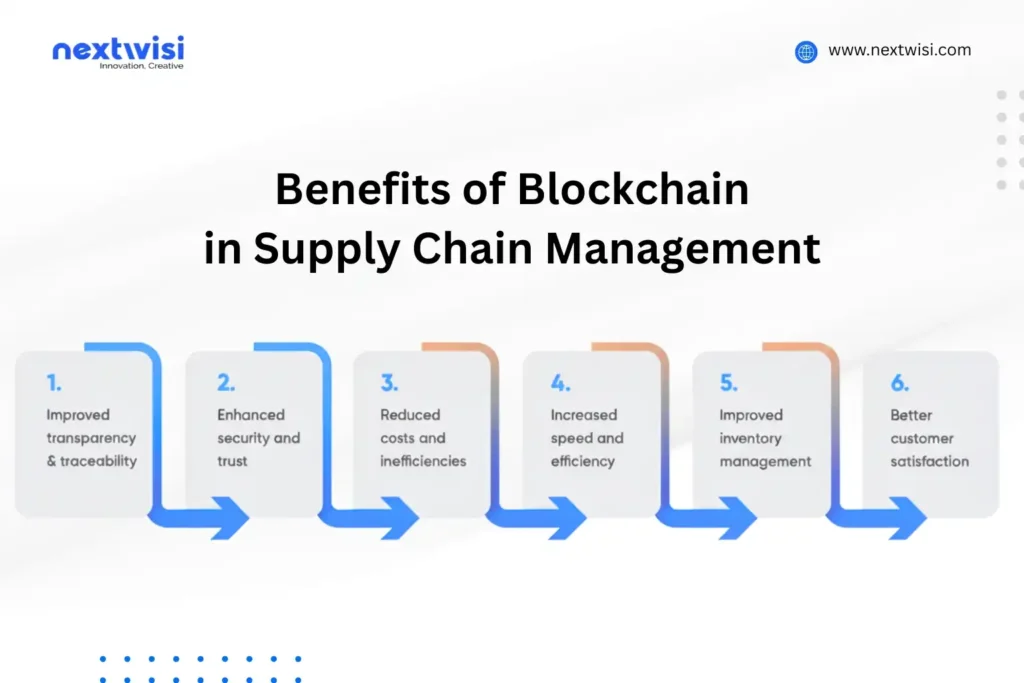
    Benefits of Blockchain
in Supply Chain Management

    Such immutability is especially useful in the supply chains where the accuracy of data is vital. Blockchain will preserve information integrity in the product lifecycle, either through quality assurance records or custom documentation.

    Challenges to Consider Before Implementation

    Although blockchain has its benefits, such adoption does not come without difficulties. The process of integrating with the legacy systems may be complicated, and large volumes of transactions still pose a challenge of scalability. Legal and regulatory uncertainty is also possible, as blockchain standards are still developing around the world.

    In order to successfully implement, the correct blockchain framework must be selected, supply chain partners need to collaborate, and it has to be carefully planned. Companies also need to invest in competencies and forms of governance to operate blockchain networks successfully.

    The Future of Blockchain in Supply Chain Management

    The digital, interconnected, and data-driven supply chain management is the future. Blockchain will become a key factor in making ecosystems transparent where the trust is embedded in the system instead of being imposed by means of manual controls.

    With more people using it, blockchain will become more intertwined with IoT, analytics, and automation tools, providing more business opportunities and efficiency incentives. Building more resilient and flexible supply chains will provide early adopters with a competitive edge.

    Conclusion

    Blockchain in supply chain management is reshaping how businesses manage data, logistics, and partnerships. From improved traceability and security to cost reduction and sustainability, the long-term value of blockchain adoption is clear.

    Experienced technology partners should be involved in the implementation of the secure and scalable blockchain solutions by companies willing to do it. One such company is Nextwisi Solutions, which offers professional blockchain development solutions to assist businesses in designing, implementing, and optimizing blockchain-based supply chain systems that are customized to the needs of real-life business operations.

  • How to Pay for Dexscreener Solana: A Complete Guide

    How to Pay for Dexscreener Solana: A Complete Guide

    The question of how to pay for Dexscreener Solana is turning into one of the most popular search questions of new users of Web3 who are interested in getting on the Solana tokens. Dexscreener is popular for real-time charts, liquidity, and volume monitoring, whereas most novices believe that they need to make payments within Dexscreener itself. As a matter of fact, Dexscreener is just a display of data. All token swaps and payments occur, in fact, on decentralized exchanges (DEXs) on Solana, which are linked together by Dexscreener.

    To learn how to pay for Dexscreener Solana, you need to learn how Solana wallets are used, how SOL is used to pay network fees, the execution of token swaps, and how Solana DEX tools can be integrated with Dexscreener. After clicking the trade button on Dexscreener, it redirects to verifiable DEX platforms where real payments occur. This guide is stepwise, and thus you can find your way through the process without any difficulties.

    The Hypocrisy of How to Pay for Dexscreener Solana

    Most users do not understand the term and can look up how to pay for Dexscreener Solana, as they must pay it at Dexscreener itself. What it actually means is explained as follows:

    1. Payments happen on Solana, not on Dexscreener

    The reason you search how to pay with Dexscreener Solana is that you are learning how to transact on Solana-based DEXs connected to Dexscreener charts. Dexscreener displays price charts, liquidity, and data on tokens, but any real payment is made on other external applications, such as Raydium, Jupiter, or Orca. These are sites that are charged and wallet authorized by SOL.

    2. You must use a Solana wallet to approve payments

    When teaching on how to pay Dexscreener Solana, Solana wallets like Phantom, Solflare, and Backpack are needed. These wallets keep your personal keys, contain SPL tokens, and enable you to authorize or deny payments. Your connected wallet should become a part of every transaction, which is why it is the key to successful Solana-based payments.

    3. You will pay small network fees during each transaction

    At every trade of tokens, providing a liquidity, or a swap via the DEXs linked to Dexscreener, you have to pay network fees in SOL. These charges are very low – they are sometimes a cent in the hundred – yet they must be paid on every proceeding. Knowing this enables you to make no deal and enhance better trading.

    Why Learning How to Pay for Dexscreener Solana Matters

    It is also essential to learn how to pay for Dexscreener Solana, which can ensure that you trade safely, prevent scams, and confirm valid tokens. Dexscreener offers real-time analytics and contract addresses, and when you learn how to make payments on Solana, you can comfortably navigate the ecosystem of SPL tokens, which is rapidly growing. You also prevent such mistakes as lack of SOL balance, wrong choice of tokens, and incomplete approvals of wallets.

    Blockchain Development in Solana Transactions

    The increasing use of Solana DEX tools shown on Dexscreener highlights how fast blockchain development is progressing. New projects, tools and decentralized systems work based on the speed of Solana to establish a smoother trading and payment experience to users worldwide.

    How to Pay for Dexscreener Solana: Step-by-Step Process

    This is the entire procedure of knowing how to pay for Solana Dexscreener and make your initial payment on Solana with ease:

    1. Install and secure a Solana wallet

    Start with the installation of Phantom, Solflare, or Backpack, which are reputable Solana wallets. These wallets contain your SOL and SPL tokens, contain your own private keys, and give you the safe platform required to authorize payments. No transaction can be carried out in the display of Dexscreener without having a wallet.

    2. Add SOL to your wallet to cover fees and trading amounts

    To do any Solana transaction, SOL has to be in your wallet. SOL can be utilized in purchasing network tokens and associated network charges. Although the charges are very minimal, the lack of sufficient SOL may result in transaction failure. You may purchase SOL at big stores and put it in your wallet.

    3. Find the Solana token on Dexscreener and study its chart

    Click on Open Dexscreener and choose the Solana network. Find the token you would like to buy. Dexscreener indicates liquidity, price movement, holders, contract address, and a history of recent trading- give you all the information to make the right decision to make a payment or swap a token.

    4. Click the trade button to open the Solana DEX interface

    A swop or trade button is provided on each token of the Dexscreener. On clicking it will redirect you to a reputable DEX like Raydium, Jupiter, or Orca. This makes sure that you deal with the right token contract and the right liquidity pool when making your payment.

    5. Approve the payment using your connected wallet

    Once you choose the number of tokens to use and have gone through the swap information, your wallet will ask you to accept the payment. Such permission permits the transaction and settles the Solana network fee. After this is validated, the transaction is finalized on-chain, and your tokens are sent into your wallet soon after.

    What You Need Before Making Solana Payments

    The secondary requirement to understand how to pay Dexscreener Solana is what you need to have before you begin:

    • A secure Solana wallet
    • Adequate SOL to charge and trade.
    • Dexscreener: Correct contract address.
    • Stable internet connection
    • On-chain confirmation awareness of Solana.

    These fundamentals make payments easy and avoid some mistakes that beginners usually commit.

    Solana & Supply Chain Traceability

    Solana transactions are visible and traceable, similar to how digital supply chain solutions can trace goods through complicated paths to make sure that data is conveyed correctly and with reliability.

    Common Issues While Paying on Solana

    Dexscreener Solana still has problems with payment that can occur even with the skillful users. Other typical obstacles are:

    • Lack of adequate SOL to pay network fee.
    • Relating to the incorrect wallet or incorrect token address.
    • Slippage parameters that lead to unsuccessful swaps.
    • Selling at low liquidity.
    • wallet, which does not work well with the DEX.

    These problems can be prevented by checking and rechecking before making payments.

    Smart Trading With AI Agent

    The newest trading automation devices, like an AI Agent might assist in tracking Solana charts on Dexscreener, notify you about price changes, and aid in timing your payments or swaps in a more effective way.

    Tips for Secure and Smooth Solana Payments

    These best practices should be observed when understanding how to pay for Dexcreener Solana:

    • It is best to copy contract addresses straight out of Dexscreener.
    • Do not press the random links in the social sites.
    • Keep SOL in reserve for fees
    • Trusted wallets and official DEX links are required.
    • Examine liquidity prior to the purchase of new tokens.

    The following measures can make you prevent deception and secure your funds.

    FAQs About Paying on Solana DEX Platforms

    Q.1 Do I pay Dexscreener directly?

    No. Dexscreener just provides charts. Any payments are made in external Solana DEXs.

    Q.2 Do I need SOL for every transaction?

    Yes, swaps, transfers and network fees are all mandatory by SOL.

    Q.3 Which wallet is recommended?

    The most popular ones are phantom, Solflare, and Backpack.

    Cloud Services Performance

    Similarly to the fact that Solana DEXs are based on decentralized architecture, contemporary cloud services can provide scalability and global performance to Web3 applications with high transaction rates.

    Final Thoughts

    The tutorial on how to pay for Dexscreener Solana will make you see how Solana wallets, network charges, DEX integrations, and token swaps interact. Solana transactions will be rapid, safe, and beginner friendly with the appropriate configuration, SOL balance, and verified tools. Dexscreener is a mere display of the data the actual payment occurs via Solana DEX platforms and once you familiarize yourself with the process, moving through the ecosystem becomes easy.

  • Where Do Chinese Create Mme Coins ?- Full Guide to Meme Coin Creation

    Where Do Chinese Create Mme Coins ?- Full Guide to Meme Coin Creation

    Learn about Where Do Chinese Create Mme Coins? and the emergence of meme coins, how they are made and find out where the Chinese mint meme coins in the current crypto economy of the world.

    What is a Meme Coin?

    Meme coins are a form of cryptocurrency whose popularity is primarily due to internet trends, pop culture, or viral jokes, and not technical advancement. Meme coins are flourishing on social hype, community participation, and online trendiness, unlike more conventional cryptocurrencies such as Bitcoin, which are using technology or utility to drive their growth.

    Among the most notorious examples are Dogecoin and Shiba Inu, which began as a joke but soon became famous among people globally due to the quality of their online communities and successful social media advertising.

    Meme coins are heavily dependent on social media usage, particularly Twitter, Reddit, Telegram, and in China, WeChat and Bilibili, where communities share memes, discuss trends, and hype up the token. The more viral the content, the higher the likelihood that the value of a coin will improve.

    The most important meme coin features:

    1. Pop Culture or Meme-Based Origin: Meme coins are based on the idea of viral jokes, internet culture, or trends.

    2. Community-Driven: Meme coin success will be determined by active and ardent online communities.

    3. Nature of Speculation: The coins that are considered as memes are not typically of great use, and thus the coins are highly speculative.

    4. Social Media Effect: They are led to grow with the support of social media, viral posts, and influencer recommendations.

    The meme coins have been on the increase in recent years due to several reasons:

    1. Social Media Power: Tweets/posts by celebrity figures such as Elon Musk cause a huge price spurt.

    2. Low Barrier to Entry: Meme coins tend to have very low prices, and this is the way in which new owners are attracted to risk their fortunes.

    3. Involved Communities: Meme coins are based on communities building memes, hosting events, and promoting the coin on the internet.

    4. Celebrity Endorsements: Tweets by celebrities who talk about a coin usually enhance its popularity.

    5. FOMO (Fear of Missing Out): The hype of the meme coins may result in a frenzy around it, hoping to get the next big thing.

    Chinese Create Meme Coins Where?

    China is a rapidly expanding cryptocurrency community despite the heavy governmental regulations. A large number of Chinese developers are working on meme coins, frequently with both local and global blockchain.

    1. Ethereum (ERC-20 Tokens):
    Ethereum is popular with the global community, even in China, for creating meme coins due to its powerful smart contract features.

    2. Binance Smart Chain (BEP-20 Tokens):
    Chinese developers prefer Binance Smart Chain due to the low cost and rapid transactions. A large number of meme coins that are aimed at foreign audiences are created on this platform.

    3. Solana and Polygon:
    Other developers prefer more fast blockchains such as Solana or Polygon with low transaction fees and more speed.

    4. Private or Offshore Platforms:
    Some developers make meme coins in offshore exchanges or decentralized platforms to avoid the regulatory restrictions of China because of its cryptocurrency restrictions.

    Chinese developers do not consider technical development only but also creative marketing and the global community building in order to viralize their meme coins.

    How to Create a Meme Coin ?

    To produce a meme coin, one needs to plan, be tech-savvy, and do strategic marketing. Here’s how you can start:

    1. Identify Your Meme Coin Idea

    Although meme coins are entertaining and funny, it is necessary to have a clear vision. Ask yourself:

    • What is the meme or trend that the coin is going to be patterned after?
    • So what is unique about your coin?
    • Is the coin simply a fun toy, or do we intend it to be used in real-world applications?

    A clear idea becomes an attraction to the supporters and serves to create a faithful community.

    2. Select a Blockchain Platform

    It is important to select the appropriate blockchain:

    • Ethereum: well supported and secure, best with ERC-20 tokens.
    • Binance Smart Chain: has fast transactions and low rates, and is popular with Chinese developers.
    • Solana / Polygon: Ideal when speed and low-cost transactions are required of projects.

    3. Develop the Token

    The process of token development consists of the creation of a smart contract to establish the rules and supply of the token and the ways of its transfer.

    • Unless you are a developer, then you can pay a professional meme coin development company and be assured of a bug-free and secure contract.
    • Carry out security audits in order to curb hacks or vulnerabilities.

    4. Launch and Market the Meme Coin

    To be successful with meme coins, it needs marketing:

    • Community Building: Reach out to users at Telegram, Discord, and Reddit, as well as Chinese platforms such as WeChat and Bilibili.
    • Influencer Collaboration: You can use crypto influencers to market your coin to people around the world.
    • Viral Campaigns: Design attractive memes, giveaways, and content to share the word.
    • Exchange Listings: Trading on a decentralized exchange (DEX) and centralized exchange (CEX) enhances availability.

    5. Maintain Momentum

    Developing a meme coin is not enough. Sustaining growth is key:

    • Active Engagement: Maintain engagement with communities by way of contests, memes, and updates.
    • Transparency: Publish updates on the development of shares and roadmaps to gain trust and loyalty.
    • Future Improvements: Add functionality such as staking, NFTs, or collaborations to keep the interest.

    Advantages of Meme Coin Development

    • Low Technical Barrier: Easy to develop as compared to more complex blockchain projects.
    • Potential of Viral Marketing: Meme coins will expand fast with the support of the community.
    • High Return Potential: Viral meme coins could offer enormous returns even though they are speculative.

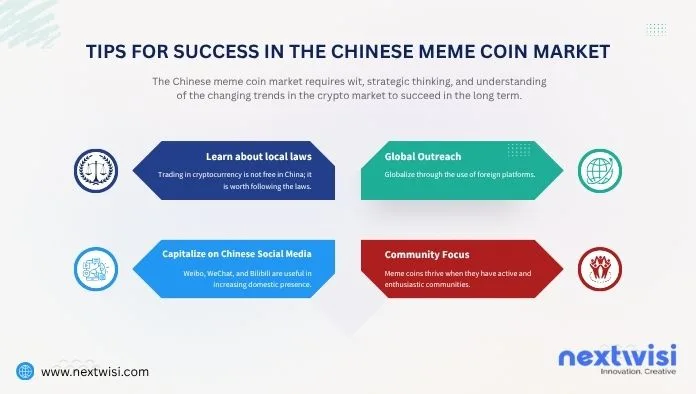
    Tips for Success in the Chinese Meme Coin Market

    Tips for Success in the Chinese Meme Coin Market


    1. Learn about local laws: Trading in cryptocurrency is not free in China; it is worth following the laws.

    2. Capitalize on Chinese Social Media: Weibo, WeChat, and Bilibili are useful in increasing domestic presence.

    3. Global Outreach: Globalize through the use of foreign platforms.

    4. Community Focus: Meme coins thrive when they have active and enthusiastic communities.

    How a Meme Coin Development Company Can Help

    It can be facilitated by cooperating with a professional meme coin development company:

    • The development of tokens and smart contracts.
    • Hack prevention security audits.
    • Community and marketing strategies.
    • International exchange listing guidance.

    Most Chinese developers work together with other international companies to introduce meme coins that are internationally compliant but still reach the local market.

    Start Your Meme Coin Journey!

    Meme coins are a blend of fun, community, and speculation. The answer to the question about the creation of meme coins in China has shown the increasing role of China in the crypto sphere in the world.

    Anyone can make a meme coin with adequate planning, a concept, effective marketing, and the backing of the community. Collaboration with the professionals guarantees the successful and safe launch. Meme coins are living up to their name, remaking the cryptocurrency world whether it is having fun, community, or potential profits.